Showing posts with label My interests. Show all posts

Friday, November 17, 2023

I see lead people

Last year I wrote about the games the family played most.  Those were games that the whole family played together over the years.  During the Covid years, our turning to board games became a major part of our family entertainment, since so many things we used to do were denied us by way of lockdowns and closings.  And there are only so many movies you can watch without going bonkers. 

In that list of games was the grand dam of the Sci-Fi/Fantasy genre - Dungeons and Dragons.  Believe it or not, over the next couple months I had several tell me through one venue or another that they were shocked - shocked I tell you - that this Catholic, former Evangelical pastor, former Baptist no less, played that controversial game of games.  Well, let me 'splain. 

I've written several times over the years about how I first stumbled upon the game.  How initially I detected no particular 'stigma' about playing it, from my peers or pop culture, any more than there was a stigma with the Trivial Pursuit fad or the Pac Man fad.  I also have mused on the media driven coalition that aimed like a Death Star laser beam at wrecking the game, and how it succeeded.  I've mentioned how, by the time I graduated high school, most guys I knew who played it not only stopped playing it, but denied ever having heard of the game. I always found that significant. 

For my part, after hearing of it for the first time, I went out and bought all the books I could in order to see what it was all about.  Walden Books and KB Toys were my main source.  Problem was, upon actually playing at a local game group in the basement of the town's First Federal Savings and Loan, I was less than impressed.  It was mostly fighting and arguing, which I could get aplenty in the locker room after the next gym class.  After a few tries I more or less set the game aside.  Besides, fantasy and sci-fi were not my cup of tea anyway.

Years later, preparing to head down to the main OSU campus for my junior year of college, I was playing poker with a group of friends after work.  One of their friends from high school was there, and he invited anyone to join a game group he was part of that played a variety of games.  I said sure, even though I didn't know him, and the group was already at the main campus.  The Wednesday evening I first went there, they were playing Dungeons and Dragons.  Usually it was D&D, or a variety of other card games, sometimes RISK or Monopoly, depending on how many showed up.  

It was actually fun.  The group was almost exclusively science/computer science majors.  The referee (that's DM, or Dungeon Master, to those in the hobby) was, along with me, the only humanities major there.  He was a literature major hoping to be a sci-fi/fantasy author.  Perhaps because of his creativity, he made the game fun and accessible to me.  A couple others tried their hands at running a D&D game over the next couple years, but I didn't find those as enjoyable.

Nonetheless, it being me at the time, I eventually worked them over toward more of a strategy/wargame focus.  At one point we even spent a few months playing Empires and Arms (until the fellow's roommate made him take it down from the kitchen table).

After the group disbanded owing to life moving on, that was that.  When I moved to Florida I knew nobody and had no contacts to call  upon.  I found a hobby store, because at that time I was trying to gobble up what old Avalon Hill wargames I could find.  There was a D&D game going on in the store, made up almost entirely of grown men.  One even drove a Corvette.  Nonetheless, it reminded me of my first experience.  Those grown men sat there fighting and arguing and almost yelling about what, to me, was a bunch of stupid trivialities about a game based on fighting dragons. 

Then I met my future wife, and most such pastimes went into the rearview mirror.  I brought up to her that I had played D&D, and did have fond memories about that time even though I seldom played it.  Baptist that she was, however, it was a long time before she warmed up to the game or the genre.

When my boys came along, and heading into the 2000s, I noticed that there was a new wave of 'Fantasy/Sci-Fi/Comic Book' focus in pop culture.  Driven by the news of Jackson's The Lord of the Rings films, and overflowing from the Harry Potter phenomenon, I called this the Second Fantasy Renaissance.   

The obvious similarities only made Potter a bigger hit in the household 
Now the way I raised my kids was this.  I wanted them to be aware of their generational surroundings, within reason.  But I also exposed them to the things of my childhood, or earlier.  Or things rooted in our older culture in general.  Things I was interested in.  I didn't shove it down their throats.  I simply watched this old TV show or that old movie or read this or that older book from olden times.  At the same time, I encouraged them - again, within reason - to follow or like the things around them.  For instance, though I may not have cared for everything about the Potter books or the latest comic book movie, I found them harmless - at least compared to what I grew up with in the very freewheeling, promiscuous 70s and 80s. 

It wasn't surprising that the boys glommed onto the Fantasy/Comics fad at the moment.  That included seeing the newly revised D&D game, especially the vast line of plastic miniatures that accompanied it.  Had I been their age, I probably would have loved those, too. 

So I got my hands on the game (called by that time the 3rd Edition), and began priming the family for this, since I figured at least some of them would become interested in it anyway.  I always felt that, without imposing myself into their lives, getting ahead of the trends was the smart way to go. Plus, I must admit, there is a strange sense of nostalgia for this game, even if I never did much with it in my youth.  This has increased as, while I'm still no big fantasy/sci-fi fellow, I have grown to appreciate the genre more and have tried my hand at a variety of such books and movies over the years. 

My wife warmed to the hobby because you could still buy the old lead miniatures.  Those are ones you have to paint, for those with that particular skill.  My wife, always the artsy-craftsy type, actually found those enjoyable.  That was the gateway for her.  The boys simply came along when I opened the door.  I waited until my third oldest was at least old enough to have some idea about what was happening, and then began playing the game.  Already they had heard about it, and this seemed the better way to introduce them, rather than letting the world do it. 

After a few months, I confess I began to find myself under-impressed.  I didn't care for the game books as presented.  Yes, they were quality productions (until they fell apart from moderate use).  But it made me think of a game trying to be a computer game on paper.  The text was spartan and uninspiring.  The game was somewhat 'blah' in terms of its feel.  I seemed to recall a genuine feeling of inspiration when I read the original rule books back in the day.  This new edition made me think of stereo instructions with elves.  I compared it to chewing on tin foil.  

At that point, I went down into our basement, found an old box with books and paraphernalia from my younger days, and located the old, original AD&D books I still had.  Since I didn't play it much, they were in tiptop shape.  Because the hobby at that time in the early 2000s was centered around the latest, hippest, I was able to find multiple copies of those old 1970s releases for pennies on the dollar.  Today, perhaps because of the hobby bowing low before the Woke idol, such books will cost you in the hundreds. 

I gave those old rule books to the boys, and they were immediately taken by the charm, the feel, the basic atmosphere that they evoked.  For instance, in a section dealing with how to destroy items of special power called artifacts, one of the methods is: 

"Cause it to be broken against/by or crushed by ... the Juggernaut of the Endless Labyrinth" 

You have to admit, that is far better than 'do this feat with this skill at a -6 on your die roll' which was how the 3rd edition would render such actions.  Or, when describing a character of the assassin class, the text reads:

"Assassins are evil in alignment (perforce, as the killing of humans and other intelligent life forms for the purpose of profit is basically held to be the antithesis of weal)." 

Perforce?   Antithesis of weal?  Who writes like that for an instruction manual?  The boys agreed.  They said the new edition was simply a new edition of the original game.  But the original game was not an edition of anything.  Rather, it was the game statting direct inspiration from a wide variety of influences and cultural staples.   

L: D. Trampier, 1st Ed AD&D, R: Lang's Green Fairy Book, 1900
As one historian once said, the original D&D game was a bit like a ball of Velcro rolled through the lint warehouse of late 20th Century Western culture.  From mythology and folklore, to pulp fantasy and classical literature, from Bugs Bunny cartoons to Hammer Horror Films and Night Stalker episodes, the original rules took inspiration from anywhere and everywhere and simply added statistics.  And it showed in the feel and appeal of the originals. 

From that time on, the family warmed up to the game, enjoying the colorful (and at times quirky) presentation along with the more clearly defined links to the literary and cultural inspirations for the game.  We played it over the years, sometimes months at a time, sometimes it would sit on the shelves for months at a time.  But we always went back.  

Friday, August 11, 2023

Friday Frivolity: Favorite strategy games

After my post on wargaming as my go-to hobby, I began musing on my favorite wargames/strategy games from over the years.  I don't have a massive collection, but it's not a bad little collection, especially when added to the overall number of games we have.  I have played others, but rarely. I was never one to hang around hobby stores and play endlessly in that environment.  Most of my games have been with friends in the day or family, primarily the boys.  In that I was blessed.  I would never say they all enjoyed such strategy games to the same degree, but they seemed to enjoy them enough.  And often it was the time together, more than the outcome, that was the best part of it all.  Such is life I suppose.

Anyway, below are some of the games I've come to favor over the years.  This isn't to say others not on this list are throwaway.  And it doesn't include anything but strategy and wargames proper.  At least as I define it. Thus no poker or Cataan or Monopoly. Those are for other posts.  This is simply those strategy games that I especially like, either because of the quality of the game, or because they bring something to my love of history and strategy games. 

Stratego - Stratego?  Yes, Stratego.  This is here because it was the first 'strategy game' I ever played.  The son of a friend and coworker of my dad's owned the game.  Once when we were at their house while our parents played euchre, he pulled this off the shelf.  I couldn't have been more than six or seven.  I remember being instantly taken by the game.  I don't think I learned it well, and most likely lost.  Likewise I didn't see it again for many years.  But that was the first such game I ever played, and it planted a seed that only grew with time.  

RISK - Who didn't learn where Kamchatka was from playing this?  I visited a cousin's house when I was in middle school, and they had the most recent release of RISK, which actually played on television commercials.  Unlike every other edition, the playing pieces were molded in the form of Roman numerals.  There was one, three, five and ten army pieces.  The three is unique, as most editions only have the options for one, five and ten armies.  Something about that caught my imagination and I obsessed about getting that edition of RISK until I finally did.  Eventually I taught several friends how to play the game, and we would play it off and on over the years, even into college.  For my more socially conscience sports jock friends, this was just enough strategy game without flirting too closely with the deepest, darkest side of wargaming subculture that might cramp their style.  

Now perhaps in a universe with the Almighty, there is no such thing as luck.  If so, then the dice I roll have an incorrigible knack for never being what I need.  That's why for those who play me in RISK, I'm known for amassing about 30 to 1 odds in my favor before anything happens.  Oh, fun fact about me.  Never attack me and insist it's merely part of some big strategy when we've made an agreement not to.  I will spend the rest of the game making sure no matter who wins, it won't be you.  Something my best friend found out once in college when we were playing this with a group of friends back for Christmas break. 

Empires in Arms - What some call the single best wargame ever.  It covers the military part of the Napoleonic Era from 1805 until 1815.  Turns represent a single month.  It pulls together the two tricks of any successful historical strategy game.  It has enough historical flavor and reference points that you are always aware of the historical period in question.  Yet it allows for enough open ended play that doesn't railroad things toward their historical end.  True, by the end, most of the players of this game will have to unite against France unless they want the French player to win.  It's set up that way.  But just who does so, and what the outcome will be, is still up for grabs.  The game balances a grand strategic with tactical considerations in a way seldom matched.  There is enough 'non-fighting' considerations, such as national morale and home front economics, to add flavor.  And each turn has a diplomacy phase.  Unlike many games with a diplomatic factor, there are actual game options you can choose that must be adhered to, or game penalties are incurred.  If there is a flaw, it is the same one for any game that lasts more than a couple hours: how to get everyone together for extended periods of time.  I was blessed by the boys enjoying these games to one extent or another.  I wish we would have dusted this off earlier, but then only the two oldest could have played.  It is a game that needs at least four, if not five, players to really work. But we had fun with it during its run.  That, perhaps, is the most important thing of all. 

Civilization - Not the computer game series, but the board game that started it all.  Released in the early 1980s, it was a generic board game loosely referencing ancient civilizations.  There is combat, but it's not a war game by any stretch.  It has the civilization cards and the trade goods that become the main source of victory points needed to win.  I bought the expansion, but never played it.  My wife is no big fan of your strategic war game, hence I decided to have four sons to satisfy the requirements.  But she does like Civilization.  We've played it several times over the years.  As family fun goes, this has always been a reliable option. 

Republic of Rome - I bought this bad boy before I got married.  I liked the fact that it was high on the solitaire ability. Not a few such wargames are made for solitaire play, for obvious reasons.  At that time I had moved to Florida and didn't know many people, much less people to play strategy games.  Shortly afterwards I met my future wife and it sat on the shelf for about, oh, twenty five years.  Then my third oldest son - our boardgame guru - glanced at it and decided it was time.  At first it lived up to its high difficulty rating.  But in a strange twist, once we 'got it', it was as easy as pi.  And it gets it, the feel of the period in question.  That's not always easy, and we've had more than one game over the years that missed the mark of evoking the theme in a way the game should have.  With Republic, it all works, though ours is an old version with many millions of tiny pieces that need about a good dining room table to fit.  Like most such games, the more players the better, especially due to some of the bartering and backstabbing elements that would have to be in any Roman themed game.  

Squad/Panzer Leader  - We use as supplement with World in Flames.  Squad/Panzer Leader is the ultimate tactical level game.  There are also miniature games of the same scale.  I played one once when there was a game convention at OSU.  It was the first and only time I did that, since I led my tank platoon into an ambush and discovered the others there must have bet their mortgages on the game's outcome.  Nonetheless, in the boardgame format, these two are WWII (again) at the squad/platoon level.  It's like Flames of War, but without the models.  On the whole, I prefer my games on a bigger scale than the house to house tactical.  But when that itch needs scratched, these two work nicely.  For our third eldest's most recent birthday, I found a couple extensions of these using British and Japanese scenarios.  That way we can break from World in Flames, and dive into a particular scenario on the tactical level when the action of World in Flames allows.  

Battles of Waterloo - This is the first time I delved into an actual tactical game, apart from Panzer Leader.  Until then, most of my games were on the grand strategic level.  I had never purchased a game that sought to reenact an actual historical battle.  As the plural suggests, the game encompasses more than the famous battle of June 18, 1815.  It includes the battles and encounters the previous days that led up to that fateful conflict.  Waterloo is so studied and so analyzed that any game attempting to reproduce that legendary clash of arms will have its critics.  At some point, you pick a game and dive in and enjoy, remembering that no game, like no movie or book, can reproduce history exactly or without dispute.  I find this, with its scale, emphasis on orders of battle and unit specifics, along with some of the optional rules that unpack the details a little more, is the game to go with.  

Struggle of Nations - Quite frankly the most difficult game I've ever learned. In fact, one of the most difficult things I've ever learned, period.  And I studied Alfred Whitehead in graduate school.  It isn't the same  problem as World in Flames.  With WiF, much of the confusion comes from poorly written and edited rules that are all over the place mixed with thirty years of patchwork releases and revisions.  As I've said, with WiF you have to read about a half dozen sections from two or three instruction manuals to figure out what most rules books could put in a single paragraph.  SoN isn't convoluted, though the instructions themselves are in pros, which adds to the difficulty.  Instead of breaking things down in sections, or bullet points, or outline form, it writes them out like a novel, only breaking down certain terms or concepts on rare occasion.  Only when there is a sparse illustration does it break from that, and then you take a breath and rejoice.   The game itself is difficult, and plays to the old wargame stereotype of needing your average MIT grad student to make sense of the endless charts, graphs, cross-references, equations and variables that go into a single decision.  Unlike many such wargames, the emphasis here is on logistics, and keeping the armies fed and supplied.  Believe it or not.  Yes there is combat, but the bulk of the gameplay is about communications, transportation and supplying the vast forces that clashed at Leipzig in 1814.  

1776 - I find wargames based on the American Revolution are a mixed bag. I don't know why.  I think on one hand, the Revolution covered a large swath of geography.  On the other hand, unlike the titanic clashes in Europe during the Napoleonic Era, the battles in our War for Independence were rather small affairs.  Whereas a battle here, such as the Battle of Saratoga, might have 20,000 combatants total (and it was one of the major battles), the Battle of Austerlitz would have 170,000 combatants total.  Maybe it's trying to cover all of the colonies where such small numbers are concerned.  I don't know.  I just know the game 1776 comes about as close as any I tried over the years when it comes to striking that balance.  It literally has everything from Georgia to Canada covered, beyond the Appalachians, and including naval forces and foreign intervention.  The playing pieces display the relatively small numbers involved, and it plays out how vast the distances were in this new land.  All in all, a good mix that is worth the relatively easy play.

Flames of War  - My one foray into the world of miniature models wargaming.  Truth be told, such a hobby is tough for me.  I have what medical folks call 'essential tremors.'  That is, my hands shake.  For no apparent reason.  If I concentrate on them, or am relaxed and sitting down at the telly, they're fine.  But let me take my mind off of them and focus on something else, and they start shaking.  My dad had the same thing.  That's why when I used be a minister, I never walked about with a Bible in my hand.  Folks would be able to see it shaking and figure it was some nervous thing.  So I usually stood by the pulpit, leaned on it with an elbow or such, and just talked.  My congregations often called them my 'chats' rather than my sermons.  So try as I might, painting little figures that are half the size of a thimble is a tough call.  Nonetheless, I think in the end I did OK.  My second oldest son is better.  But when our economic fortunes hit the skids, sadly the hobby came to an end.  It wasn't cheap after all, and the ongoing paints and supplies just weren't warranted.  We still have several boxes unopened. 

As wargames go, this was a very 'intro' level.  It was generic, basic and painted with one broad brushstroke the complexities of such a tactical level game.  It went so far as to have artillery on the same board with the infantry and armored units (artillery, by that time, was a zillion miles away firing according to coordinates given by those spotters along the front).  Nonetheless, there was a method to its madness.  The producers of the game once said to imagine the game board (itself built of modelling terrain and buildings) as a computer game map.  You click on a certain part of the map, and suddenly you have a new screen zoomed in on the action happening.  This time an infantry platoon.  That next time the artillery batteries.   That's what this was.  The map was the general campaign or battle.  Then each little encounter between the units was supposed to represent something larger, even if each model was one-for-one scale (an infantry unit with five figures meant five soldiers, not representative of one platoon or such).  Given the heavy complexity such miniature wargaming can bring to the table, such a watered down approach wasn't bad.  Especially for the kiddos.  

Diplomacy - Perhaps calling this a strategy game is stretching it, but I think there is strategic thinking involved.  Truth be told, this is a game we've played as a family, but in that context it has its limits.  At the end of the day you need to be ruthless, cunning, and not afraid to stab each other in the back to get ahead.  When it comes down to it, with one exception, most of us just can't bring ourselves to do that.  Therefore the game starts strong, and then more or less bogs down when we can't do anything without stepping on each other's toes. Nonetheless, when you can play in mixed company, this is one of the purest of thinking games out there.  No luck.  No dice.  Pure thinking and diplomacy.  In the early days of the Internet, a Presbyterian pastor friend of mine organized a Diplomacy by Email game.  It had the total number of players, with him as the coordinator.  I came in second at the end. In fact, I was next to last until the final turn.  As he said in the game's summation, I must have pulled some historic level of diplomatic maneuvering to leap that far ahead (he won, it should be noted).  But then, that's what makes Diplomacy fun.   

This Hallowed Ground:  Part of a game series set in the Civil War, this particular installment features the Battle of Gettysburg.  This is one of only two American Civil War games I have.  The other was an early buy, The Civil War, by an old company called Victory Games, a subsidiary of Avalon Hill.  Most of my friends and classmates from back in the day who were history majors got into the subject through the Civil War.  That was their passion, and whatever interest they had in other historical eras grew from the Civil War.  For me, as I've said many times, it was WW2.  Truth be told, the Civil War never interested me that much, beyond the monstrous impact the war had on America.  Perhaps because by the time I came along, efforts were already under way to draw out only the negative from that period, and downplay or erase any positive.  I dunno.  It just wasn't a big topic for me.  Then a few years ago I asked Donald McClarey over at The American Catholic, to suggest a few 'Civil War for Dummies' level books to get my feet wet.  At that time, I decided to purchase this as well, since in some cases you can find quite a lot of good scholarship in the game notes of these products.  I'm not enough of a CW historian to judge this game's historical merits.  I do enjoy studying orders of battle, and I found a couple of the counters were wrong.  That sort of thing does bug me.  But it's Gettysburg on a regimental level, no easy feat.  As far as I can tell, at least in terms of playability, it didn't do bad, and was a boost for me learning about the battle.  As far as wargames go, that's not a bad combo. 

Axis and Allies - I've written about this before as well.  At least as part of our favorite games.  There are literally dozens of variations on this, and we've bought most of them over the years.  Happily, we bought the two anniversary editions when they were released.  They are now out of print and, like most out of print things, will cost a hefty price tag if you want them today.  In terms of playability, you don't get much better.  True, it isn't going to get into the nitty-gritty of World War II history beyond the generic.  But if the Second World War is something you've only heard about in news stories about internment camps, then you could come away with at least a little more knowledge of the conflict.  And as is the case with any such game, that's not bad. 

World in Flames - The game I waited my life to play.  I've written on this before, and likely will again.  It's technically my third oldest son's game.  He saw an old version of it online some years ago.  I tried to get a copy of an original print from back in the 80s, but just couldn't find one.  At least one for less than about 400.00, and then with no guarantee everything was there.  So we went all out for his 21st Birthday and got the latest versions, and everything ever published with it.  I already have written on this, and will likely do more.  If any of these games deserve the title 'hobby' in and of themselves, it's this monstrosity. 

Thursday, June 9, 2022

A blog milestone

If I count a post I've scheduled for a later date (I do that sometimes), as of now I have written 10,000 posts for the blog since I began in 2010.  Not bad.  As I've said before, the original reasoning for the blog passed many years ago. Since then it's became an informal setting for me to just spout on about things, but usually not things in my own areas of expertise.  That's so I don't feel pressured to do much more than type off the top of my head, hit spellcheck, and then publish. A sort of 'sit a spell' place to bounce around ideas and observations.  Truth be told, its the comments more than my own ramblings I find the most valuable.  

But something interesting caught my eye.  It isn't that I've published 10,000 posts.  I've actually only published 4,913.  So where are the rest?  Left in mothball for the most part.  Those are posts, some of them quite long, that I had second thoughts about or decided there was a reason I shouldn't hit publish.  Some I've deleted over the years, most I keep around for reference if need be.  But that's over 5,000 posts I wrote out, then chose for reasons not to publish. 

Not sure why that made me think.  I'm conservative by nature, though not necessarily 'a conservative.'  That is, I tend to exercise restraint.  If I write fast and spellcheck fast, I nonetheless will sometimes let a post sit for days or weeks before I decide to hit publish.  And as is obvious, in at least 5,000 cases, I may think the better of it and decide not to hit publish at all. 

For instance, I saw a story about Pope Francis a couple weeks ago. Something about him and education.  It wasn't anything that surprised me.  But after about a half dozen paragraphs of fussing, and hitting save, I went back and figured it would do no good to publish.  One, there was nothing especially new about the complaint.  And two, to be honest, a more charitable take might have given a different spin than the one I took, and I could see how someone could take that approach.  So I decided not to publish.  That's why most of the over 5,000 posts sit there collecting digital dust. 

Just thought that it interesting I've not posted more than I have posted.  Plus, that it was an even 10,000 total was, I felt, noteworthy and fun. 

Monday, November 17, 2014

One of the nice things about traveling

Is the food you get to experience.  Finances being what they are, the one thing I miss is traveling.  I can take everything else, but in our day we did quite a bit of traveling.  Some of it was ministry related.  Often personal.  But we made some pretty good dents in the map in years gone by.  Not so much the last few years.  But we've still had our chances to go hither and yon, if not on a limited basis.

Not great for the culinary experiences we used to enjoy, but you can still touch base with old favorites.  One of ours is quite simply the best Irish Pub on this side of the Atlantic, known rather whimsically as The Irish Rover.  Even when not staying in Louisville, we will adjust our travels to make sure we stop there for a bite and a draught.  It's owned by a bona fide Irishman who routinely goes back to the old country to make sure his recipes are authentic and darn good.  It's not a bar made to look like a pub mind you.  You feel as if you've stepped back a generation or so and into a land of emerald greens half way around the world.

In my Doctoral days, I used to stop there every Wednesday at lunch for fish and chips and (psst, don't tell any Baptists) a glass of Harp.  A Presbyterian minister friend of mine sometimes joined me.  It was an 'everybody knows your name' time when my faith in my own denominational doctrines was being shaken, and my journey toward the Historic Faith was taking shape.

Anyway, we found an article in a Louisville publication that had some of the recipes, and we tried our hand at one of the Rover's more scrumptious offerings - Scotch Eggs (a traditional English dish named after Scotland and served in an Irish Pub).  I have to say, except for using mild rather than spicy sausage, the results were splendid.  My Mom called it the best thing she's eaten since she doesn't know when.  Perhaps we'll get her down there someday for the full options.

A perfectly poured Guinness, eyed playfully by our 'still too young' oldest. 

Before the meal, all eager with anticipation. 

Our little attempt at matching the greatness.  Not bad at all. 


Friday, October 19, 2012

My stages of history

A whimsical Friday post.  As we wander about waiting for tomorrow when our eighth grader returns from his Confirmation retreat, I thought I would use my Friday to reflect on some things that nobody in the rest of the world could care less about.  But for me, it's something.  I've often said that my love of history is one of the things that brought me first to Christianity, then eventually into Catholicism.  One of the main reasons is because of my love for Medieval history. But how did I get to medieval history?  How did the son of a railroad engineer with no real interest in that subject, and no particular books about the Middle Ages, come to a point of loving the subject enough to see through the Hollywood veneer and look at the Christian Faith of that period, manifested in the Catholic Church, in an entirely different way? Well, here's how.  For my amusement and anyone else this desperate for entertainment.

It all started back on State Route 42, outside of Mt. Gilead.  My family had moved there at the end of my 2nd grade year.  The house was on the highway  next to a couple other houses surrounded by fields.  The boy next door was what we called at the time mentally retarded, and his parents did what many did in those days: hid him from the world.  That was all I had.  There were a few kids a couple miles away, but nobody to play with that really meant anything to me.  So I was by myself.  I could play, but that was all.  There weren't many things on TV to watch, since we didn't have cable.  While other kids grew up watching Sesame Street or Romper Room on PBS, I watched old reruns of Hogan's Heroes or the old TV show Combat! on WUAB, channel 43, Lorain-Cleveland. Since we didn't have that channel, I was stuck making my own entertainment.

They're gone now, but their laughs are still around
The reason I liked those shows was that my family was chockablock full of war veterans  most of whom had served in the Second World War. My Dad, however, did not serve then, but rather joined the army years later during the Korean Conflict.  He served stateside at Fort Knox, and later Fort Hood in Texas.  Though he never admitted it, I learned as I grew up that he really, really envied his older brothers who served in the super colossal war that was the high point of the history of the United States.  I also learned that those who almost went to that war sometimes were a little more gung-ho about the glories of fighting it than were those who actually fought. This was reinforced because my Mom's brother Walt used to regale me with stories from the war - and he was the one who couldn't  go due to medical problems.  Mom's other brother, who served in the Pacific, seldom spoke about his experiences.

Years of fun as a child; and will you look at that price?
Still, the stage was set, and I grew up hearing tale after yarn about all that was World War Two.  Over the years  enough of the uncles and relatives who served tossed in their accounts to give me an appreciation for just what the war was all about - the good, the bad, and the ugly.  So it was that while other kids watched Romper Room and played with Hot Wheel cars, I watched Combat! and played with expansive sets of WWII toy soldiers.  And in that year that we lived out on 42, when all the country was awash in our Bicentennial Celebrations, I occupied myself in our basement, spending endless hours with my Navarone playset, or trying to catch whatever war movies I could without cable.

The forgotten Holocaust, prisoners who survived Japan
Because of that, one day for no particular reason, Dad brought home a large coffee table book titled simply The Second World War.  The cover sported a B&W photo of SS Troops in parade down a large flight of stairs.  Inside, the text was credible  but limited due to the large number of pictures, drawings, maps, and charts.  The sheer volume of pictures in a pre-VCR/Internet world was enough to hook me.  These were the real things!  From the amazing to the gory to the stunning, I spent hours and days and weeks pouring over the book.  Some pictures disturbed my nine year old mind.  I remember one of a hapless German soldier who was crushed by tanks on the Eastern Front.  Another of a Japanese soldier, victim of a flame thrower attack.  Of course the Holocaust and Japan's brutality.  Brutal stuff.  It made me realize that war was not Hogan's Heroes or fun and games.

Eventually, I turned to our Encyclopedia Britannica set.  Both the older version, and the Junior High version. So enamored was I with everything I was reading, that I actually stood up and read the encyclopedia article about Adolf Hitler to our 3rd grade class.  Soon, Dave Griffey and WWII were synonymous   Football?  Baseball cards?  Cars?  Even girls?  I didn't care.  I immersed myself in everything I could find about the subject.  I should also mention that this fascination would never be replaced by other topics, though I'd like to think it did mature.

This was my introduction to history.  It took what I had heard, the stories, the tales, and it filtered it through a growing appreciation for what really happened.  And this remained for the next several years, until 6th grade, when the next subject of interest hit.

It was 1978.  Star Wars was everywhere.  Disco was the soundtrack of the year.  Gas lines and inflation were the topics adults talked about around the dinner table.  I was in sixth grade.  For reasons unknown, our small town joined an even smaller town named Edison, and kids near that burg of a few hundred people attended their own elementary school.  In 6th grade, however, we were all joined together in the Edison Elementary building.  The school was one of those schools right out of A Christmas Story: Brick building, wooden floors, chipped green plaster walls, a coat closet with old, iron hooks.  And my teacher was Mrs. Roberts.  At the time I didn't like Mrs. Roberts, and was convinced she didn't like me.  Multiple decades have not changed my thoughts about her feelings toward me, but I have softened a bit, and realize she was actually one of my best teachers.  I learned quite a bit from her, despite myself.  In addition to teaching myself chess during the endless days I was held inside during recess, I also picked up the love she must have had for social studies.

Images of Ancient Greece sparked my imagination 
In addition to a stellar unit on China, in which I was responsible for drawing the Great Wall, we did a unit on Ancient Greece.  I was given the subject of Plato for my report.  Most of it, quite frankly, went right over my head.  I think I remember it mostly because of the obvious impact the name Plato has on any kid who first hears it. But one thing hit me square in the eyes, and that was our textbook's section on Ancient Greece.  In addition to a description of ancient Greek life that almost transported me back in time and placed me firmly in the Agora, it also had a sidebar that told the story of the Minotaur.

I had never heard of the Minotaur before - no bull!

Again, my parents - and I love them like the world's greatest parents should be loved - weren't too keen on a broad range of literary subjects.  Mythology?  I had never heard of it.  If it wasn't on Super Host's Mad Theater, or on some made for TV movie, I didn't know it.  No books in our house would have such subjects, and what you don't know, you don't know to look up.  But there it was, a quarter page retelling of the Minotaur myth.  The idea of a group of youngster taken from their moms and dads, and put in some form of a maze, only to be devoured by this hideous creature, captured my imagination.  Suddenly, I wanted to learn more about this age, and any other potential monstrous threats that lurked in the distant past. Though my love of ancient civilizations would often end where the hero slew the Chimera,  I still developed an appreciation for that period in early Western Civilization that would stick with me until the present day.

In addition to the ancients and their endless battles with the abominable monsters of old, I maintained my interest in the Second World War.  Dad would, every now and then, buy another book or two for me to read.  As I got older, and recreating faux battles with soft plastic soldiers ceased to be an acceptable option, I found myself looking for other outlets to keep my interest in the subject alive. During this time, another development occurred.

Perhaps because of the timing of the year, I had developed a growing interest in America's colonial past.  I always loved the holidays, and Thanksgiving was that great moment when, as a kid, you realized Christmas was just around the corner.  For me there was the added bonus of my birthday being at the beginning of December   Pilgrims, therefore  played large in my favorable category.  Plus, my Dad loved the fall, and we would often go as a family and walk through woods, or go to fun scary places  or watch football games around that time.  For me, there was just something about fall that always made things come alive.  And timeline-wise, it was during this time that any social studies unit would cover Colonial America.

It didn't hurt that, in 3rd grade, our school put on a major extravaganza celebrating our country's bicentennial   It involved skits, songs, more skits, recreations of frontier life, tales of the revolution, songs about George Washington ("The president on the dollar, that Yankee-Doodle dollar, the president on the dollar, George Washington's his name!"), and of course, costumes.  I was the narrator.  My closest friend was Uncle Sam.  Even if we learned about some of the treatment of Indians, or slaves, or even how women couldn't vote, the balance was still on how great we were as a country.  Somewhere out of it all, I slowly developed an interest in that period.

Napoleon meets his Waterloo, and again I was inspired
Plus, I developed an interest in that period's approach to warfare.  Part of me was beginning to focus on the military aspects of history.  By middle school, I was starting to become aware of the entire revolutionary period, and in addition, the period of Napoleonic warfare   Again, with no real resources at hand, I went to the encyclopedias, found what books I could, watched any movie that might involve that period of time, and even hounded my parents of the boardgame RISK.  Anything that I thought hearkened to that period of time.  So by the time I entered high school, I could add the Colonial Period to my growing collection of historical interests.

But it was the early 80s.  The long awaited sequel to Star Wars just caught my attention, though not enough to go see it.  Fantasy was all the rage.  Science fiction was buoyed by Lucas's space opera, and an obscure game invented by fellows in a garage somewhere in the Midwest called Dungeons and Dragons was catching the fantasy wave, and pushing it in an entirely new direction   On the heels of this fad, Hollywood obliged, and soon movies ranging from space adventures to swords and sorcery were inundating the market.   For my part, though I loved Star Wars when it first came out, I was never into either form of fantasy, science or otherwise.  I still preferred history.

Alas, it was lost in a move long ago
Nonetheless, there were still elements that were pushing me in a more fantastical direction.  My freshman year, I received - quite out of the blue - an electronic boardgame (then all the rage) called Dark Tower.  Complete with an elderly Orson Welles pitching it on a television commercial, it was the game of games, and just about everyone I knew, of any stripe or background, wanted to play that fascinating adventure game.  I admit, it did pique my interest.  In 1977, the same year of Star Wars, I saw the first broadcast ever of Rankin and Bass's animated version of The Hobbit. Though I didn't give it much thought then, the more I saw it in the ensuing years, the more it inspired me to finally read the books and see what the fuss was all about.

The fact that in the early eighties, before social stigmas would finally squelch the phenomenon,  everyone who was anyone I knew from every conceivable social group was playing Dungeons and Dragons, also kept the entire fantasy genre more or less in my face.  And of course, the fantasy genre as typically understood involved a pseudo-mythical rendition of Medieval European culture. Eventually, castles and moors, dungeons and knights, ancient monasteries and that special dose of European folklore, began to tweak my thoughts and imagination.

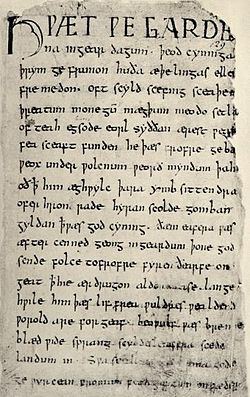
The cover of Beowulf
Then, in Ms. Johnson's 11th grade English class, we did a section on the epic poem Beowulf.  At first, I was no more interested than I was in the Canterbury Tales right before it.  But then one day, Ms. Johnson read to us from the book Grendel, that tells the story from the main antagonist's point of view.  She then went on to describe the setting.  She explained that it was a dark, cold time when people huddled inside this vast hall, while outside in the impenetrable darkness lurked the monsters and the spirits and the terrors that only the rising sun would vanquish.  I can't explain it, but all of a sudden I had to learn more about this period!  And so it was, I began to find what I could about anything to do with Medieval Europe.  If it mean buying a D&D book here, or a book on knights there, or even pining for an old Atari game called Adventure, if it was medieval looking, it made it into my hands.

From there, of course, the rest is history.  My love of each period of history set the stage to learn about others, or sometimes outside forces brought me along.  In each case, I approached it with the same attitude I learned from my first history book: what you hear in tales and legends may not always accurately reflect what really happened.  If my Dad or others loved to tell tales about what those brave soldiers did landing on the beaches, I noticed those braves soldiers, as often as not, were more subdued.  When I saw the photos and graphic scenes in that first war book, I could understand why.

So when I went into other periods, I was prepared to set aside the common narratives, the accepted versions of what everyone really says happened.  To that end, I would rail against the growing tendency to see all of American and European history in the worst possible light.  I would also be highly suspicious of the general narrative, by my days in college, of seeing the Christian contribution to Western Civilization as purely incidental, it's only value in giving us the horrible against which to measure enlightened secularism. And that's how, after all those weird and twisted years, a simple table book led to my ability to look through the standard Medieval narrative and see something there in the One, Holy, Catholic and Apostolic Church.  There's more, of course, when it comes to my historical theory and various approaches to the subject that I developed in college and graduate school, but those topics are for more serious posts.  This was, after all, meant to be a whimsy.

Wednesday, October 10, 2012

Vincent Price peddles some enchanted wares


I know I already posted this, but every now and then I'll repost something just because I want to. And it's my blog. What was I thinking to post this so long ago? It deserves to be here among the seasonal celebrations. Vincent Price? One of the coolest Time Life book collections ever? Why, it has Halloween written all over it!

Friday, November 12, 2010

In A Home, in Ohio, there lived Dave Griffey

Not a lavish, opulent home.
Nor a humble, rustic, country home.
It was a Maronda home.
And that means, crappy.

I have a blog. It's mine. It's mine to say what I want. And right now, I have to say that it is pretty clear America has already sunk to second-rate status. A visit by friends from Hungary this last weekend confirmed that America is already well on its way to becoming one of the has-been-jokes of history. There are no doubt many reasons, the inevitability of societal decline being among them. But I have to say, as I look at our 8 year old home, and see the deplorable level of craftsmanship, the appalling cheapness of materials, the embarrassing standards by which it was not only built, but approved, it's not hard to see why American is fast becoming synonymous with jack-ass. The hardest thing I see as I look around at the abysmal lack of pride that went behind my little dwelling, and other modern housing projects, is any real care on the part of the adults at the royal screwing our children will get because of our lazy, spoiled, stupid short sighted narcissism that values hedonism above all things. Well done America. If only we, instead of our posterity, would pay the price.

Whew. That felt good.

Monday, July 26, 2010

On the other hand....

I will post about my experiences as a Catholic, what I've seen and experienced, the blessings I have received, and how all of this fits with my life from agnosticism to Protestantism to Catholic Christianity, as well as what I see in the world around me - that world we are about to hand over to our children.

Sunday, July 25, 2010

Priorities in life


The boys. They make me proud. Great kids, smart, clever and fun. It must be their Mom, or they had to dive deep into the gene pool to find those recessive genes. But they are as much fun as a Dad could have hoped for. Expect a large amount of bragging on them as time passes.

Posts I will Post

This is the type of thing I will post on. Or this. Every now and then it may be something like this (particularly if I like the headline). I'll even toss out an opinion now and then. Or it may be a picture of the kids, or talk of a vacation, or anything else. Even a hobby or two.