Showing posts with label Movies. Show all posts

Wednesday, March 18, 2026

Telescoping cultural history

Internet age style.  One of the odd quirks I've noticed over the last decade or so is how so much of older culture is being forgotten, or at least devalued.  Outside of certain fanboy circles, what once was held with reverence and revered is today almost entirely irrelevant.  It isn't that I'm shocked that the 80s are now as far away as the 50s were when I was growing up.  But I'm shocked at how aware we were of the 50s culture versus how little awareness there seems to be regarding the 80s, 40s, or any other decade today.

Let me explain.  The reason why Back to the Future worked for my generation is not that we were stunned by the cultural differences that Marty McFly discovers on his way back to his parents' teen years.  It's that we knew the references very well.  We knew the music, the TV, the fashion.  We were aware of those things.  We knew who the biggies were.  We even admired some of those old icons.  We knew the movies, the stars, Elvis and the other early rock stars.  We also knew the older stars they were replacing: Dean Martin, Frank Sinatra, even older Bing Crosby. We knew the TV shows, the movies.  We knew how people dressed.  And we sometimes admired and even liked their craft.

Today, when I read sites dedicated to culture, like movies, it's as if there really wasn't a film industry before 1992.  Oh sure, some will have the obligatory Chaplin movie, or Duck Soup, or The Seven Samurai.  But on the whole, you'd think if it wasn't laden with CGI or featuring the latest, hippest, it just didn't exist.  And if older movies are mentioned, there is almost an apology for the lack of sophistication, or old standard styles that existed at the time.

Which brings me to Steve Graydanus.  He's every Catholic's favorite movie critic.  And yet?  He exemplifies what I mean.  Set aside the fact that when it comes to movies influenced by American Protestantism, you can expect at least a finger wagging, if not a drop of a letter grade.  That's just the Catholic coming out.

But go to his site here, and see what he praises, what he doesn't, and what he doesn't even mention, which to me represents everything I'm noticing.  Movies like The Godfather, Gone With the Wind*, Cool Hand Luke, Cape Fear, Psycho, and The Sting - movies considered revolutionary, influential, or among the greatest ever made, aren't even mentioned.  You might say it's because his is a family guide site, and those aren't family.  Yet he has R rated movies (see The Silence of the Lambs).  Why not these?

When he does rate classics, such as Snow White or Stage Coach, he often injects slights at them for various era based distinctives, or seems to say 'nothing special, but an A for reputation', even if he ends up praising  the overall films for reasons his review doesn't reflect.  Or he dismisses them outright.  Yet he gives a B- to The Phantom Menace.  A B+ to The Lego Movie!  Are you kidding me?  Sure it was cute, but Lawrence of Arabia gets an A-, while the Lego Movie gets a B+?

It's as if the Internet age has changed things.  Changed what we accept as good, quality, acceptable, unacceptable, classic, legend.  Sometimes it's as if things that once were the "Essentials" have suddenly been tossed on the trash heap.  What was once legend is now antique at best.  Once the medal standard is now a forgotten footnote.  I don't know why. I don't even have a theory.

I just know that when my friends and I watched 1933 King Kong, in the post-Star Wars era, we thought it was awesome.  We got that it was old, the special effect weren't up to Star Wars.  We got that the acting was different than modern acting.  We hadn't been influenced by Multi-cultural PC enough to look for racism and bigotry in every frame of every movie, but we got that it was of its time.  Unlike modern movie review sites, we wouldn't lament the special effects, acting, racism, or anything else.  We took it for its time and praised it accordingly.  And any young, budding movie critic would also have to grapple with such films, even if they didn't care for them, because they were part of the whole cinematic package.  It's noteworthy that Decent Films doesn't even review the original Kong, mentioning it only in the review of Jackson's 2005 remake, and then more or less dismissing it as uninteresting and not worth much more acknowledgement than setting up the basis for Jackson's B Graded remake. A movie that once garnered praise and adoration from critics, movie buffs, film historians, and youngsters of every generation, reduced to an afterthought.  Such is the fruits of the Internet Age.

Mr. Graydanus is not alone.  Like so many modern film critics, he seems to have little to say about anything old, unless it tickles his fancy for this or that reason.  Likewise, fanboy that he is, his respect is reserved for the latest fantasy/comic book laden stories with copious amounts of CGI.  Sure, he gives bad reviews to movies, often when they flagrantly assault a major part of the Catholic ethos.  This isn't to pick on Mr. Graydanus.  In fact, I enjoy reading his reviews, even if I disagree with many of his conclusions.  But he represents a trend that is far more common, even among older critics trying to appeal to the Internet age, than it is the exception.  Just look at the IMBD top movies list for examples.

It's post-modern, mixed with the Internet cubicles of a fragmenting generation. I owe nothing to anything greater than myself or the particular clique to which I belong. If I'm a movie reviewer, and don't care about or want to look at a given movie, then so be it. And woe betide anything other than a small handful of old offerings that fail to measure up to the awesomeness of Now (compare his C rating for the delightful 1977 The Hobbit animated movie with his B level rating for Jackson's 2012 cinematic version - what was better in Jackson's other than the use of CGI?).  Back in the day, a movie critic who didn't include The Godfather would be like a Revolutionary War historian who had nothing to say about Washington.  But not today.  What that says about the greater trends of our post-modern Internet age, I don't know.  But I'm 100% convinced it says something, and eventually will say it loudly.

*It's worth noting that Decent Films has few reviews of the greatest movies from 1939, considered for almost all time as the Greatest Year in Movies.  Including Gone With the Wind.  Again, it says much, IMHO.

NOTE:  This is an old post from about a decade or so ago.  This was well before Deacon Greydanus banned me the first time, when we used to get on well even when we disagreed.  So this was not some slap at him over his clear swing to the Left of center.  This was when we got along, and he sometimes would admit I made a good point or two, even when we disagreed.  It just came up with a slew of visits, and I found it interesting.  Especially as I pondered how he did exemplify many of those old 'postmodern' traits, well before his shift left. I wondered if there might be a connection, somehow postmodernity being a gateway drug to the left of center so to speak.  Perhaps that's the loud statement I was expecting.  

Friday, October 31, 2025

Movies to scare kids by - the long awaited sequel!

Just in time for a nice Halloween rambling!

Back in the earliest days of my blog, Simcha Fischer posted a list of scary movies she watched with her family around spook season when she was at National Catholic Register.  Deciding to shamelessly steal the idea, I posted the same thing, and it led to an early boost in my visits. No doubt in part because of the images I used being ones people at the time were likely searching for.  Eh.  It still worked, and the old blog got quite a lift in page views. 

Since then, we've watched many more movies that weren't on the list. Some on the list aren't watched as much anymore.   Of course most aren't watched with everyone because of obvious life changes.  And there are those not listed here because, while we have watched them many times over the years, they aren't even a once every three Halloween watch.  So here is the much awaited update - Movies to Scare Kids By, Part II:

Night of the Demon, 1957

MacGinnis (L) and Andrews selling the story
They say this was the first movie in the modern era, post-war at least, to handle the topic of demonology, the occult and Satanism.  Subjects that would dominate the film world during the 1970's 'decade of realism', culminating in the early 1980's infamous 'Satanic Panic.'  In the 1950s, the old monsters of folklore and myth were passe, giving way to radioactive giant reptiles, insects, and people, all mixed with endless aliens from everywhere in the universe.  At the high noon of such nuclear age focus came this British movie.  The story deals with the 'Great Karswell' and his cult of devil worshippers.  It shows you up front what is happening, so the audience doesn't ponder if it is real (something the film makers didn't want but were forced to show by the studio).  Nonetheless, Dana Andrews is the usual skeptical scientist who needs bludgeoned over the head by a hundred foot tall demon before he'll believe - and even then he seems to drag his feet.  Beyond the subject matter, the movie is carried by Irish actor (and physician) Niall MacGinnis as Karswell, whose unique "poetic timbre" gives an offsetting, odd and not quite right feel to what could have been a cardboard caricature.  

The City of the Dead, 1960 (US: 1961)

The shadow of the cross will protect them...
Released in the United States with the unfortunate title Horror Hotel, The City of the Dead is a movie also seeking to discard the post-Nuclear monster insect fad that dominated the late 50s and 60s. No mad scientists here.  In fact, the only scientist is the obligatory sceptic, having nothing to do with their obsession with witches and witchcraft.  Christopher Lee stars as Alan Driscoll, a professor of history and expert in the topic of New England witchcraft. A prize student of his, Nan Barlow, played by model and actress Venetia Stevenson, is directed to Professor Driscoll's childhood home, which happens to be the the sight of a famous witch burning that is shown in the movie's opening.  Once there, the fog never lets up.  Really. It is never daytime, and not foggy in the village of Whitewood.  It is a ramshackle, run down community where nobody speaks and everyone looks, well, off kilter.  Soon things begin to happen, young Miss Barlow vanishes, and her brother (a professor of science) and boyfriend must find out what happened.  The whole drama culminates in a final scene I saw on TV as a child and never forgot.  It has much atmosphere, and continues with the themes of the occult and supernatural that we saw with The Night of the Demon.  Also it's fun to watch and see the obvious influences on some of Stephen King's works, as well as the age old question - given the basic framework of the movie and its year of release, did it come first or did Psycho?  

Psycho, 1960

No caption needed

Speaking of which, somehow this began to be included in the annual cycle of spooky viewing.  I needn't dwell on the specifics.  I mean, is there a more iconic suspense thriller than this?  I knew about the shower scene before I knew what showers were.  And that was back then.  Though I will say this. I have forever envied those moviegoers who saw the film upon its initial release. Only they could have appreciated Hitchcock's sleight of hand, as it's clear the early movie sets up Janet Leigh as the actual psycho. Embezzling money from her boss to force the hand of her lover Sam Loomis into marrying her, she then drives across country,  becoming more neurotic and paranoid with each mile.  Each person she runs into -seeing her boss cross the street, a police officer, California Charlie the used car salesman - becomes more and more of a threat as her mind runs wild.  Then as the weather turns sour, she pulls into the isolated Bates Motel.  Upon meeting a young Norman Bates, the audience thinks here's another person she's going to go crazy worrying about.  And yet, as they converse over an impromptu snack, something is different this time.  From the moment you see him change from picking keys to Room 3 to Room 1, you begin to get the impression that somehow, in some way, perhaps she wasn't the psycho after all.  To be able to watch it like that is something I do envy.   

The Wicker Man, 1973

Christopher Lee gives another understated performance
A disturbing movie on many levels, brilliantly executed, and a reminder for all of those who pine for the peace loving hippy days of love fest paganism.  On the surface, it does look like a celebration of good old pagan free sex versus that tired old religious puritanism of Christianity.  Edward Woodward plays a devout Christian policeman investigating the disappearance of a young girl from a nearby island off the English coast.  As he makes his rounds, he is stunned at what he sees - like a Woodstock orgy on acid.  This is only made worse when he meets the island's unapologetic lord, played by Christopher Lee in what he called one of his favorite roles.  Things begin to go from crazy to nightmarish for Woodward until, only when it is too late, he realizes just what he has uncovered.  It is an ending that will stay with you a long time after the movie is over. 

Steven King's Silver Bullet, 1985 

Made in the wake of The Howling and Rick Baker's groundbreaking effects for An American Werewolf in  London, it is inferior to those two movies in most ways.  The design for the monster in question always looked like a teddy bear with a mean streak and not much more.  With most of King's movies, either they deviate enough to improve the material, or try to stretch the material out to a two hour version of not much.  Somehow, this movie manages to do a little of neither.  Still, there are some things to like.  It wisely adds a seasonal feel by having the final confrontation take place on Halloween night (while picky observers note that in the actual year it is supposed to happen, the moon was not full on Halloween).  The principal actors are good enough, and do their jobs well enough to carry the story.  Many in the support cast actually shine brighter than the leads.  There are some heartfelt moments, and some good scenes that suggest a better movie in the making.  Plus it does contain one of the most purely gothic scenes ever put to celluloid.  Then of course there is Gary Busey.  Never has Gary Busey more Gary Bussied than here.  If you like your Gary Busey acting three sheets to the wind even when he's not drunk, this is the movie for you.

L to R: Angry teddy bear; Werewolf to scare the bloody pants off of you (courtesy of The Howling)

The Fall of the House of Usher 

One of the catalogue of Roger Corman's 'how to mutilate Poe' films.  Of all of them, this is the one trying at least somewhat to cleave unto the original source material.  Vincent Price, Mr. Horror of Poe himself, does a good job of making the ailing Roderick Usher come off as unsettling at best.  The settings are typical Corman, lots of fog, everything looks dead (as well it should), the interior shots are properly gothic, and the costumes are straight out of a Broadway costume drama.  At only 79 minutes, it still feels like the main goal is to stretch and stretch again the story into a full length theatrical release.  Nonetheless, when it does get going, and the set of the crypts is revealed, the whole begins to come together and makes for viewing that fits well into the Halloween seasonal feel.  

Dracula, Prince of Darkness (1966)

The sequel to Hammer's The Horror of Dracula, its first instalment of an eternally long string of Dracula movies.  Featuring one of the best showdowns between Dracula and his arch-nemesis Van Helsing, Hammer reminds us that when it comes to adapting books into movies, don't worry about the books.  The names are the same, but don't apply to the same people.  We still have no clue where it is supposed to take place.  The story begins in the first minute by quoting Jonathan Harker's journal, and then promptly begins rewriting the journal itself, with the story to follow.  Nonetheless, so successful was its performances at the box office that a sequel from Hammer was inevitable.  Dracula, Prince of Darkness begins a decade or so after the events of the first movie.  Not able to get Peter Cushing back, they bring in four stalwart Brit performers as well as the always reliable Andrew Keir to weave together a new story centered around a speechless Dracula (the reasons for Lee having no dialogue being debated to this day).  Two brothers and their wives defy warnings from a rambunctious abbot and visit too close to the Castle Dracula.  As they say, when you're in horror movies, you make dumb decisions.  What follows is predictable, and the ending, while interesting in leaning on the tale that vampires can't cross running water, is nowhere close to the first movie's ending (see below).  Also, the 'vampire as bizarre mutant monster, not supernatural' gets kicked into high gear, and you're left pondering just what Keir's abbot actually believes about - anything.  I suppose it was the apex of accepting that everything spiritual must really be material.  It's worth noting, BTW, that the TV channels we had when I was growing up must have owned this movie outright, because more than almost any other horror movie, it seemed this was shown repeatedly.  Also, like The City of the Dead, one can see some clear influences on both Stephen King and, of all things, Dungeons and Dragons! 


Curse of the Werewolf (1961)    

Oliver Reed shines in this tortured tale.  While Hammer would raid old Universal story lines and adapt them liberally from the source material, they toss Curt Siodmak's concocted Wolf Man story out the window.  Instead, for this movie they lean on actual European folklore and superstitions about werewolves and their origins.  Reed's Leon is definitely a tragic character, almost as much as his adopted father, played brilliantly by Welsh actor Clifford Evans.  A viewer will almost be lost at first, as the initial scenes in the movie tap into historical beliefs about where werewolves originate.  Then we meet Leon as a young child with decidedly un-childlike tendencies: Like sleepwalking and returning with blood all over his torn up clothes.  Growing up doesn't help, and like any true Gothic tale, it oozes with tragedy, for that's typically what defines a Gothic tale.  True to form, Hammer Films, as it so often did, managed to punch well above its weight in terms of what it could do with very limited budgets and resources, and makes this one of the most rewatchable of its extensive catalogue. 

The Curse of Frankenstein (1957)

The Hammer film that put Hammer in the spotlight. Initially panned for its gore, its production and its gratuitous levels of - then - shocking visuals, the movie has since been seen as a milestone due to its role in bringing back the classic horror genre in the age of sci-fi and nuclear paranoia.  Like most Hammer films, the source material is out the window. It isn't even based on stage plays.  The film begins with Dr. Frankenstein awaiting his execution.  He tells his tale of what happened, a tale we should be at least vaguely familiar with.  If Frankenstein is sometimes less sympathetic than his creation in the original novel, here he's pure villain.  Willing to murder to maintain his project of life creation, Cushing's Frankenstein ranks as one of Hammer's most heartless monsters.  Even more than the grotesque creature itself, played again by a speechless Christopher Lee.  Scottish actor Robert Urquhart is wonderful as Frankenstein's mentor, turned adversary as he begins to recoil in horror at what his prized student is capable of doing.  Like most Hammer films, for its day it pulled no punches, and the ending shows that not all movies need to end happily. 

The House on Haunted Hill, 1959

The move makes as much sense as this photo
Pure schlock of the highest degree of schlock.  Vincent Price is at his hammy best here, playing the eccentric zillionaire Frederick Loren in what has to be one of the most hilariously convoluted storylines ever.  Released back when low budget movie gimmicks was a fad, the story, the logic, the consistency, the defiance of reality, the basic 'what the hell is going on here' problems with the plot, all take a back seat to a faddish technology long lost on modern audiences.  The basic idea is that Mr. Loren has put together a party at a notoriously haunted house - for reasons?  And then he and his wife pretty much hate each other, until it is revealed there is at least a five way double cross conspiracy orchestrated by - someone?  Elisha Cook is almost slappable with his annoying prattling, and most of the actors seem genuinely confused, because the audience certainly is.  Nonetheless, it sort of got added to the mix some years ago, and is a family favorite.  Especially since the boys like to do with it what they do with the old Frosty the Snowman Christmas special.  That is, eviscerate it down to its core with comedic jabs and digs at the obvious loopholes of logic and plotlines.  

The Haunting, 1963

In keeping with the emerging focus on the supernatural and away from space aliens and giant mutants, we're treated to this cinematic version of Shirley Jackson's novel The Haunting of Hill House. To be honest, this isn't really my cup of tea.  For some reason, the atmosphere and the portrayal of the haunting itself comes off as almost tinny, if that means anything.  There is a mechanical feel to it all that doesn't hit me as 'supernatural' or 'spiritual.'  More like sound machines and drum sets behind the stage than ethereal spirits.  Nonetheless, it is liked here on the home front, and I don't hate it.  There is some good there, especially the lore attached to the story.  The sets themselves are good, and the acting solid.  Yes, we all get the subtle inuendo behind the two female leads' relationship. But overall, each actor of the small cast does good enough.  Not to mention Julie Harris's Elinore Lance has a bullseye over her that even the least attentive viewer can't help but see.  So it's OK, but probably not a favorite, at least for me. 

Night of the Living Dead, 1968

And in color, too!
The low budget independent film against which all low budget independent films are measured.  Literally filming out of the trunk of his car, George Romero managed to redefine a mythical concept and invent a genre in almost one fell swoop.  Despite the heavy handed Civil Rights Era messaging, Romero has always insisted the story was already in place when Duane Jones was cast.  The ending just coincidently looked like it was pushing a message.  A spin on societal paranoia and survival against all odds that would make Rod Serling proud, it manages to start with a punch and never let up.   With a budget barely enough to buy a McDonald's happy meal in terms of movie financing, Romero managed to piece together an intense, suspenseful, and compelling labor of love that still holds up, and unsettles the viewer, even today. 

Ghost Story, 1981

Enough class to fill the screen

Based on Peter Straub's 1979 novel of the same name, the movie distills the book down to the classic 'old dark secret shared by friends' storyline. As they enter the twilight of their years, four life long friends become concerned when one suddenly dies, for no apparent reason.  Then goes another one.  Finally, the son of the first to die shows up and tells his tale.  A beautiful young woman came into his life who seemed, well, every guy's dream.  It being the sex saturated early 80s, this dream is played out on screen in very non-family friendly ways.  Yet something begins to look wrong.  He soon links her to his own brother who died mysteriously after meeting a young woman who sounded a lot like his current flame.  Stories are told, and the dark secret the four pledged to keep forever when they were young is revealed.  At that point, they conclude this might be a case of revenge from the netherworld.  The fact that they rounded up some phenomenal acting power - Douglas Fairbanks, Jr., Fred Astaire, John Houseman and Patricia Neal to name a few - lifts the movie by at least a letter grade.  Good atmosphere and creepy settings don't hurt. 

The Witch, 2015

It's a family in-joke
A movie that came out of nowhere and absolutely awed everyone who saw it. The story is of a Puritan family in 17th Century American concluding their community isn't up to their own high Christian standards.  Therefore, they strike out to make their own way in the American wilderness.  Things soon go from bad to catastrophic as the disappearance of their newborn is followed by a strange and disturbing series of events, both natural and unsettling.  Meanwhile, one by one the members of the family are either lost or turn on one another.  The movie itself deserves a full blog post, and much has been written about it.  The thing I like, beyond it leaving things open at the end, is that the movie respected the material.  It didn't hoist the Calvinist family up for ridicule or mockery or 'gee they were the pits' levels of derision.  It merely says 'these people did this, this is how they saw things, and this is what happened.'  Such a treatment of the past is almost rarer today than a valid witch sighting in these jaded times of ubiquitous presentism. And it helps make this some great, if not disturbing, viewing for a Halloween season lineup. 

CHEATS:

The next couple are movies we used to watch but my wife began to find a bit troubling.  I think it has to do with raising teenagers and college students.  

Halloween, 1978

It begins
It was like Romero's Night of the Living Dead, but taken to the next level.  The initial charge was for John Carpenter to make another garbage quality hack and slash movie for the post-adolescent palate.  But rather than just grab a camera and shoot, he decided to reach into that haversack of creativity, add a little golly-gee-whiz, along with some out of the box seasonal inspired thinking, and came up with a movie that blew the socks off of audiences when it was released, and showed just what independent filmmaking could accomplish at the box office. My cousin Joannie, the night they saw it in theaters, made her husband go in and turn on all the lights in their house and check all the closets before she got out of the car.  I heard that story repeated endlessly back then.  It's amazing what a bag of dead leaves, a William Shatner mask, a machete, a pumpkin special ordered from New England, Donald Pleasance, and the date October 31st gave to an otherwise forgettable low budget project.   Also, we should mention the movie's musical score, written by Carpenter, has become one of the most iconic scores ever.  A fitting bit of trivia for a movie that carved its own niche in movie history. 

The Blair Witch Project, 1999

You have to admit - it works
One of the first fruits of the Internet age, it played the new medium like a maestro and generated one of the biggest blockbusters, in terms of profit margins, in movie history.  Of course like anything, it quickly became just as fashionable to hate and despise the movie as initially praise it.  A film by actual students in the University of Central Florida film department, the story centers around students in a film department doing a documentary on the legend of the Blair Witch.  The basic premise is sort of like Dracula, but in the video age.  That is, their film cameras they used to track everything that happened were discovered, and what we are watching is what actually went down.  Ok.  If Dracula's whole 'quick, something isn't right, let's get to the diary' framework seemed to stretch things at times, this movie's 'oh no, we could die - quick, grab a camera', went over the edge. But putting aside the obvious need for suspending tremendous amounts of disbelief, the movie did a good job of reminding us that less can often be more.  The fall foliage, the wilderness isolation, the nod to a cemetery, the community with only hints of Halloween decorations never focused on, the abandoned house, the strange yet understated totems in the middle of the woods, did a far better job at helping the viewer paint a frightening mental picture than most movie special effects artists could ever do.  

SPECIAL MENTION

Ghost Story (2017)

Really, he's in a bed sheet
We still aren't sure what to make of this.  Starring Casey Affleck, it is the story of a young couple, madly in love, whose lives are shattered by the sudden and tragic death of the young man (Affleck).  After the shock of the accident, Affleck suddenly finds himself in, well, a bedsheet and confined to his home.  Without saying a word, he watches as the love of his life moves on, only to be replaced by others who come and go until suddenly it looks like the year 2929 with space skyscrapers and flying cars and then -  woosh!  There he is, in his sheet, looking upon a barren wilderness.  He sees 19th Century settlers, then the decaying body of a dead child with an arrow in her back (gutsy move that), and suddenly, things start coming full circle as around him emerges the neighborhood and house he knew.  Each scene contains characters and dialogue that muse on life, death, time, morality, the divine, and the eternal.  All while the ghost with two eye-holes silently observes.  My wife isn't keen on watching it again, but I admit I wouldn't mind giving it another whirl. 


So there you have it.  For the record, not all of them are watched every year, and some more often than others.  A few have only been watched a couple times, but almost always around October, owing to the seasonal vibes.  

Monday, September 29, 2025

An ugly fact

So the media has exploded about news that the very elderly Mel Brooks put his stamp on a sequel to the 1987 movie Spaceballs.  Here's what I have to say.  I'm sorry to the Brooks fans out there, but when that movie came out, I knew nobody who saw it that liked it.  They just didn't.  The general consensus was that whatever magic Brooks had in the 70s with such classics as Young Frankenstein, Blazing Saddles, or even History of the World, Part I, was long gone.

The common narrative was that the out of left field comedy Airplane! had out-Mel Brooksed Mel Brooks.  It was everything Brooks had done, but on steroids.  And from that point on, Brooks just didn't know how to top it. When he tried, such as with Spaceballs, or Robin Hood, Men in Tights, it came off like a screenplay written and produced by adolescents and fifth graders.  Lots of heavy handed and contrived jokes, one dimensional humor, with no real wit, meaningful homage, or even clever commentary.  For instance, with Young Frankenstein, you can almost see the love that Wilder had for the original source material (for he was a major creative force in the movie).  With Spaceballs, you felt they simply watched Star Wars and then said 'put a joke here.'  

This is what my sons often call 'the movie that nobody wanted.'  Oh, they'll make huge noise about it.  The media today often acts in the role of marketers and promoters for various artists and products and productions.  My guess is this will be something like Wicked or Taylor Swift or Lebron James, that will receive 100% media backing and hoisting and advertising over the next couple years.  And given a global audience in the billions, it will no doubt make some good money.

But don't be fooled.  As I hear the original called a classic or a smash hit or beloved, we were the audience the original was aimed at, and I knew nobody who thought much of it.  And that included mixed reviews at best from the critics.  Not that there weren't funny parts. We all quoted 'They've gone to plaid!' a million times.  Of course everyone loved John Candy's 'I'm a Mog, half man, half dog!  I'm my own best friend.'  But save for one friend who felt the various bits did outweigh the blah of the whole, we were far more taken by the movie The Princess Bride released the same year. 


Friday, July 25, 2025

Friday Frivolity: A very good movie

So our youngest hadn't seen all of the movies the older boys grew up with when they were young.  He's seen many, but not all.  Recently he watched, for the first time, the first Sam Raimi Spiderman film.  He was impressed, but not overly.  

I remember that well.  The X-Men movie had come out and brought back some of the good will lost to the genre after the disastrous Batman and Robin starring George Clooney.  After that garbage heap, I recall some folks wondering if this time the Superhero Movie genre was dead for good.  The same conversation came after the dismal performance of the uber-preachy Superman IV back in the day, only to get a second chance from Tim Burton's first Batman movie - admittedly due to the hype around then superstar Jack Nicholson's turn as the Joker. 

But X-Men got people's attention and folks thought perhaps it could work, or at least it was worth trying again.  Then came Spiderman.  In those infancy years of the Internet, I was only partly on board with the cultural conversation trends.  And I've never been a big comic book fan in the first place.  I know some of the bigger characters, and recall Saturday morning cartoons here or there from back in the day, but that's all.  

Nonetheless, I couldn't help but hear that there was quite a lot of controversy surrounding that upcoming movie.  Because for this Spiderman, some young, rather diminutive actor named Toby Maguire had been tapped to play the superhero.  A scrawny little geeky kid?  That's not Peter Parker!  Heading into its release, I remember the scuttlebutt about the assumed pushback.  This was only exacerbated by the delay in release because of the movie erasing scenes involving the World Trade Center towers, which ceased to exist after filming.  

But when it came out, it was an out of the box smash. The idea of Spiderman as the alter-ego of an otherwise put upon, beaten up, bullied and awkward super-nerd captured the imagination of young filmgoers everywhere.  Sort of every geeky wallflower's dream.  Even if they made the unwise decision of covering the face of crack actor Willem Dafoe and not allowing him to emote as he could have, it was a mega-hit.  And then, of course, you had 'the kiss', which became the talk of the pop culture mainstream media that year. 

Now the next question was, could they do it again. X-Men 2 had come out, and many felt it was better than the first.  But the X-Men franchise was always somewhat niche for the comic book world.  Spiderman, like Batman and Superman, was a household superhero name.  I knew of the character after all, and that's saying something.  Being that well known does place a burden after all. So was it luck for the first time out, or could the success of these franchises keep the genre alive?  

Then came Spiderman 2.  The first correction to the original came to the supervillain - Dr. Octopus. This time the main antagonist was played not by some A-List actor's turn as the latest supervillain, but by accomplished character actor Alfred Molina.  No masks or face coverings here.  He was allowed to show all of his human expressions and emotion, and he did so in spades.  Being an almost would be mentor to young Peter, he is transformed by a science experiment gone terribly wrong that costs him everything.  Bringing a combination of wit, snark and at times understated delivery, he was able to do what Dafoe couldn't.  And he did it wonderfully.

But more than that, my son noticed that the movie was, well, mostly just a good movie.  The 'comic book' parts were few and far between.  In fact, a sizeable part of the movie could have been a teen romantic comedy with nothing superhero about it at all.  You could have taken away the minimal comic book  story and replaced it with a young, conflicted kid overworking to get ahead, struggling with his romantic relationships, with a disgruntled coworker whose own dreams have been dashed and is seething with resentment, and the main crux of the plot and the characters would remain unchanged. Which only adds to the punch when the actual comic book element comes crashing back into the story.

FWIW, I'm not a professional film critic, and I don't know the jargon and the gibberish that film critics use to unpack this or that film.  I just know a good movie when I see it. For example, in addition to the movie itself being hailed even now as one of the best in the whole genre, my sons tell me that the climactic confrontation upon a speeding L-Train is still considered one of the best action sequences ever, not only in comic book movies, but movies in general.  I'm inclined to agree. 

Because like the best filmed scenes in any good movie, the action flows from logical development to logical development - it helps tell a story.  Just like the lightsaber duels in the original Star Wars films.  As opposed to much of the CGI action now (including later Star Wars films), which is just endless CGI action followed by more endless CGI action almost to the point of numbed boredom.  When the action starts in Spiderman 2, it's moving the film from point A to point B, as all scenes in good films should. And it's worth noting that those scenes are surprisingly brief. 

A big shout out goes to the effects for not being merely a ton of CGI on greenscreens.  For instance, the mechanical arms of the villain were real, and worked by puppeteers off screen for most of the shots.  For those cases where CGI was needed, and certainly it was used extensively throughout the movie, it was still built upon the modeled arms for reference.  It was similar to the original Jurassic Park, which filmed all dinosaur scenes with stop motion models as reference, giving the CGI more depth and realism when it was used.  

But the most important thing, at the end of the day, is that it's a movie that is incidentally a superhero movie.  The important part of the film is the storyline, the struggles of the main character and his interactions with those most important to the story arc.  Take away the fight scenes and spiderwebs and costumes, and you're still left caring about what happens to him.  Will things work out?  Will he find his footing in life?  Who is going to get hurt?  Because the rival for Mary Jane's affection is not portrayed as a one dimensional jerk.  Rather he's shown as a great guy who is genuinely good, at which point you know someone good is going to lose.  And that's a bold decision in any story.  It would be easier on the audience to have her beaux be a jerk or frothing at the mouth sexist or something.  But nope, someone has to be hurt when the dust settles, and the film does a good enough job preparing you for the star being the one who gets the loser card at the end (assuming you don't know the comics).   The same goes, it should be mentioned, to the very shy and awkward daughter of Peter's quirky landlord.  She obviously has a crush, but for her to hope for a chance, Peter must lose what he wants the most.  Otherwise, she loses. And she is nothing but a sweet, shy girl. 

That's how the movie works so well.  Maguire does an excellent job as the beat-dog superhero who is a genius on one side, but at times socially awkward and lacking in basic life skills on the other.  The guy who just seems to be there to be kicked around.  His one benefit is being a superhero, but even that is as much bane as boon in this movie.  Kirsten Dunce does a good job with the frustration and confusion she has over this would be lifelong childhood friend and possible love interest. J.K. Simmons chews up the scenery with his few minutes of screen time as Spiderman's chief critic J. Jonah Jamison. James Franco  merely broods and growls and complains about Spiderman, but this is one more part of Parker's life that seems in shambles.  And behind the scenes but always felt is Dr. Octavius, who is his own tragic character in the mix.  One of the best such villains, he is also one of the few who pass from mentor to monster and finally redeemed hero.  His classical training as an actor no doubt lent help to his role. 

Overall, it was just a good movie.  Like the original Raiders of the Lost Ark, it transcends the genre and becomes, not just a fine superhero movie, but a fine movie overall. 

As a side note, I should mention that it's been probably over a decade since I last saw this.  That's why I was almost shocked with a movie made before the last dozen or so years of the era of bat-nuts crazy.  At the end of the day, it's a movie with mostly white people, men and women, in what used to be a focus on story, characters and action.  There is no feeling that a demographic chart is at the bottom of the screen tracking various groups and their proportional representation, ready to blacklist the moment it fails in its obligation to meet appropriate group identity quotas.  There is an African American in a small part, Molina is part Spanish and Italian (but still "white"), and some long shots of crowds show a variety of groups (it is New York after all), but that's it.  It's neither a problem nor a focus. It just is.  In those days, we wouldn't have thought much about it one way or another.  Just the fact that some diversity was represented was good enough.  Likewise, Mary Jane doesn't suddenly turn into a Ninja warrior and take out a platoon with her bare hands, pinning Dr. Octopus in a half nelson for Spiderman to finish off.  She's the damsel in distress who must be save by Spiderman.  It all seemed so ... normal, natural, common sensical, and in the oddest twist, a million times more real than agenda driven movies today supposedly based on reality but that seem anything but real. 

Original teaser art that I remember got people talking

Friday, June 20, 2025

The Reality of JAWS

THIS IS FROM AN EARLIER POST.
Since today marks the 50th Anniversary of the movie that started the whole Summer Blockbuster era that would eventually separate Oscar from Box Office, it's worth reposting.  FWIW, JAWS itself, like Star Wars, ET, Close Encounters of the Third Kind, Rocky, and Raiders of the Lost Ark were also Blockbusters but widely praised by the Academy.  JAWS was, in fact, nominated for Best Picture (losing out to One Flew Over the Cuckoo's Nest).  So here it is, with the musing I had from the day: 

"None of man's fantasies of evil can compare to the reality of Jaws."

That was the line that opened one of the TV commercials for JAWS in 1975.  It was the movie everyone was talking about.  There are famous movies, legendary movies and great movies.  And then there are those historic movies.  Not movies about history, but movies that made history.  Gone With the Wind, Citizen Kane, King Kong (33), Star Wars, the Ten Commandments, The Godfather, The Exorcist, Easy Rider, and of course JAWS.

At a time when many believed it would be endless years before the 100 million dollar mark was breached, when movies were aimed at general audiences, when realism was beginning to dominate and the R-Rating was allowing Hollywood to shatter taboos, a young Stephen Spielberg unleashed what many consider to be the greatest horror film of all time on an almost ill-prepared movie going audience.

Much has been written about the movie.  And next to Citizen Kane, few other movies have become as
known for the production as the finished product.  Everyone knows the mechanical shark didn't work.  State of the art for the day, salt water did it in, forcing Spielberg to adopt a more Hitchcockian approach to what would have been a 'monster shark eats people' disaster film of the mid-70s. Union problems, zoning problems, difficulties shooting on the ocean, cantankerous crew, bickering actors - Spielberg has said that for many months after the film's release, he would wake up in a cold sweat thinking he was still working on the set.

And yet, when it hit theaters in the summer of 1975: movie magic.  Hollywood realized there was a whole new way to package and market films.  The Summer Blockbuster, whose bastard children are still alive today, was born.  Spielberg became a superstar.  John William's iconic score went down as one of the greatest ever composed for a film.  One of the greatest monologues in movie history. Martha's Vineyard officially became a major tourist spot.  And in the summer of 1975, revenues for the beach industry took a sharp plunge.

And why not?  Even then it was recognized as better than your average horror thriller, garnering an Academy Award nomination (losing to One Flew Over the Cuckoo's Nest).  And though some criticized the lack of character development among some of the cast (though usually not the principle characters), today it looks like a Shakespearean drama by comparison.

Spielberg's insistence on filming on the high seas rather than a studio tank paid off, and the atmosphere and
the ocean become major players in the film.  Robert Shaw, Roy Scheider, and a young Richard Dreyfuss all give stellar and sympathetic performances.  Even though the movie relied on locals to round out much of the town's population, they actually pull their weight well.  And while the shark has gotten some ribbing over the years (sharks don't really have 'jaws'), when looked at as a model, it really isn't far off an actual Great White.  It was just the lack of information saturation that movie makers today would have that the model builders then weren't privy to.

Still, by the time the shark appears, it's lack of continual appearances keeps it menacing until the end.  The tension and stress of the movie keeps the audience alive, and just like other great films of the past - anything by Harryhausen, the original King Kong - most are able to mentally transfer the images and remember that this isn't really a shark, but it's a character in the movie.  Just like Shaw wasn't really a fisherman, or Dreyfuss a scientist, so the mechanical shark was an actor.  And what an actor it was.  Though modern CGI creatures have the benefit of unlimited access to any scholarship about any topic, and  of course the limitless bounds of CGI graphics, few have ever sustained the menace or the horror that 'Bruce' the shark managed off the coasts of Amity all those years ago.

Knowing the movie and its place in history and the quality of its production, it was inevitable that I'd want to see it with the boys.  Our oldest had seen it a couple years ago.  But our next two youngest hadn't seen it yet.  So last weekend, busy with Mothers Day and preparations for Confirmation this weekend and  Graduation next, we set aside any major plans, popped some corn and sat down to watch JAWS.  I was curious to see how my boys would react.  After all, in 1975, unless you were able to see Rated R movies, chances are you hadn't seen much in terms of blood and violence.  JAWS made some people leave the theaters because of the blood.  I remember my then teenage sister being utterly freaked out by the huge amounts of blood.  But this is 2014.  My boys grew up on a diet of PG-13 violence, and have actually seen some select rated R movies (or scenes from them, for instance battle scenes from Gladiator). Would this be old?  Would it be dated?  Would it be a bore?

When the movie was over, and Dreyfuss had tossed out his final quip, as the credits ran I looked and my eighth grader was literally clutching the arms of his chair.  My oldest, who had already seen it once, was shaking.  My ninth grader laid back as if exhausted.  So what did they think?  My soon to be confirmed eighth grader was first to speak, and he summed up something I've been think about since.  He said, "You got to like those guys.  You didn't want to see any of them killed.'   The others agreed.  Far from two dimensional fodder, you cared about them.  Almost half the movie was spent getting to know the main characters, and even though common sense said that at least one of them had to go, you didn't want it to be any of them.  But it wasn't just that.   It was intense.  How was it intense I asked.  Because it was, well, real.  They couldn't quite put their finger on it, but they said it wasn't just 'it was real because sharks are real.'  It was because the people didn't seem like today.

I pondered that and pressed on.  According to them, today many (not all, but many) characters are not overly sympathetic.  Bad guys are supposed to be bad and get what they have coming.  Good guys are good guys, usually because they represent PC values.  Characters aren't real.  They're like types.  They are either supposed to get what they have coming, or not.  And even though the gore and violence is more, it isn't the same.  They just couldn't but their finger on what made this 1975 movie so intense.

And yet, they've encountered that more than once.  Not that they don't enjoy movies and TV shows today,
but they have time and again admitted that, with few exceptions (Christopher Nolan being a consistent example), movies today lack something. They're not 'real.'  Yes, the acting quality in JAWS among the three leads is wonderful, and that helps.  But actors today are good.  Writers.  Directors.  What is it that so struck a nerve with my boys?  I'm not sure.  To quote Quint when asked if he'd seen a shark do this: I don't know.  But it's got me to thinking.  Thinking about the media pool in which our youngsters swim.  Maybe it's my boys.  Maybe others would just laugh and guffaw.  Maybe they would cheer whenever someone got taken down by the shark.  Part of me fears that might be true.  But I can't help but think it means something, and I'll be thinking about it over the months to come.

Maybe it's not fair to compare what many (or at least pre-internet many) consider one of the greatest movies of all time to the entire package today.   After all, there was more than one pile of lousy, superficial junk movies in 1975.  But for now, three men went into the water, two came out alive, and the reaction of my boys gave me something to ponder as I think of our culture, our society, and the world which we have given them as our oldest's graduation approaches.

Friday, February 14, 2025

Biggest movie dissapointments

As a movie fan, I've seen my share of films over the decades.  Generally I'm pretty lenient where movies are concerned.  If they are engaging, or fun, or entertaining, I'll call them a win.  I'm not one who tries to dissect and hyper-analyze a movie on every technical level.  That's not to say I can't notice problems, even with movies I've enjoyed.  I just try to find the better part of them because, in the end, if I can spend time wondering what was wrong with that movie I paid money to see, I'm living a blessed life.

That's not to say all movies are winners.  Sometimes they are real stinkers, and that happens.  Sometimes it happens with movies I imagined going into it would be stinkers.  I'm thinking The Man With One Red Shoe.  We actually drove to the city of Mansfield to see it, and had to brave almost blizzard conditions on the way home.  We traveled in a beat up car with broken windshield wipers, where we one of our friends had to hang out the passenger window wiping the snow off so the driver could see as we trudged slowly through the night on that frozen country highway.  For that movie?  That's probably what makes it seem worse than it was. 

Sometimes they look so bad you not only know they will be bad, but you wonder what they were even thinking to produce them.  As I wrote on back some time ago.  But sometime it's the opposite.  It's those movies that look great, or you've heard so much praise about them that you're sure they're winners.  And yet, perhaps because of the lofty expectations, they fall short.  That's this list today.  Movies that I watched, if for no other reason than the universal accolades and thumbs up.  Some I might have only seen over the years and kicked around, some I might have seen briefly, but the appearance elevated my expectations.  But whatever the reasons, I ended up coming away massively let down.  

The list is purely subjective of course, which in most cases usually means correct. 

Out of Africa

Zzzzzzzzzzzzzzzzzzzzz.  It's hard to say why it was a disappointment because I spent most of the movie trying to stay awake. This was one of those 'Oscar Darlings' as the age of the Blockbuster was beginning to lay a thick line between critically acclaimed movies and popular ones at the box office.   The Academy praise was all about Out of Africa that year, and it was for those not dutifully impressed by the wonderful fantasy romp Back to the Future.  Despite my distrust of critical stamps of approval, it did pique my curiosity.  After all, I don't hate Robert Redford, and admit Meryl Streep is a wonderful actress, if not morally compromised in the post-Weinstein era.  But who in Hollywood isn't?  So after decades, being married, raising a family and welcoming new members through my son's marriage, my wife and I decided to get this and sit down for a watch. I'm typically pretty lenient with movies after all, and it did come highly recommended.  Perhaps it was the level of hype, as is the case with other movies on this list, but it didn't just fail to live up to the accolades.  It bored me something awful.  At one point I actually found myself wondering how much wax I would have to put on the trees in our back yard to get the squirrels to slide.  I'm not sure if it was all the hype's fault.  It could have been one of those movies you just ask in hindsight what they were thinking with all the gushing praise.  But hype or not, it was a big let down, only because I spent decades seeing it referenced positively and remembering the fanfare and adoration, only to spend the better part of the movie struggling to keep my eyes open.  

The Godfather Part II

Blasphemy!  Garnering more Oscars than the first, The Godfather Part II is often considered the greatest sequel of all time.  It's hard to disagree.  I've written on the fact that it is hands down one of the best sequels ever. I've watched it many times over the years, and enjoy it every time.  So what in the world?  How did this get on the list? Because after the first viewing - and subsequent viewings - it's easy to see that most of the hoopla revolves around the 'prequel' parts of the movie.  The parts that deal with the rise of Vito Corleone as the great mob boss of legend.  Filmed in a mild sepia tone, using subtitles for the Italian dialogue, and featuring an out of the ballpark performance by young Robert Di Niro, the 'flashbacks' are among the best scenes ever filmed.  You easily believe Di Niro would grow up to be Brando's don Corleone.  And I agree with the late Roger Ebert that the segment in which young Vito crawls along the rooftops toward his destiny, as he hunts Don Fanucci below in the street festival, is one of the best ever produced. So what gives being on this list?  Because the problem is, the 'sequel' half of the movie is just what most sequels are - more of the same, only less so.  It almost follows step by step the basic structure of the first Godfather film, but a notch down.  Begin with a big family event, then attempted hit on the new don, backroom dealings, horses head dead prostitute in bed with power player involving Tom Hagen, more wrangling over complex mob dealings, tensions in the family, a mid movie assassination attempt, betrayal, relational problems between Michael and Kay, and a climactic 'multi-professional hits' wrap up montage.  The highlight of the sequel portion was Michael and Fredo's volatile relationship and its preordained conclusion (Richard Bright's faithful hitman Al Neri does one small thing at the end that adds a letter grade to the punch, if you notice it). But otherwise, as if they had no ideas to run with, it was merely rinse and repeat.  And on top of that, they had to shoehorn Michael Gazzo's Frank Pentangeli character in as the discount Pete Clemenza due to contract and salary disputes.  You can just mentally scratch out 'Frank' and replace with 'Pete' and that part of the story barely misses what the writers most likely wanted.  Had it not been for the prequel half, and the wonderful interaction between Pacino's Michael and Cazale's Fredo, I don't think it would be much more than a forgettable above average sequel.  Which is quite disappointing if you think on it. And rather tough to admit.  

Dead Poets Society 

This was a Robin Williams vehicle plain and simple.  Williams always had a feast or famine output when it came to movies.  Either he was in wretched and unfunny cinematic drivel, or he batted it out of the ballpark, at least where critics were concerned.  Especially when he cozied to the hipster avant-garde film world of The World According to Garp or Moscow on the Hudson camp. Here, he goes for the artsy crowd, but in a movie obviously produced for a wider appeal.  In the appeal category it succeeded in promoting itself, and most of my peers at the time couldn't wait to rush out and see it.  It wasn't bad.  It was just - predictable.  Within a half hour, I knew Robert Leonard had a giant 'I'm Doomed' sign around his neck.  Not to mention it was pretty much taking John Lennon's Imagine and living it as the highest ideal.  Even then, in my liberal agnostic days, I thought that sort of messaging was beginning to wear thin.  On the whole, it was a watered down preachy movie, heavy on tropes, and fairly predictable as the characters do what they are obviously supposed to do based on the message the movie is obviously trying to convey.  For all the hype and accolades, I expected much more. 

Beetlejuice

Some of the movies on this list were likely victims of overhype on the part of critics and the Academy.  This was not one of those movies.  It was a more pop culture marketing hype you might say.  At the time, Michael Keaton was one of the rising stars for our generation, having been in some popular teen oriented comedies.  Plus, there was almost an unspoken contest between him and that other Tom Hanks guy as to which would emerge as the major star of their generation. By this time Hanks, who exploded onto the big time with his movie Splash!, was already drifting away from mere teenage comedy fodder and starting to dabble in more serious, at least by comparison, output.  Keaton, however, was keeping it in the ground with comedy.  And Tim Burton, who we first heard about with the offbeat yet strangely fun to watch Pee Wee's Big Adventure, had gained a positive reputation among those I knew.  Therefore, this movie promised much to our young college age expectations.  The commercials for Beetlejuice helped, and made it look like we were about to see a comedy for the ages.  It might be something that could even overtake the monstrous success of Ghostbusters a few years earlier, in yet another 'cross genre' comedy triumph.  But that was the problem.  The marketing.  A bunch of us went to see the movie together.  Within half an hour we were all looking at each other and asking the same question - Michael Keaton is in this movie isn't he?  The commercials we saw focused exclusively on Keaton.  To see them, you imagined he would have more screen time than Scarlet O'Hara.  But he didn't.  Not that this is new or even a problem.  Brando is in very little of The Godfather, and Darth Vader has barely a handful of minutes of screen time in the original Star Wars.  But in neither case did promotional material suggest that their characters were the hubs around which the movies turned.  All of the promotional material and trailers for Beetlejuice focused almost exclusively on Keaton's role.  So as we watched and waited, watched and waited, watched and waited, it cast a pall over the whole experience. Even once he was in it and finally began tying the story together, it was too late.  We all left the theater, along with others around us that we could hear, grumbling about the movie that was supposed to have Keaton in it.  Of all the movies I've ever been disappointed with, this was the biggest case of skewed advertising being the culprit.  The problem felt even worse when we compared it to a filmgoing experience from a year earlier. That was when, to kill time, we went to see an offbeat fantasy spoof  with Billy Crystal and, of all people, Andre the Giant, having only minimal expectations, but leaving with one of the most hilarious and entertaining movie experiences we ever had.  But that's for another post. 

Full Metal Jacket

It was Paths of Glory for the post-60s generation.  This was a book/movie that many of the young fellows of my youth read and watched with zeal.  Most loved it and couldn't get enough of it.  So after years of being told I just have to see this masterpiece for the ages, I decided why not.  And after it was over, I have to say it was a letdown.  For me, the movie failed because, let's face it, Baptist tent revivals are less preachy.  It seemed as if the different characters were more caricature than character.  Did we miss that "Joker" Davis was the cool, superior counter culture rebel atheist hipster stereotype?  Did we miss that?  Like Paths of Glory, this is pure anti-war cinema.  But somehow, Kubrick is far less subtle here than Paths - and that's saying something.  It isn't like you come away from Paths of Glory wondering what the message was.  But Jacket kicks it up a thousand notches.  There's just a point where a movie 'over-does it' when preaching a message, even a valid one. And Jacket is one of those times, so much so that it ends up obscuring the movie itself.  The messaging doesn't feel as if it flows from the events and people portrayed, but rather it feels as if those moments in the story are simply endless square pegs to be pounded into the hole of the message whether they fit or not.  As if every scene and person exists solely to be another bullet point in the sermon.  Not that there aren't some good moments, some compelling moments and some memorable moments.  It's just I've learned that even if you want to be ham-fisted with a preachy message, some restraint or limitations are still needed.  Not to mention that preachy messages in an age of unrestrained sex, drugs, vulgarities, blood, guts, gore and cussing and middle fingers and drugs, are just a bit much.    

Though I must admit, I'd have bet anything that you couldn't take the stupidly weird song Surfin' Bird and make it as riveting to experience as this.  Kudos to those involved for the framing and pacing of this scene: 

Joker

Yeah.  Joker.  Everyone raved about this when it came out.  Perhaps one of the best fictional villains of the 20th Century, the Joker almost plays the part without trying.  He is the perfect combination of villainy, intelligence, wit,  panache, and offbeat sophisticated debonair - at an obtuse angle from normality.  After Heath Ledger's brilliant performance as the clown prince of crime, it was hard to believe anyone would want a shot at it.  Now the point of the movie was a confusing backstory to be sure, and whether this was supposed to be The Joker or not was never clear, at least to me.  But Joaquin Phoenix, odd as he can be, is also a good actor when the stars align.  In many ways he brought an extra level of interesting to the somewhat sterile epic Gladiator.  Which helped it be a better movie than it might have been.  So setting aside my reservations about modern movies, the hype was enough to convince me to watch it.  I actually paid for it.  Perhaps I still suffer from Pamela Ewing syndrome (or Bob Newhart withdrawal?), but when the SHOCK! ending was revealed, I just rolled my eyes and thought it was - lame.  Even towards the end I was less impressed by the movie than I imagined I would be.  But when the grand surprise ending came around, all I could do was think of how Mayer and Janowitz did it so much better with The Cabinet of Dr. Caligari.  And when something like that comes to mind when witnessing such a shocking Reveal!, you know things went seriously wrong before then.  If I want legendary shock endings, I'll stick with The Usual Suspects, The Sixth Sense, the aforesaid The Cabinet of Dr. CaligariPlanet of the Apes, or heck, Newhart

The English Patient

I heard about this for endless months when it came out. It was another movie that the critics and the media just couldn't love enough, and it put Ralph Fiennes firmly on the international film map.  So a few years ago, I decided to see.  We began watching it one night. About twenty minutes into it I stopped watching it.  Enough said.  Though I will say of all the films here, I'm willing to watch this again someday and give it another chance. Maybe it was the weather. 

Raging Bull

Perhaps the biggest disappointment of all.  My mom read the book back in my youthful days.  I've heard about it for decades.  It's been universally praised.  I think it's an ultimate case of high expectations.  Especially because in recent years it skyrocketed from 'one of the best' to 'fourth greatest ever!', behind Citizen Kane, The Godfather and Casablanca.  Because of such a lofty leap forward, I was expecting something along the lines of Citizen Kane, The Godfather or Casablanca. And it just wasn't.  Perhaps had it remained 'somewhere among the best', I would have had lower expectations and enjoyed it more.  But since I only saw it after it rose to #4, IMHO it fell far short.  Because nothing causes disappointment more than falling short of inflated expectations.  And to quote Forrest Gump, that's all I have to say about that.   

Glen Gary Glenn Ross

So I didn't spend my life yearning to see this.  But the snappy title had bounced around in my mind for years.  You can't help it.  Once you hear it there is almost a rhythm that keeps in your mind like an unforgettable tune.  Not to mention the fact that the acting talent involved with it was, alone, a good selling point.  Probably of all the movies on the list, I heard less about this one.  A strange business drama poking at the usual foibles of a life revolving around money mixed with money.  It was, however, one of those movies where you come away thinking 'it wasn't anything like I imagined.'  That happens sometimes, and not always in a bad way.  But with this, I just kept waiting for something to happen.  With due respect to the legendary Groucho Marx, I wanted to say 'If you get near a storyline, film it'.  It had plenty of cursing and expletives and everyone in the story was royally pissed off about everything at all times.  But in the end, I felt I could have achieved more watching two hours of arguing on a cable news business show.  Again, it wasn't something about which I heard endless years of praise from multiple sources.  It was something that roused my curiosity over the years, simply because of the title, and then failed to do more than make me wish I left it with the title.   

Gorillas in the Mist 

Amadeus was one of the 'hip movies to watch' when I was in college.  Especially in the first couple years.  But in 1988 and beyond, even into my seminary years in the 90s, this took over as one of THE movies that people, usually left of center, gushed over.  I remember them talking about it in different classes in college, especially one of the anthropology classes I took.  Naturally.  Perhaps it was because of that snotty 'it was soooooo meaningful' pandering I heard that I didn't go out and watch it like I did our Mozart based morality play.  Nonetheless, over the years I would still hear about it, often as one of Sigourney Weaver's high points as an actress.  Since I've always had an affinity for Africa anyway, and the continual repetition of praise, I finally watched it with my wife a few years ago.  After all, I ended up loving Amadeus.  But I dunno.  Was Diane Fosse really that much of a - jerk?  I'd like to think it was the screen writing and Ms. Weaver's interpretation, but boy did I want to grab a stick and hit her. Knowing how the movie - and her life story - ends, of course, I didn't want to go there.  But there just wasn't anything in the way that Weaver carried herself that would ever make me want to love her character, much less the gorillas for which she fought.  I get that the story was tying to be that 'impassioned crusader for the holy cause who can't let personal quibblings get in the way.'  But there were times I thought Weaver's performance of this trope went too far.  I  kept thinking at some point in the movie the tone would change, and she would begin to endear herself to the hearts of those who might have sympathized with her and her cause.  But she didn't.  Again, I don't know the detailed, personal history of Diane Fosse.  But this movie left me content not finding out.  I prefer my image of her being poorly portrayed, rather than thinking the way she behaved toward everyone around her ended up being a self-fulfilling prophecy for what eventually happened.  And for a movie whose message and desired sympathies are as clear as day, that's quite a downer when all is said and done. 

Druids 

OK, for sheer laughs, this was a resounding success in the disappointment category.  Its badness is still the stuff of legend around the Griffey homestead.  At least for the 40% of the movie I watched.  When we rented it at the Blockbuster (yeah, back then), we noticed the tape hadn't been rewound.  It was left just before the halfway mark.  We wondered about that.  Based on the tape box, it looked like another contributor to the Braveheart/Gladiator epic renaissance. A grand Hollywood treatment of the compelling legend of Celtic chieftain Vercingetorix. Which is pretty darn cool if you think on it. So after several times seeing it, we rented it and took it home to watch.   As soon as it showed druids as if they had actual supernatural powers, we wondered.  Then we saw unfold  - the movie.  I have never watched a movie where I began wondering if the catering for the film crew was as bad as everything else in the film. Everything was awful: The costumes, the acting, the action scenes, the plot, the cinematography, the editing, the score, the lighting, the sound, and especially the gawdawful wigs.  Really.  In all my life I never thought so much about how bad a job the hair stylist did than watching this.  At first we were confused.  Then we began to roar with laughter, imagining it to be some sort of Monty Python knock-off.  A parody of the Braveheart/Spartacus genre.  It certainly succeeded there, and I've seldom laughed so much, until about a third of the way into the movie.  That's when we began to realize that this movie is real. It's actually trying to be a serious historical epic. That they meant it! With that, we burst out with another round of laughter, then stopped the movie.  Life is just too short.  We took the tape out and noticed it was stopped at about the same spot it was when we rented it.  Yeah.  It was that bad.  Not a movie that really disappointed some age old expectation, because I hadn't heard of it as much as the others.  But with even the slightest level of expectations, it was about as bad of a movie letdown as any I've ever had.

Saturday, April 27, 2024

We call this an in joke

Because you have to know movies, and at least a couple genres, to get it:

Saturday, June 3, 2023

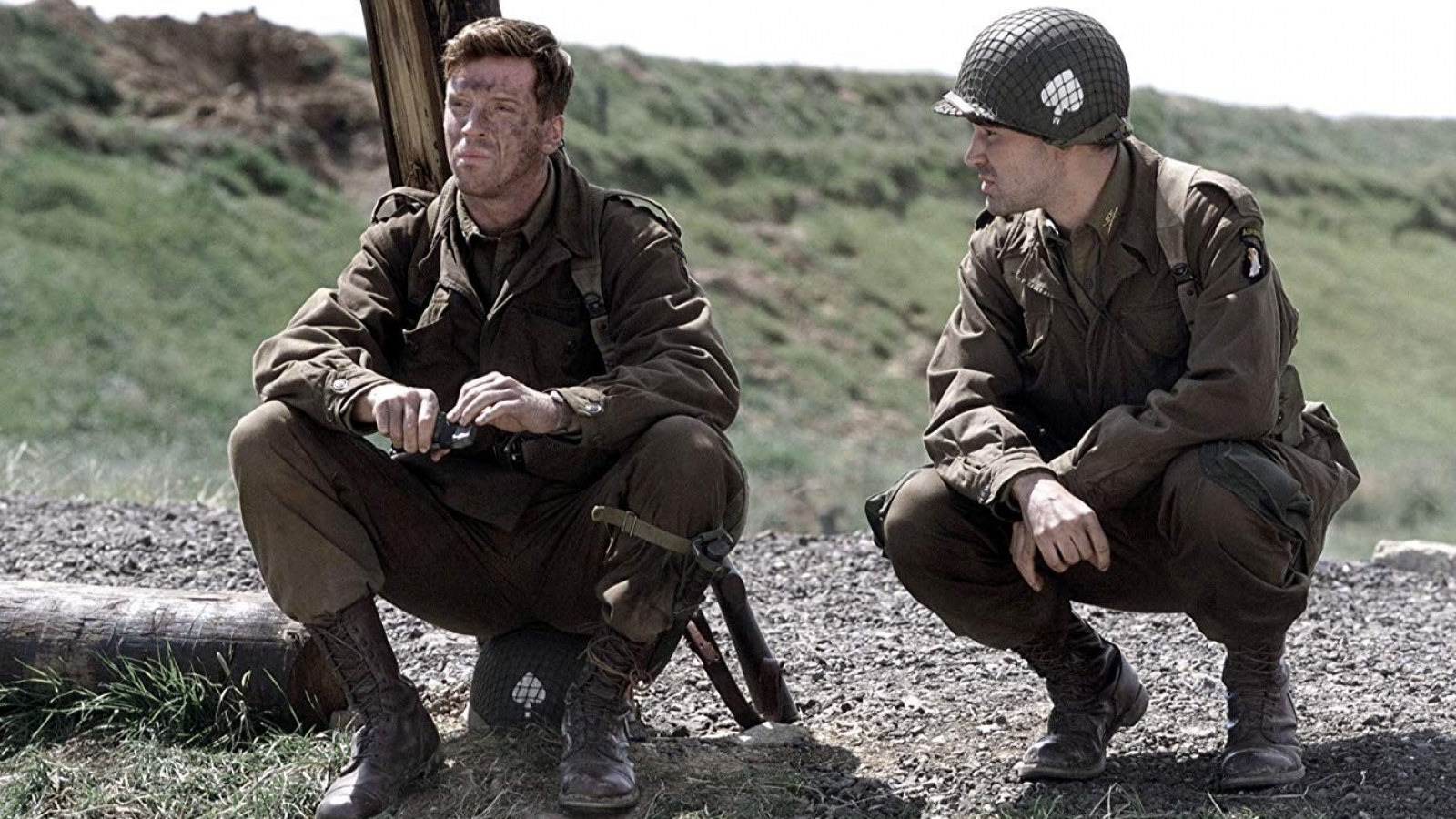
Kicking around Band of Brothers


We broke out the HBO miniseries Band of Brothers over Memorial Day week.  We allowed our youngest (now going on 14) to watch it for the first time.  We typically kept our kids from watching intense shows, expletive laden shows, overly violent shows, or similar until they hit an appropriate age.  And we don't watch movies with explicit sex scenes, no matter what the age. When they ask to see something like The Terminator or even Platoon (there are, after all, varying degrees of expletives) we tell them once they're old enough, they're free to watch them - on their own.  

But Band of Brothers is a triumph of television that should not be denied him.  It's quite frankly one of the best miniseries ever produced.  It's also one of the best war films put on screen.  Yes, it's Hollywood.  And you have to account for that.  After seeing a prescreening, Major Richard Winters expressed disappointment in the series.  He told Tom Hanks that he was hoping for more authenticity and accuracy.  He said at one point they had the men standing around with their helmets off!  No way a soldier with even a brain cell would do that in that setting!   Hanks responded that he knows, but this is Hollywood, not reality.  They had the helmets off so the audience could see the different characters.  Just like they left the 101st insignia on during the Bastogne segments, even though historically Eisenhower had ordered them removed so the Germans wouldn't know they were up against an elite unit.  You have to account for the audience.  Instead, Hanks told him most Hollywood productions teeter around 12% accuracy.  Band of Brothers was shooting for about 17% accuracy, which would make it legendary as one of the most accurate productions ever made. 

With that in mind, it succeeds gloriously.  Coming in the wake of Saving Private Ryan, the movie that brought World War II out of mothball and gave it the full, modern Hollywood treatment, BoB was based on Stephen Ambrose's book of the same name.  It wasn't really a history book per se, but mostly a collection of memoirs, anecdotes, stories and recollections of the men from Easy Company, 506th Parachute Infantry Regiment, of the 101st Airborne Division.  On the whole, with your usual embellishments and dramatic license, the series attempted to stay as close to the stories as possible, and did so admirably. 

Like the 1962 movie The Longest Day, a casting call went out in Hollywood and around the world for any male actor under about the age of 30.  A string of young actors just starting out, but later achieving stardom in their own right, was brough into the series.  Ron Livingston from Office Space (Cpt. Lewis Nixon) and David Schwimmer of the TV Show Friends (Cpt. Sobel) were the biggest names.  Other names like Damien Lewis, Jimmy Fallon, Tom Hardy, and James McAvoy would eventually come into their own.

The casting was famously based on appearance.  Rather than acting skills, the casting director tried to find actors who looked similar to the veterans in question.  And in a brilliant twist that has seldom seen its like before or since, the series included interviews with the actual veterans themselves.  Before (or after) the credits, different Easy Company vets are interviewed about the theme of the respective episode.  Their names are avoided, so the audience won't know who did or, sadly, who didn't make it. 

As an aside, I must say that when we watched the interviews with the vets for the first time, we immediately and correctly identified Richard Winters.  Without being told who is who, you know he's Winters.  Even as an elderly man, he had that 'it' factor, that something about him that said 'here is a leader of men, you can tell.'  

Dale Dye was brought in to do his famous Dye Boot Camp for Actors that changed the way war movies are made.  For his 1986 Vietnam war semi-biopic Platoon, Oliver Stone said he was tired of seeing movies where the actors clearly had no clue about being a solider, much less being in combat.  He looked up Vietnam War veteran and Marine Correspondent Dale Dye, who had been trying to improve productions in that area.  The two worked together and ended up putting the cast of Platoon through a couple weeks of a basic training crash course.  Dye drilled them like they were army recruits so they would demonstrate a more realistic performance as combat soldiers.   

Dye brought the same to BoB (as he did Saving Private Ryan), but by now more refined and well honed.  He also turned in a fine performance as Colonel Sink, CO of the 506th PIR.  Stone once recalled how, during filming of Platoon, they needed a company commander.  He asked Dye if he could do the job.  Veteran though he was, Dye nonetheless buckled and said he could handle anything - but not being on film!  Stone pushed back and said just be yourself.  You're you, in war with two squabbling sergeants.  Just do what you would do.  Dye did the job and did it admirably (and, FWIW, provided what I think is the single greatest 'commentary' for a movie DVD I've ever seen).  Since then I'd say Dye has warmed up to the camera quite well. 

When Band of Brothers first aired, it was on the eve of the 9/11 attacks.  The timing couldn't have been better for the series.  Many Americans were already taken by Saving Private Ryan,  since it showed a whole new generation that WW2 was a real war, every bit as horrible as Vietnam.  Then came that momentary burst of patriotism, in which BoB rode the waves to endless accolades, awards, and financial success.  

Of course that, like so many things, is ancient history.  By now all of the men who served in Easy Company have passed.  The country that so adored the production in 2001 has turned its back on almost everything they fought for.  Many young people today (you can find their reviews) revile the series as proof of America as the racist Nazi state it was, owing to the lack of minorities (the various soldiers of Polish or Italian or other descent not counting, since now anyone born west of the Urals is merely 'white').  

A follow up series, a sort of Band of Brothers in the Pacific, failed to resonate.  Politically correct pressure on not showing Japan for what it was, trying to equate the US to the Japanese Empire, as well as being based on fictional storylines rather than actual events, all caused the series to fall short.

But for the briefest of moments, after almost two decades of being overlooked, the WWII generation came back into their own.  For a brief time, they were celebrities again.  For a time that war and those who fought it were remembered and applauded.  Yes, already the press was beginning to insist we remember the segregation, the racism, the evils of America rather than look starry eyed at this series.  Nonetheless, most people watched in awe and realized that, somewhere along the line, we lost something good from what that generation brought to the table. 

Frank John Hughes, who played "Wild" Bill Guarnere, once talked about a day when the vets arrived on set.  Hanks said he wanted the vets in question to have some input in the series, and to make their presence known.  Hughes said they were notified the vets would be arriving, and were waiting for them.  When they arrived, Bill Guarnere got out of the vehicle, and hobbled forward, his leg missing from that artillery shell during the Ardennes Offensive.  Hughes said that hit him like a ton of bricks.  To see Guarnere walking forward as if it was nothing, missing a leg, and greeting him like an old friend, took his breath away.  In fact Hughes, like many of the actors, became lifelong friends of the veterans, especially those they played in the series.  Some of the actors have become advocates for veterans and the military since then. 

Again, different time and different world.  Nonetheless, we watched the series for the first time in years.  As my sons have said, it's a bit rough watching, knowing the country they sacrificed for is on its way out.  Still, it's a good reminder.  It's also a good watch.  So good that I decided to list my favorite episodes from worst to best.  Mind you, by worst I mean worst in the sense of the worst Mozart symphony.  A relative measure to be sure.  The worst episode here flies miles above most Hollywood production today, if not ever.  Nonetheless, as with any series, some are better than others.  The following is my list leading to the best of them all, which is a way of saying one of the best war productions ever filmed.  

Like most of my lists, it is entirely subjective, which means most likely correct. So from least to best: 

#10. Episode 4 - Replacements
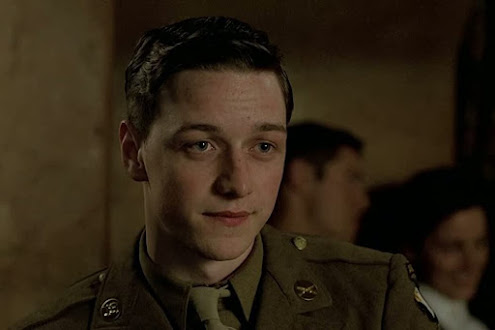
James McAvoy as replacement Pvt. James Miller (KIA)

The weakest of the episodes in my opinion. I think because it tried to do too many things.  The title of the episode suggests it's about those replacements coming into the unit throughout the war and trying to fit in.  Most of the pre-episode veterans' interviews discuss their experience with this.  It is told by both vets who were brash, starry eyed replacements and the veterans who, as one says, got to the point where they didn't want to get close to the replacements because they didn't want to see them killed.  James McAvoy, as Pvt. Miller, is the token 'here's what we mean' character for the episode.  Nonetheless, the episode spends only a portion of its time focused on this angle.  It also tries to give a sweeping bird's eye view of the 101st's part in the failed Market-Garden campaign, one of the great Allied blunders in WW2 (though my son disputes that assessment).  And then, to add to the list, it decides to make one of the veterans - "Bull" Randleman - a focal point, giving about a quarter of the story to his exploits when caught behind enemy lines.  As some critics pointed out, Winters was clear that Randleman was hands down the best soldier in the company.  Nonetheless, that doesn't necessarily mean that, on his own, he would be the most interesting.  Plus the fighting in the episode, while based loosely on their exploits in and around the town of  Nuenen, comes off as a bit generic.  That is, the pieces are all there, but unlike other battles filmed in the series, you get the impression it's not a step-by-step retelling.  At the end of the day, this suffers from wanting to do too much with too little time.  Had it been over two episodes it might have been better.  Nothing horrible, just not enough and too much at the same time. 

#9. Episode 1 - Currahee
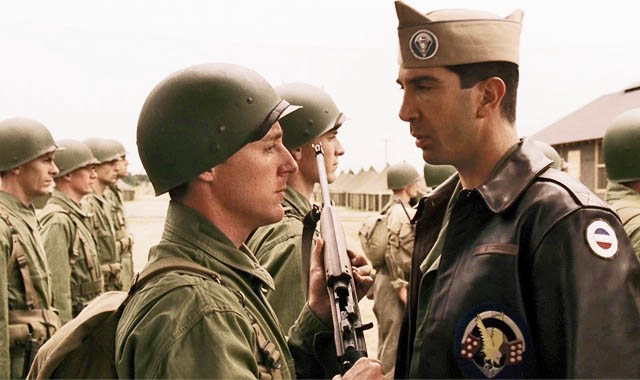
David Schwimmer as Lt. Sobel dresses down Pvt Malarkey (Scott Grimes)

This is the introduction episode.  If you've seen one 'boot camp' segment in a  movie, you've seen them all.  Many of the vignettes come from stories told by the veterans, such as the bumbling of their CO during maneuvers, the practical joke involving an English cattle farm, the court-martial of Dick Winters, and the CO's trick of serving spaghetti for lunch only to break in and send everyone out on a vomit inducing run.  You have dozens of characters thrown at you, and it requires multiple viewings before you sort them out.  You are introduced to Dick Winters (played by Damien Lewis), who Hanks and Spielberg agreed would be the one much needed focal character of the series.  Winters is a significant character in Ambrose's book, though hardly the only focus, or even the main focus.  Having read the book after watching series, in fact, I was taken by how Winters was often merely one source of many.  In the television series, however, he was chosen because, as a leader, the emphasis would make sense to the audience. Plus, as Tom Hanks said, they knew nobody in Easy Company would object to Winters getting the attention, as he was much loved and admired by his men.  Ambrose agreed, saying that to the men of Company E, Winters was like unto a god.  You also meet their commanding officer during basic training, Herbert Sobel.  The Sobel family objected to the portrayal of him, but the vets all held firm that in this case the portrayal was fair.  Winters himself said that Sobel was the worst type of commander, a petty and vindictive fellow who seemed to get his kicks bullying the recruits.  While he was good with basic physical training, he proved poor with tactics.  Hence his real life transfer before the D-Day invasion.  The only good point about him, per the veterans, was that almost every man in some way owed their survival to Sobel (played against type by Friends alumnus David Schwimmer).  After all, he put them through hell and, what's more, got them to go above and beyond if for no other reason than to 'stick it to Sobel'.  The episode wraps up on the eve of the airborne assault on Normandy, the night before the amphibious landings.  

In one of the more telling scenes, right before they board their planes to fly into action, one of the men - Pvt. Guarnerr - accidently discovers his brother was killed in action in Italy.  According to those around him who remembered the story, his reaction was pretty much as portrayed in the show.  He said he hated it for his mom, but then said it's time to go and get the job done.  Perhaps that old Victorian stoicism wasn't always pure Christian morality, but I can't help but think we lost something in that level of grit, and have gone way far in the opposite direction these days. 

#8. Episode 10 - Points
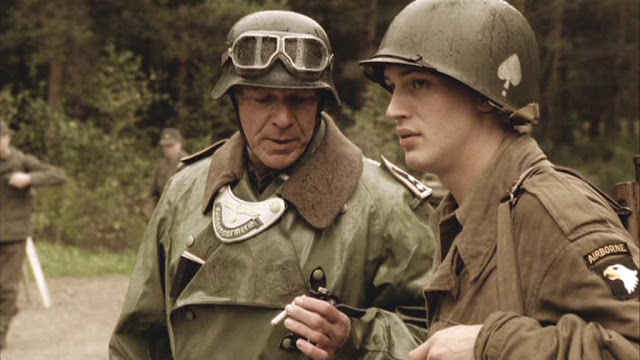
Pvt. John Janovich (KIA) fraternizes with the enemy after the end of hostilities

This is the wrap-up episode.  It is only after this episode ends that you are shown the names of the actual veterans who were interviewed through the series.  Not all of them.  Mostly just the veterans whose characters were shown in the majority of episodes.  The episode itself merely strings together a series of stories and events into a vague 'winding things down' plotline.  The instance in which a drunken American soldier shoots one of the men in the Company, and how that drunken soldiers is 'dealt with' is the high point.  Otherwise it's seeing this person transferred here, that person going home there, and generally mopping things up.  Though one constant is the fear the men have of being transferred to the Pacific; a fear that loomed large in those final months.  Another theme is how, even after hostilities cease, accidents did happen, as the soldier who was shot demonstrated, or another dying in a car accident.  At the end, the war is over and we're treated to a sort of 'where are they now' narration from Lewis as Winters. Perhaps the high point of the episode was a decision that would not happen today.  To give the obligatory 'this is what the whole series is about' speech, focusing on the 'Band of Brothers' ideal, Spielberg chose to use a German general (played by German actor Wolf Kahler, most famous to Americans as Colonel Dietrich in Raiders of the Lost Ark).  The American characters watch as he addresses his defeated troops, and speaks of all that they should take with them from this bond they have developed as combat veterans.  Again, wouldn't happen today, choosing a German in WW2 to make that point.  But in 2001, finding ways to come together and reconcile was still a thing.  

As a side note, Ambrose observed that a great number of the E Company vets, in the years following the war, took up jobs in one of two general categories.  They either turned to professions that dealt with serving or helping people, or they got jobs in agriculture, architecture, construction, or similar. That is, jobs that built and grew things, or helped others.  As if, without saying it or planning it, they instinctively sought out livings that would offset their youth that was spent among unimaginable death and destruction.  Sometimes I think our obsession with mental health has people being pushed along when, if we just stand back, we might see people will find ways to overcome.  

#7. Episode 9 - Why We Fight 
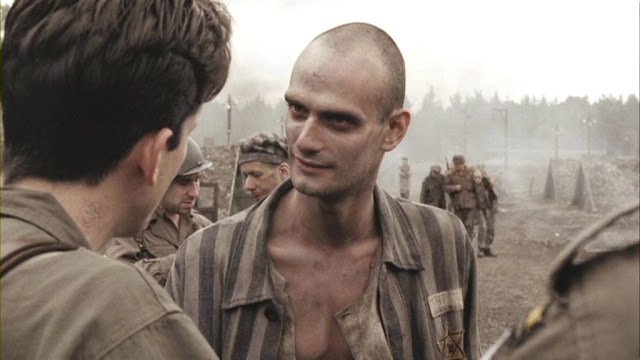
"Are you criminals?  Nein! Nein. Nein ... Juden."

The most somber of the episodes, it is the 'Holocaust' episode.  This is the most artistic, symbolic episode, and also the one that ignored the vets' requests not to have a gratuitous sex scene.  If I may unpack that a bit.  When Hanks went to Spielberg about doing BoB, he said he wanted the vets to have at least some input.  Early on, he asked what they would like to see in a series that they didn't see in Saving Private Ryan.  There were three things according to Hanks: 1) Please don't act like nobody smoked in 1944.  Whatever the modern sensitives, not showing cigarettes as the gold standard of trade that they were is grossly inaccurate. 2) Please no gratuitous sex scenes.  They'd like to watch this with the grandkids.  Finally 3), could they cut down on the cussing.  Hanks recalled responding with some skepticism, assuring them that people cussed back then.  To which, according to Hanks, they responded that 'yes they cussed - but not like that!' (referring to the endless barrage of vulgarities and pornographic expletives in Saving Private Ryan).  Winters would say in his memoirs that the cussing was most common at basic training, when the young men were away from home for the first time.  But then, said Winters, they grew up.  Sure there was cussing, but it wasn't the dominant form of communications that modern movies suggest. Winters himself said he didn't cuss, not because of some religious objection - though he was religious and, despite being only alluded to in the series, spent most Sundays in church.  He avoided cussing because he knew if he did cuss to drive home a point, it caught the men's attention (sort of like Patton - if they all swore like in SPR, then Patton's famous speeches would have been closer to Mary Poppins).  Nonetheless, this is the episode where it had to fulfill the HBO sex scene obligation.  

The overall episode cuts several corners and, quite frankly, moves events around to have E. Company arrive at a Nazi death camp in a way that fit with the theme and symbolism.  Much of it is therefore 'generic' or fictionalized, with much less taken verbatim from the sources.  Winters' best friend Nixon  (played well by Ron Livingston), who was with battalion (and briefly regimental) intelligence, is the key figure here.  He is shown as a broken man with family problems, drinking problems, a recent demotion, and a low appraisal of himself.  This depression is kicked off by a real event in which Nixon was in a parachute drop with another unit, being one of a couple who survived when the plane was hit.  At one point he stumbles into an opulent home looking for alcohol, only to be confronted by a contemptuous woman, the wife of a deceased German general, who stares him down.  Later, as the citizens are ordered to clear out the bodies from the horror of the death camp, Nixon walks along and sees the same woman dragging the dead out of a mass burial pit.  This time she looks up with shame at Nixon.  Symbolic stuff.  In a purposefully ironic twist, the interviews with the real vets focus on how those vets realized most German soldiers were just kids, doing their jobs.  The evil wasn't them. In fact, as one vet says, in other circumstances they might have been good friends. Wow.  Not the mentality today. Told in flashback, the episode is bookended by the soldiers of E Company listening to some Germans playing in an impromptu string quartet amidst the bombed out rubble of their town.  At the end, Nixon lets the men know that Hitler is dead from suicide.  Pvt. Webster responds that Hitler should have killed himself three years ago.  And in one of the most poignantly gut wrenching lines of the series, Nixon merely shrugs and says 'Yeah, he should have.  But he didn't', then turns and walks away. Such a pithy statement with so many ramifications.  

As a side note, the ongoing joke about Nixon and his obsession with the scotch whisky Vat 69 was true.  Based on the other vets, Nixon was a clever scrounger, and no matter where they were, he always seemed  magically able to produce his favorite drink when needed.  It would be years before he beat his alcohol problem.

#6. Episode 7 - Breaking Point

"Buck" Compton (Neil McDonough) falls apart.  Some in Easy Co. said it was merely trench foot

The second of the two episodes dedicated to the siege of Bastogne.  The focus in this episode is men being pushed to the brink because of the horrors of war.  You also cash in your dramatic chips in that several of the main characters we have followed meet their ends here.  Either they are permanently wounded, or killed.   Sgt. Carwood Lipton, played brilliantly by Donnie Walberg, is the focal point, and he also provides the narration.  The narration is based on Lipton's  own memoirs, with license.  He's the man of the hour and the one who keeps things held together.  That's because as soldiers die and artillery barrages fill the woods and some men are pushed to the brink, the constant question is 'Where is Dike?' That's Lt. Dike, E. Company's replacement CO.  This is one of the more controversial parts of the series.  In the book, when mentioned, it's clear that Dike and the men of E. Company did not hit it off.  Lipton in particular was rather scathing in his assessment of Dike as 'an empty suit.'  But in real life, Dike was a capable soldier who had already earned two bronze stars, in addition to other citations, for bravery and leadership.  When the company attacked the town of Foy, it shows Dike having a complete breakdown and being replaced by Lt. Speirs.  Some, however, say he was hit during the attack and stopped only because of that.  There was no such breakdown.  Most men of E. Company, however, say he fell apart under pressure.  In any event, his decision to halt the attack - agreed upon by all witnesses - was a disaster and almost cost the battle.  The episode gives the impression that Dike died in the battle.  Instead, he continued to serve until the end of hostilities, and served in Korea with distinction, eventually making Lt. Colonel.  Why the difference in perspectives?  That's history for you.  It could just be he had a particular style, one that the tight (and at times full of themselves) men of the 101st did not warm to.  

It's also worth noting from a production standpoint that the scenes from this episode were filmed first.  As a result, to be brutally honest, some of the performances weren't quite honed yet.  Some of the actors were still 'getting into their characters.'  Plus, several of the actors were British, including Damien Lewis as Winters.  And it shows.  In a few scenes they are still working out their American accents, and their line delivery is a bit stilted.  It doesn't last long, and in other scenes in the episode it's much smoother.  Nonetheless, there is a certain 'learning curve' that you can detect, especially upon subsequent viewings.  One of my sons said, however, you might be able to excuse the line delivery since it was supposed to be Bastogne, in freezing weather, and anyone would sound a bit off in that case. 

#5. Episode 8 - The Last Patrol

Compare Sgt. Malarkey to his earlier picture - the price of war

The follow up to the Bastogne episodes, this shows the futility of war, the general waste and, sometimes, shallow reasons for decision making.  In short, the men are being asked to go on patrol and seize German prisoners for questioning.  The problem - per the series - is that this is being done so that Col. Sink, their regimental commander (Dale Dye), can brag to his buddies.  A cost too big to pay for bragging.  You're introduced to a Lt. Jones (play by Hanks' son Colin Hanks), and reintroduced to Pvt. Webber (Eion Bailey).  Webber was a Harvard man.  Per the memories of those in Easy Company, he was a fine soldier.  He did anything you asked of him - but no more.  He was said to be a bit aloof and often distant owing to his Harvard pedigree.  Years later he was lost in a boating accident.  His own memoirs, however, were plumbed heavily by Ambrose for his book.  In this episode, he returns from being wounded in Holland, only to get the cold shoulder from the others.  Why?  He was with them from the beginning, jumped on D-Day and fought in Market Garden.  Ah, but he wasn't at Bastogne, and that's the star on the belly versus no star on the belly distinction.  Only by the end of the episode, after he goes on patrol (Easy Company's last combat mission of the war), does he earn his way back into their good graces.  Altogether a tight episode, enough action, but more focus on characters, and their changes over the course of the war.  As a note, the character of Pvt. Cobb was, per Winters, given a bad spin.  In the series he's the token 'jerk', the one who insults, puts down, and generally spouts off obnoxious dribble, while being nowhere as good as he thinks he is.  Winters admitted that, when he drank, Cobb could be a bit abrasive.  But overall, Winters corrected the idea that he was always like that.   He also added that,  again in Winters' opinion, he was one of the better soldiers in the outfit.   

I must admit I also personally liked the episode because it showed what my dad used to say about being in the army.  Especially what did and didn't get you in good graces of your peers.  At one point Webster goes to Lt. Spiers and objects to being put on the patrol as a translator.  After all, Joseph Liebgott is on the patrol and Liebgott knows German.  Plus there was only supposed to be fifteen, and Webster makes sixteen on the patrol. Why do they need Webster?  Without missing a beat, Lt. Spiers looks a Liebgott and asks if Liebgott would like to sit this one out.  At which point Liebgott winks at Webster and says thanks.  Not what Webster meant.  I remember my dad saying that in the army there was little patience for those who tried to get out of things by hoisting them on others. 

#4. Episode 5 - Crossroads

Their chemistry (as Winters and Nixon)  was wonderful as best friends who experienced the war differently

Another 'it really happened' episode based upon a celebrated encounter between an outnumbered Winters and his men versus a much larger German force.  This one also focuses on Dick Winters and, as can be expected, was his least favorite episode.  He called it silly.  He also strongly objected to the scene that has him gun down an unarmed sentry possessing a cherubic face.  His report stated clearly that the engagement was with an older, armed veteran.  Winters said he never would have gunned down an unarmed man like that.  Plus the episode has Winters experiencing a form of PTSD while on 48 hour leave in Paris.  Winters stated you didn't have PTSD on 48 hour leave.  That wasn't enough time.  You had to be away from combat for a longer time before the visions and the unwanted memories start up.  The actual engagement, in which Winters and a handful of his company destroy two SS infantry companies, is pretty much shown as it happened.  The combat scenes in the series are at their best when they simply take what happened and show it.  Despite Winters' own misgivings, it is a well written episode, and one that zeroes in on more than just 'soldier in a combat setting.'  The story actually sets up Winters as the brilliant tactical leader who is promoted, and then inundated with the boredom of administrative leadership.  The episode opens, in fact, with Winters getting chewed out for not having his reports done on time.  The combat at the crossroads is told in flashback as Winters struggles to put things down on paper.  In other words, great men are not always great at everything.  This is driven home later when, according to real events, the new commander of E Company is accidently shot by a nervous US sentry.  When 'Doc' Roe the medic shows up, he asks if the man has been given morphine.  Winters and his friend Lt. Welsh respond that he has, but they can't recall how much.  At that point the medic rips into them for being irresponsible, as Winters can only display an understandable level of self-reproachment from yet another dressing down.  It's after this that Winters goes on his brief 'fish out of water' R&R in Paris, returning just in time before the episode sets up the events that will lead the 101st to their rendezvous with destiny at Bastogne.  

#3. Episode 6 - Bastogne
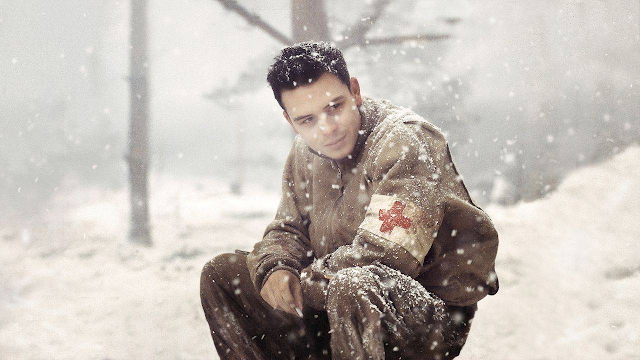
Awaiting the cry for a medic.  It didn't hurt that actor Shane Taylor as 'Doc' Roe bears an uncanny resemblance to my late uncle.

I have a soft spot for this episode.  My uncle - my dad's brother - was a medic with Patton's 3rd Army.  That's the one that broke through the German lines around Bastogne and relieved the 101st, despite what the men of Easy Company insist.  We had no way of knowing what he experienced since he, like most combat veterans in my family, spent little to no time discussing his experiences.  In this episode, it focuses on one of the company's medics, Eugene 'Doc' Roe.  According to the veterans, the most important men in the company were the chaplains (shockingly not given much screen time) and the medics.  This episode shows the horrible wringer that a combat medic would be put through, as he must wait while men he has gotten to know get shot, hit, and otherwise wounded - sometimes mortally - and only then hope he has the abilities to save them.  Throughout the episode he returns to Bastogne at times to deliver the seriously wounded to a makeshift hospital.  There he meets two young women, one Belgium and one Congolese, who are nurses.  Contrary to what some viewers imagined, the two nurses were historical figures, not fictional.  Whether Roe actually met them in real life or not is unknown, and their interactions purely the result of the writers' imaginations.  But it allows Roe to reflect on his experiences, and to hear an outsider's view of things as well.  The slow unraveling that Roe goes through as the pressures mount and the horrors compound is brilliantly done.  By the end, it shows Winters' leadership ability when he sees Roe possess the famous 'thousand yard stare' of combat, and tells Roe to go back to Bastogne to get some rest.  But there is no rest for the medic as the wounded and dying are all around.  The episode tries to show the bitter cold, the lack of supplies and rations, and the general misery of the experience as best it can.  And, unlike most war productions, chooses a man outside of an armed combat role to illustrate the theme.  It is a bit better, and more focused then the second episode dealing with Bastogne (see #6 above). 

#2. Episode 3 - Carentan.  

British actor Mark Warren as Pvt. Albert Blithe, who did not die in 1948

When this episode first aired, it was preceded by a warning that the following depicted in brutal filmmaking the horrors of modern, industrial war.  And it wasn't kidding.  Though the results of battle are seen in many episodes, it is here where you see the actual carnage as it happens.  Like no other episode, you see the injuries, the horrible wounds, and the fatalities as they happen and how they happen.  For instance, you get to see graphically the dangers of fighting alongside tanks.  The episode focuses on a character who doesn't appear in any significant way in any other episode - Pvt. Blithe.  It opens with him in a state of shock following the initial airdrop into Normandy. Finally he falls back in as we're walked through the days following the Normandy landings.  Eventually the 101st will come upon the important town of Carentan.  It is here that the 101st got its first big baptism by fire.  They were called upon to attack a defended town, and paid for their effort with many casualties as a result.  The episode stays focused on Blithe, with some poetic license meant to trace the arc that develops from Blithe as stunned, overwhelmed novice to Blithe, seasoned veteran following the battle to take Carentan.  He eventually is wounded, and the text after the episode says he died of his wounds in 1948.  In one of many corrections following the series, it was reported by his family that he did no such thing, but lived until the late 60s (though he never did fully recover from his wounds).  

One of the most celebrated scenes in the whole series happens at the end of this episode.  Back in England, one of the men, Sgt. Malarky, goes to a local woman who does many of the soldiers' laundry for them.  It's one of those scenes that has much unstated buckshot to it.  From the woman asking if he would like to join her for 'a cup of tea', to him politely declining, then catching himself in mid-cussword and reverting to his polite manners, to her asking  him at least to help with the laundry that has been left behind - by the men who died over D-Day -  it puts much into little.  It's good writing, as is most of the episode, and could almost be considered the best of the list.  

#1. Episode 2 - Day of Days
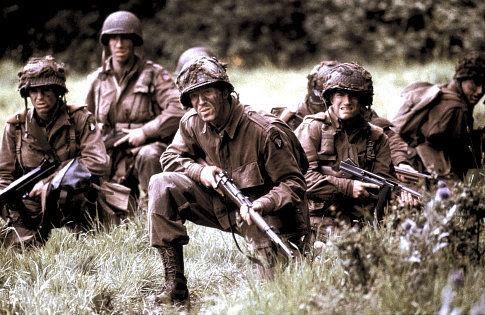
Winters prepares to lead his men in the much lauded (and improvised) attack on German artillery on D-Day

The shortest of the episodes, it is the best because it simply says 'this is what happened.'  Of all the episodes it leans most heavily on the accounts of the men with as little embellishment as possible.  Not that it doesn't combine characters or cut corners, but it's done with an eye dropper if it's done at all.  The episode throws you into the fray, literally taking up where the first episode left off.  Suddenly you're in the planes with the troops ready to jump, with the chaos, explosions, death and confusion that resulted.  It's as intense and nail biting as anything in Saving Private Ryan.  You don't have time to take a breath until the next day with sunlight and the coming of the seaborn invasion.  In one embellishment, it sets up the big mystery about whether or not Lt. Speirs (played by Matthew Settle) actually killed several German prisoners.  That was a real thing, and he was under investigation when the officer in charge of the investigation was killed in action, and the case never picked up again.  Contrary to modern imagining, you weren't allowed to just gun down prisoners willy-nilly back then.  The series jumps on this and uses it as an ongoing storyline a bit more than it was in real life.  Again, Hollywood.  Nonetheless, when it comes to Winters and his men taking out the German artillery battery at Brecourt Manor, it is filmed with near documentary style accuracy.  With only a few embellishments and cutting down for time, it walks the audience through how it was done.  It shows their first true encounter with a German position, and how its effected those involved.  A major focal point is how the men fought to avoid being taken away, even when wounded, because they didn't want to let their fellow infantrymen down.  No cry-rooms or snowflakes here.  It also continues the focus on Winters, and walks along with him until the end.  At that stage, the night of D-Day, Lewis quotes Winters' original promise to himself and to God that if he survives the war, he will get a piece of land somewhere, and live the rest of his life in peace. A promise that Winters, in his post-war years, kept. 
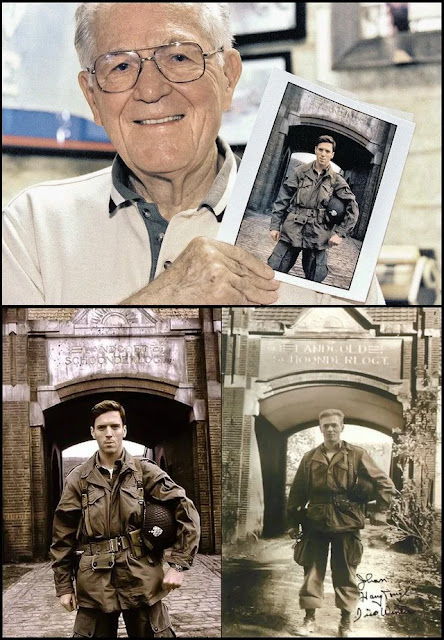
RIP Richard Winters (1918-2011) and all the veterans, and thank you.