Showing posts sorted by relevance for query hobbit. Sort by date Show all posts

Friday, November 27, 2015

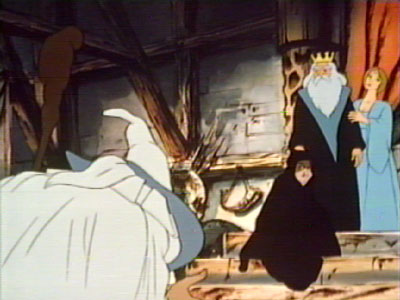
Why 1977's The Hobbit is still the best

At least in my opinion.  As I said here, I consider the 1977 Rankin/Bass version of The Hobbit to be the best screen adaptation of Tolkien's works.  Since we had our annual watching of the version last night, complete with homemade mulled cider and pumpkin and dutch apple pies (again, homemade), it got me to thinking, without any real research to back it up, just why I still prefer this to any other version yet made (not that I hate the others, I simply think this the best effort to date).

1. The Talent

Not that other adaptations haven't had talent, especially Jackson's versions.  But Jackson has an incorrigible knack for making sow's ears out of silk purses.  Take for instance the inestimable voice of Benedict Cumberbatch.  No wonder he would be cast for Smaug, the real climax of The Hobbit story.  And yet, what does Jackson do?  Spin it through layers and layers of electronic and digital remixing so as to render his distinctive voice almost unrecognizable.  So why have him?  Just to say you have him?  In contrast, Rankin and Bass got gravely voiced Richard Boone to be Smaug, and Boone nails him perfectly.  Just like Alfred Molina was able to emote in Spiderman 2 in a way the talented Willem Dafoe was not in the first Spiderman, so Boone is able to put just the right amount of sneering and arrogance into Smaug that Cumberbatch was unable to convey through the computerized masking Jackson demanded.

The rest of the cast of The Hobbit can't be ignored.  The great John Huston, who could have been Gandalf in live action, provides the narration as well as the voice of Gandalf.  Hans Conried, known to most as the voice of Captain Hook in Disney's classic Peter Pan, is Thorin.  The usual cast of Rankin/Bass faithfuls are also present, lending their expertise.  But where Jackson could sometimes waste the talent, or the production compromises the talent (as in Bakshi), the Rankin/Bass production allows the talent to shine.  Even Otto Preminger, cast as the Elven King, lends a special spin to the scenes.  With talent like that used correctly, you can't go wrong.

2. The Background Art


Tolkien was no mean artist in his own right.  And if you've seen the artistic vision he had for Middle Earth, you can see how Ranking/Bass is far closer to the mind of Tolkien than other versions, especially the sweeping, CGI post-Death Star, imaging of Jackson's two trilogies.   The choice of a water color base for the background captures much of the Middle Earth feel, much less the feel of a pre-modern, antiquated world that Middle Earth evokes in the first place.

3. The story


No film adaptation of a book can be just like the book.  It's not expected.  But the changes should enhance the story, or be at least as good.  The 1931 Dracula, starring Bela Lugosi, is based on the stage play of Dracula, not the book.  Kubrick's The Shining bears scant resemblance to King's book of the same name.  Even King's authorized mini-series changes things up.  But the changes must be for the good, or better, or at least take advantage of the medium.  So Puzo's The Godfather, a light porn novel with occasional mob themes, is transformed into a sweeping crime family opera by Coppola.  And the high point at the end of the film, the assassination of the heads of the Five Families, is done to perfection utilization the editing capabilities of film, versus the chapter by chapter account of the book.

So no Tolkien adaptation can be what the books are.  But they should be at least as good, or make sense.  Bakshi stripped away much of the story of the first two books and left us with a bare branch arrow shooting right across the basic story arc.  While much was missing, most of what was there still held to the essence of the books.  Jackson, of course, wanted to show the world what Tolkien should have written, and almost each time he meddles, he makes it worse than better.  Rarely do his embellishments do anything other than add confusion and plot holes, ruining characters or diminishing the impact of scenes in the book.  Great moments, such as the confrontation of the Witch King by Eowyn, or the standoff between Gandalf and the Witch King at the gates of Minas Tirith, are lost on Jackson.  Occasionally Jackson does well, as in the conversation between Frodo and Gandalf in Moria about Bilbo's mercy, or the destruction of the Ring and the flight of Sam and Frodo.  But those are balanced by so many lost or ruined chances on Jackson's part.  And that's the first Trilogy, which is head and shoulders better than the deplorable Hobbit series.

In contrast, given the confines of a 2 hour prime time slot for a cartoon aimed mainly at children, Rankin and Bass keep everything needed to get the plot.  I first saw the cartoon long before I read the book.  And when I read it, I was pleasantly surprised by how close to the story line the cartoon adhered.  Sure, there is no Beorn, and the Arkenstone isn't mentioned.  And the final chapters are condensed to the last few minutes of the cartoon.  But the basic story of Bilbo there and back again is maintained and conveyed.  And that, if you aren't going to reinterpret it artistically with an entirely unique vision, is as good as you can get.

4. The Music

Many decry the music in the R/B The Hobbit for its 70s cartoonish sing-song style.  And yet, that's the charm.  We read The Hobbit in light of the epic The Lord of the Rings.  We forget that The Hobbit was for children.  It was a fairy tale story aimed at young audiences.  Not the sweeping young adult and adult masterpiece sequel of 15 years later.  And in many ways, like the background art, the music seems to capture a feel for the songs and the atmosphere.  I have no way of knowing what kind of music Tolkien would have wanted.  But the songs in R&B's The Hobbit are able to move back and forth from light hearted (Chip the glasses, Where are you going, Heave-ho!), to the heavier (Mountain King returns), to the sinister (Fifteen birds).  And that's not bad.  Often music, when trying to capture 'a feel', keeps the feel across the board, no matter what the style of music or the moment in the story.  And this doesn't count the absolutely out-of-the-ballpark excellent rendition of the dwarven song of the lonely mountain at the beginning.  Partly sung, partly narrated tag-team style between John Huston and Hans Conried, it is the high point of almost all attempts to put Tolkien's songs and poetry into film in any version.  Ever.  And that's not bad for a prime time Rankin/Bass production.  But then, when you have Huston and Conried, what do you expect?

5. The Themes

Where Bakshi and Jackson often fail the greatest is missing the basic themes of the stories.  In his first trilogy, Jackson does at least try to keep some of the basics, such as the importance of Bilbo's mercy.  But by The Hobbit trilogy, Jackson seemed to have thrown out any regard for anything Tolkien had to say.  Bakshi, also seemed to miss overarching themes that Tolkien thought important.  True, the confrontation between Golum and Bilbo in Rankin/Bass misses the emphasis on Bilbo's mercy.  But it was a one-shot deal, and without The Lord of the Rings to follow up with, that could be forgiven.  In the end, Ranking/Bass manages, through its time constraints, to keep the basic three-fold comparisons that are Tolkien's basic plot themes: Bilbo, like all children of the kindly west, like simple things, Thorin covets gold for gold's sake, and Smaug simply guards treasure he has no use for.  In the end, adventure and war may have their place, but it's the wise Hobbit who knows that food and good cheer are what make the world go around.  And in our day and age, just like the 50s, or the 70s, that's not a bad message to remember.


Friday, September 29, 2023

A hobbit's holiday


Last year I posted a rambling about what autumn meant in the olden, agrarian days.  I noted that autumn, when the harvests were good, was a time of great celebration because it meant another year of life.  Of course if the harvests weren't good, autumn would not be as joyful.  

In the post, I quoted from Washington Irving's The Legend of Sleepy Hollow.  It detailed many of the scrumptious vittles that Mr. Crane beheld as he strolled across the Hudson River landscape.  It included not only baked and cooked wares, but also the succulent fruits of the harvest, from pumpkins to apples and everything in between. 

I was thinking on that as I read through The Hobbit this year. As I've said in the past, for the longest time I was never much of a fan of The Hobbit.  I have been a huge fan of The Lord of the Rings since I was in college.  But The Hobbit was part of that broader fantasy and sci-fi genre that has never - to this day - interested me that much.

Nonetheless, it has grown on me over the years.  I've come to appreciate its place in the greater Tolkien canon.  Unlike LoTR, The Hobbit is pure fairy tale.  A children's book  in the best sense, you see some of Tolkien in its pages in ways you might not in his more influential follow up. 

One way was Tolkien unpacking that rural, later Victorian era social setting that finds its way into his Shire.  It's there in Rings, at least at the beginning.  But as more than one literary commentator has pointed out, as the hobbits move from Hobbiton to take part in the greater War of the Ring, they leave that English pastoral setting and enter a vast, sweeping epic tale of mythical heroism.  

In The Hobbit, however, that Victorian setting oozes through the entire narrative.  And one way it raises its head is through Tolkien's emphasis on food.  In The Hobbit, Tolkien lays out what for him must have been standard, and at times coveted, items for a Victorian era menu.  Not only in the Unexpected Party, but nowhere else as much as in that first chapter.  Nor is it to say he never addresses menu items or the contents of a table in Rings.  It's just not quite unpacked to the same level.  

So I thought we could look at the world's first introduction to Middle Earth in The Hobbit.  Below is what I came up with looking at that party menu in Chapter One.  It is the most extensive list of foods that I'm aware of in any of his writings. Here he lets us see what the table should have looked like, at least as Tolkien envisioned it. 

At the unexpected party, before Bilbo meets the dwarves, he is preparing a 'low tea' for Gandalf the wizard.  For us Yanks, we might think that means a mundane, working class tea.  But in one of those linguistic twists in a culture, in Victorian England the 'low tea' was for the upper class.  It was set on a 'low' table, around plush furnishings, with the dainties and the pastries and the fine China we associate with your classic British tea.  The 'high' tea was called that because it was set on the higher tables associated with the working class, the servant class, and others who used higher set tables. Such teas would be for a later time of day, combined with dinner, and accompanied more with cold meats and cheeses and such.  

Close up of a 'beautifully round' seed cake
Anyway, Bilbo's tea is essentially sideswiped by the arrival of two dwarves, rather than Gandalf.  These two, Balin and Dwalin, are offered tea but dismiss the offer and ask instead for seed cakes, along with beer rather than tea.  Bilbo obliges with pints of beer and two 'beautiful round' seed cakes, which he appeared to possess in numbers.  

The other dwarves appear over time, up to the total number of thirteen plus Gandalf.  Fili and Kili arrive and join in and appear to accept what the first two are eating.  Nothing else is mentioned.  When Dori, Nori, Ori, Oin and Gloin arrive, however, we're told they ask for cakes as well, along with a different list of beverages:  ale, porter and even coffee.  

The joke there is that in English parlance, the terms 'ale' and 'porter', are basically two different terms for the beer mentioned above. The only difference is that the 'porter' references what we nowadays call stout, as in Guinness.  The other two terms are interchangeable for ale, as opposed to beers that we call lagers.  Eventually the seed cakes are gone, and they are treated to buttered scones in their place. 

The remaining dwarves finally arrive along with Gandalf and Thorin. It is here you get the biggest list of specific foods and drink.  It is implied they are offered tea again when Gandalf asks if there is anything left, but like the first two dwarves, he responds with a hearty 'no thanks'.  I wonder if that was Tolkien digging at England's most famous beverage based pastime.  Instead Gandalf asks for a little red wine, and Thorin jumps in with his only request by asking for the same. 

The other dwarves in this last arrival then interject a series of specific requests.  Bifur asks for raspberry jam and apple tart, while Bofur asks for mince pies and cheese.  Bombur - who Tolkien repeatedly points out is especially fat - asks for porkpie and salad.  The other dwarves call in through the door and ask for more cakes and ale and coffee.  To this Gandalf adds a request for a few eggs, as well as cold chicken and pickles.  Whether by more cakes they meant more seed cakes, or different types of cakes, isn't said. 

So the whole menu of Bilbo's unexpected party looks a bit like this, based upon what information we are specifically given:

DRINK

·         coffee                                          Various

·         tea*                                             Offered only, never accepted        

·         pint of beer/ale                            Balin and Dwalin

·         ale/porter                                     Various

·         red wine                                      Gandalf and Thorin

MEATS/DAIRY

·         pork­pie                                         Bombur

·         cold chicken                                 Gandalf

·         eggs                                              Gandalf

·         cheese                                           Bofur

VEGGIES/PRODUCE

·         salad                                              Bombur

·         pickles                                           Gandalf

BREADS/PASTERIES        

·         biscuit                                            Bilbo

·         mince pies                                      Bofur

·         apple tart                                        Bifur

·         seed­cakes                                       Balin and Dwalin

·         buttered scones                              Various

·         raspberry jam                                 Bifur

I like that Bombur, the overweight dwarf, asks for porkpies (about the heaviest item on the list) and salad (the lightest).  I can't help but catch a twinkle in Tolkien's eye when he wrote that, and I don't think it was a random accident.   The pickles were a change from the original manuscript.  Apparently it originally read 'cold chicken and tomatoes.'  For some reason, Tolkien decided tomatoes didn't strike that appropriate Victorian/Middle Earth feel, and went for pickles instead. 

A traditional pork pie
So there you have it, at least in terms of the unexpected party.  The menu was what Tolkien no doubt experienced growing up in the English countryside.  With the exception of the red wine, none of it is 'high brow' fare.  In fact, the constant offer of tea by Bilbo, having planned a tea with Gandalf, and the one spread that would have echoed upper class British dining, is all but rejected. 

It's the middle class, working man's favorite foods you see here.  One food historian pointed out that in Leicestershire, there was a product called 'Mowbray Pork Pie' that had been sold since the 1830s, and was very popular through Tolkien's day.  Tolkien may have had those in mind when he has Bombur ask for the same followed by his request for a salad, perhaps to make it look good (a bit like ordering a Big Mac accompanied by a diet soda). 

So there you have it.  The introductory feast for first time visitors to Middle Earth. 

Tuesday, December 4, 2012

On my Birthday

I have places to go and people to see, or at least I get to spend an evening tuning out the troubling world and focusing on my so cool family.  In addition to a couple nice gifts (including an old video game Sonic, that I used to play all those years ago when we was fab), a homemade card, and a specially wrapped pencil courtesy of my youngest, my boys also pulled together and got me a small, leather bound pocket copy of The Hobbit.  Including artwork by Tolkien himself.  How cool was that?  After homemade cherry pie by request, my 8th grader suggested we read The Hobbit together as a family   Since we have enough copies of the book, each of us will have a copy, and parts have been divvied out.  The lack of female parts relegated my wife to the sort of character parts that Scout would understand.  I get to be the narrator and Gandalf (naturally), plus a later appearance as Bard.  The boys will divide everything else, with my wife handling the poems and songs. So after watching the classic How the Grinch Stole Christmas with our youngest, once he's in bed, we're going to dive into our own family rendition of The Hobbit, in anticipation of the upcoming Jackson films.

FWIW, if you're ever itching to dine on appropriate hobbit fare, you might want to try this little gem of a website.  It contains references to the foods mentioned in The Hobbit, as well as appropriate recipes.  Yum. And now, it's there and back again and as I bid all a goodnight.  TTFN.

Sunday, April 3, 2016

The best Tolkien Adaptations

1. The Hobbit, Rankin/Bass, 1977

I've written enough on my affection for this version and why I love it.  It's still the best.  It does take away parts from the story.  Any adaptation from book to movie has to drop some things.  But it keeps the heart and flavor of Tolkien's children's book, and keeps it on a children's book level.  Most importantly, it inspired me to want to know more about this fictitious world and the Hobbits therein.  And when I finally read the book, I wasn't disappointed in the cartoon. Instead, I was impressed at how the cartoon captured the feel of the book.  That, among many other reasons, is why I feel it deserves top honors.

2. The Two Towers, Peter Jackson, 2002

This was a tough one.  Some would argue Jackson's first LoTR film was the best.  Certainly it had fewer gross deviations from the books than his later films.  And we all know the hatchet job Jackson did on the character of Faramir, the added scenes with Frodo going to Osgiliath, the plot holes and inconsistencies that arose, the reworking of the bloated Aragorn and Arwen love story, the Theoden cum Exorcist scene, and of course the cringe inducing surfing elf that was a warning for future silliness.   And yet, when Two Towers shined, I feel it did better than the best of the Fellowship.  The scenes with Treebeard, the storming of Isengard, the introduction of Gollum, the retelling of Gandalf's fight with the Balrog, and the Battle of Helms Deep (sans surfing elves) all were better than the best scenes of Fellowship.  Yes, Jackson's annoying tendency to want to out-write Tolkien by the above changes ruined what could have been the best  of any series, but when he actually produced the visions of Tolkien as presented by Tolkien, he ended up with some of the best sequences of Tolkien's works ever put to film.

3. The Fellowship of the Ring, Peter Jackson, 2001

As I said above, this could be number two.  There were fewer deplorable interpolations than Two Towers.  There were fewer places where Jackson stepped in and messed up the story or added illogical plot holes.  Yet he did do so.  The appearance of Arwen, Super Elf, who fears nothing in all of Middle Earth and yet is excluded from the Fellowship, was the most glaring.  Much of the tension and thrill of Frodo's flight before the Nazgul was utterly lost because of that.  Likewise, you had Jackson's inability to simply direct dialogue in several missed opportunities: The Council of Elrond, the first meeting of Strider, the conflict between Biblo and Gandalf.   True, there are times where Jackson let the dialogue shine.  One of the best scenes in any of his films is the conversation between Gandalf and Frodo in the mines of Moria.  It doesn't happen like that in the book, but Jackson shows you can make changes to the book and have them be for the better.  Unfortunately, that is too often the exception rather than the rule for Jackson.  Most of the time, the best Jackson offered was giving a major Hollywood treatment to what fans had imagined for years.  When the final cut was evaluated, the misses ended up outpacing the hits, if only because the hits didn't live up to the potential they could have.  Or live up to the potential of the best hits of The Two Towers.

4. The Lord of the Rings, Ralph Bakshi, 1978

Much maligned by fan boys who worshiped at the altar of Jackson.  Jackson himself breached honesty by first denying that he ever had heard of Bakshi's version, then admitting he had but it had no influence on him, and finally by admitting what we all knew, that his Fellowship movie was based on Bakshi's version, including introductory summary montage of the history of the Rings and the elimination of certain scenes like Tom Bombadil and the Barrow Mounds.  Because of the nature of Fanboydom, that which was once great is often superseded by that which is the latest, hippest.  So Bakshi, who already received mixed reviews upon the film's release, became the brunt of withering assaults and attacks in the early 00s.  Which wasn't fair.  Yes, Bakshi's version is a classic case of studio executives messing up the final product.  See their insistence that the name Saruman be changed to Aruman half way through production for an example.  Also the sudden and abrupt ending pending  a sequel.  In today's prefabricated movie franchises, it's hard to believe that even as late as The Empire Strikes Back, audiences didn't like movies that only set up the next movie rather than wrap up a complete story.  But Bakshi is treated unfairly.  In the end, he also captures Tolkien's feel, albeit in a different way.  His take on the Nazgul as black riders is much better, IMHO, than the horsed army tank versions of Jackson. He keeps the characters in check based upon the book, rather than shift roles around (Gandalf, not Frodo, solves the riddle of the gates of Moria).  And he managed to keep some pretty good dialogue where Jackson often floundered (the meeting with Strider is far superior to Jackson's).  Yes there were artistic decisions and strange choices in envisioning some characters like Boromir or Sam, but after Jackson's beardless beefcake dwarves and elven love stories, we can cut them some slack.  To this day, when I read Fellowship of the Rings, it's John Hurt's Strider as Native Woodsman I envision, not Viggo Mortensen's brooding Grunge Rock ranger.

5. The Return of the King, Rankin/Bass, 1980.  

I realize this is almost scandalous, to place a famously convoluted retelling of Tolkien ahead of Jackson's Return of the King, the same film that swept the Oscars in 2004.  Let's face it, he got the Oscars as a nod to his industry and reshaping the business of Hollywood.  The awards were for all three of his films and the production behind them.  The Rankin/Bass version, on the other hand, has been the target of mockery and outright hatred since its release in 80.  In a strange twist, it was the sequel that Bakshi never made, even though it was really the television sequel to The Hobbit of 77.  That alone sets the stage for confusion.  And despite psychedelic musical numbers, Saturday morning cartoon artwork, and a convoluted timeline that involves dismissing key characters (including the eponymous king) for the sake of drawn out musical sequences, there are some scenes that shine.  Roddy McDowall's Sam is better than either Bakshi's Lou Costello version, or Sean Astin's buddy-from-a-locker-room take.  As I've said before, there actually are some segments that play out better than Jackson's, who has a knack for wasting key scenes on needless swordplay and physical action.  And you had the same voice talent behind the R/B production as their original Hobbit.  It's been said that there were two groups who worked on this special, one dedicated to keeping Tolkien's vision alive, and one dedicated to producing a kid's cartoon for prime time television.  Watch it once with that idea in mind, and it will make all the difference.

6. The Return of the King, Peter Jackson, 2003

I know, in overall quality it is far better than the above Rankin/Bass version.  And there are some wonderful parts, the best probably being Frodo and Sam's flight from Mount Doom after the destruction of the Ring.  But there were so many lost opportunities as Jackson began to define himself as the director who just wont' stop directing.  By the end of the bloated Battle of the Pelennor Fields, I didn't care who won, as long as it ended.  His messing with the Frodo/Sam/Gollum story line sacrificed some of the best and most dramatic moments in the novel.  Due to lack of creativity, Shelob is reduced to being nothing other than a big, creepy spider.  His attempt to end the movie with the multiple fade ins and fade outs has become the stuff of legendary humor.  Worse than anything, it was in Return of the King that Jackson did what Lucas did.  When Lucas gave us ewoks, we had no way of knowing he would base his entire series of prequels on the same level of film making that imagined ewoks and levitating droids added quality to the Star Wars franchise.  So Jackson took surfing elves (an attempt to one-up the awesome sequence of Legolas fighting Orcs at the close of Fellowship), and based most of his final movie (and subsequent Hobbit Films) on that same mentality: over directing, over the top stunts, over the top effects, over the top acting, kindergarten level humor, and Elijah Woods' ongoing attempt to have more than three facial expressions.  In the end, some changes were good.  Just like Aragorn slicing the head off of an unsuspecting opponent during parley, however, many of the differences were changed at the expense of the heart and soul of Tolkien's works.  And that is why, for me at least, it ends up at the near bottom of the list.  But not the bottom.

7-9. The Hobbit Franchise, Peter Jackson, 2012-2014

In all fairness, I only watched the first of Jackson's cinematic trash heaps that would become the Hobbit series.  In many ways, Jackson's series seems to have single-handily gone toward diminishing the affection and desire for Tolkien's works more than anything else in the last 50 years.  In addition to the liberal inquisition in which anyone who lived more than two decades ago must be condemned as a racist, the fact that Jackson's bloated, celluloid cacophony seems to have driven youngsters away from Hobbits and Middle Earth for good is reason enough to dismiss these endeavors.  Some see the lukewarm reception that the Hobbit movies had as proof of Tolkien's waning influence in our PC age, but it could be just the opposite, that the waning affection for Tolkien is, in addition to the PC witch hunts, the result of people seeing these films and coming away assured that nothing upon which these dumps were based could amount to a good read.  My boys saw the second two, and kept me abreast of their diminished quality, though there was some debate over whether the final movie, having almost nothing to do with the original story by this time, still managed to be better over all.  It's hard to say.  I just know that going into the 00s and Jackson's films, The Lord of the Rings and its accompanying children's book were legendary as some of the greatest works of fiction of the 20th century.  Even as a non-fantasy fan, I remember hearing about their reputation.  Now, partly due to the PC thought police, and I can't help but think partly due to Jackson, we have a Tolkien still lauded by some, but increasingly dismissed by a growing number of post-moderns.  And for that, if for no other reason, a movie series can't help but be placed at the bottom of any list.

Honorable Mention

I just have to include this one.  I have no clue where it came from, but it reminds me that Tolkien has been much loved and very influential for decades, and more than just fantasy fans in America have embraced his stories.  I hope his works and reputation can survive the dark days of modern PC McCarthyism.  If so, I have no doubt the future will produce many more takes on Tolkien's works, his world, and his wonderful vision.

Friday, September 21, 2012

In a hole in the ground there lived a story

The first paperback version I read
And what a story it was.  75 years ago this very day, a publishing company released a children's book by an English professor named 'The Hobbit.'  It was a cute little thing, based partly on the bedside stories the professor told his children, and interwoven with a fictional myth he was working on and a new bread of characters that he had invented once while monitoring exams - hobbits.  The book was a children's book for a more literate age.  If more people read today, the reading level of those who do, I'm convinced, is much lower than those days.  Maybe fewer people could read, but those who could had a reading ability far beyond ours today.  I say this because I've heard young people who began reading at the feet of J.K. Rowling and her boy wizard who then attempted The Hobbit, come away shocked at its difficulty and depth.

Still, The Hobbit was merely the pregame warm-up for that epic masterpiece that our little British professor named J.R.R. Tolkien would pen as a sequel: The Lord of the Rings.  Though I'm not a fan of fantasy, and I've never really 'loved' The Hobbit, I appreciate it for its role in the overall Middle-Earth corpus.  And it all started today.  Who would have known the love that Tolkien had for myth and legend, nature and languages, would be embraced by so many, and influence so many more.  So here's to you Professor Tolkien, cheers and well met today, the anniversary of the book that started it all.

Saturday, December 1, 2012

Six Tolkien Scenes that others did better than Peter Jackson

With Jackson's upcoming The Hobbit, everyone is rushing about wondering what Jackson will do with Tolkien's original Middle Earth saga.  If the The Hobbit is like Jackson's first go round, there will be much hashing and trashing of any previous attempts to bring Tolkien's delightful children's book to the big screen.  That means, mostly, it will be a hash fest of the Rankin/Bass cartoon special from 1977.

I was introduced to Tolkien through that special, and later when I read the book, I was amazed at how faithful the little TV cartoon actually was to the source material .  At no point did I have to wonder where the book went wrong.  Sure, things were missing.  But notably, nothing had been added.  Except for some strange animation choices due to the animation work at the Japanese studios, I've always held the animated special in high regards, and still consider it the most faithful adaptation of all Tolkien's works, Jackson's attempt included.  Oh, and I adore the songs, and consider the recited version of the Dwarve's lamentation over the fall of the Lonely Mountain to Smaug, narrated by the great John Huston and Hans Conried, to be one of the artistic high points of any filmed version of any of Tolkien's works.

Still, the modern Internet tendency of 'everything before 1992 sucked, isn't everything since 1992 so cool?' will no doubt play up the comparisons with the release of Jackson's The Hobbit in a couple days.  This is in keeping with that post-Jackson fashionable trend to trash and hash every previous attempt at bringing Tolkien's works to life.  I can't help but notice, however, that the critics who weep over Rankin/Bass's removal of Beorn or the Arkenstone, seem to overlook the myriad additions, plot holes, post-modernizing of the characters and general dumbing down of Jackson's versions.  Oh, there was plenty that was good and watchable, especially at the beginning (dismissing Arwen, Warrior Elf Princess), but for every profound Tolkien dialogue or cinimatic wonder of Jackson's trilogy, we were beset with surfing elves and belching dwarves.

So in thinking of what the upcoming three part movie series based on The Hobbit will be like, I'm reminded that each and every attempt to adapt Tolkien's works has had some hits and misses. And in all due respect to Jackson fans, those hits were sometimes well beyond anything that Jackson, with all his superficial over-directing of CGI battles scenes, was able to overcome.  Naturally I can't speak to upcoming The Hobbit, but based on his first three Tolkien films, the following are scenes that he filmed, but were done much better by previous attempts, at least IMHO.

The Flight to the Ford: The appeal to feminist sensitivities by adding Arwen, Warrior Princess to the mix was one of the glaring assaults on the story.  No movie has to stay in line with the book, and some of the greatest movies of all time are hell and gone from the original source material.  But the changes have to be for the better.  The imposition of Arwen created a story line that was later reworked, leaving gaps and portions of the movies that seemed to be lacking at best.  In Fellowship, Arwen shows up to flex her feminist muscles, outshining a bumbling Aragorn, and proudly boasting that she, herself, has no fear of those pesky Black Riders (prompting my boys to ask why she wasn't included in the Fellowship if she's the only person in Middle Earth they don't seem to scare).  Jackson's slice-and-dice editing of the chase, with the cumbersome Ringwraiths-as-living-tanks, left me wondering what was happening, only hoping the scene ended soon before any more embarrassing interpolations.  Next to this, while Bakshi suffers from the famous psychedelic sequences of vanishing landscapes, once those fade, the chase itself is far more exhilarating than the sliced up version of Jackson.  And having Arwen, Warrior Princess make the bold stand for an out-cold Frodo, simply added to the ongoing question of just who has what qualities in the story worth celebrating?  Frodo, in Bakshi and the books, has a resiliency that will bear him through many ordeals in the coming months.  Here, he never even makes it, and wouldn't have had it not been for a person able to overcome all odds who was, strangely, not so much as invited to come along with the Fellowship (yes, I know Jackson had other heroic plans for her, and their thankful omission only makes her role in Fellowship seem that much more awkward).

The Inn at Bree: Like so much of Jackson's work, he seems almost bothered with having to worry about dialogue, and wants everything to involve some form of physical altercation, fighting, tumbling, belching, or something.  Bakshi shined here more than most of the rest of his animated movie.  Again, excepting the strange rotoscope technology, the interactions in the tavern, Frodo's song and dance, the introduction and interplay with Butterbur, the introduction of Strider - all of these brought forth the spirit and heart of the books, and gave great introductions to the character of Aragorn.  Jackson, on the other hand, can't help but rely on quick cut and paste editing, fast paced scene shifting, rushed dialogue, and the usual 'nobody speaks that they aren't threatening someone' tendency of his films.  While some parts hint of potential quality (I'm thinking of the eerie closeup of Strider as he smokes his pipe and observes the hobbits), the later parts all melt into convoluted imagery, with a very strange appearance by the Black Riders, rushing by a bedridden Butterbur.  In Bakshi, the scenes are similarly ordered, but the menace of the Black Riders is greater, the tension thicker, and the wisdom and intensity of Strider is better established because Bakshi is willing to let the dialogue do the heavy lifting.  It's not for no reason that when I read The Fellowship of the Ring, my mind conjures the Indianesque nature-ranger of Bakshi, and not the brooding, leather and mail draped Mortenson.  On a side note, Aragorn's smack down of Butterburr as nothing other than a 'fat innkeeper who only knows his name because people shout it at him all day', which demonstrates the urgency of the mission, was again sorely missing from Jackson's film, which preferred Jackson's own contributions, such as the ever-famous 'let's hunt some orc!'

The suffering of Theoden: Nowhere was Jackson's lack of depth as a story teller more apparent than his dealing with Theoden's mental enslavement to the wiles of Grima Wormtongue.  Not that the actors were to blame, they did what they could with the material at hand.  But to anyone who has read the books, it's clear that Theoden is not captured by some satanic possession spell, but by the sweet deceptions of Saramon through his agent Wormtongue.  Just how to show this?  For the briefness of the scene, Bakshi shows it could be done as it was intended: psychological abuse and exploitation of an old man feeling the crushing weight of a world spinning wildly out of control.  Instead, what we get with Jackson is a look of demonic possession so ripe with The Exorcist ripoffs that I was waiting for Bernard Hill to spit pea soup.  Like his battle of the two wizards in Fellowship, the over-the-top drama of Gandalf cleansing him made Max Von Sydow that much more appreciated.  A perfect example of Jackson being a mile wide and an inch deep when it comes to unpacking profound insights.

Gandalf and the Witch King: Rankin/Bass wins this one easily. Once again, a scene filled with drama and intensity by virtue of masterful storytelling is compromised by Jackson's belief that if there isn't physical brawling involved with heavy CGI effects, it must be dull.  The final confrontation between the Witch King and Gandalf at the gates of Minas Tirith is one of great dramatic high points in Tolkien's works.  After the mega-ram Grond decimates that which had never been broken, all men of sound mind and common sense flee for their lives, as a being of the supernatural, who is reputed to be invulnerable,  marches triumphantly to seize his prize.  Pippin witnesses the event, and notices how small and bent Gandalf appears before the terror of the Nazgul Lord.  With mockery, the Witch King challenges Gandalf, and Gandalf, taken aback by the otherworldly appearance of his opponent, looks to be making peace with his maker when, all of a sudden, a cock crows.  Invoking images of another rooster whose crowing shamed the a delinquent apostle, this noise breaks the dread of the darkness, and causes the Witch King to realize that a new threat to his victory has just arrived.  Jackson, however, feels it must all boil down to a physical duking it out by the two parties, leaving us missing what could have been, especially after a previous scene where Jackson does shine by allowing Gandalf to comfort Pippin about what lies beyond this life.

Eowyn and the Witch King: If Rankin/Bass outdid Jackson with their version of Gandalf's encounter with the Witch King, they obliterated Jackson when it came to the the passing of the Witch King at the hands of Eoywn.  Already Tolkien has established that the Witch King is nigh on unbeatable, and R/B did a nice job of reinforcing this with an introduction to the character in its earlier battle scenes, making sure each kid watching understands that this being is invulnerable, and that no living man can hurt it in any way.  This is one of the truly great scenes in LoTR, and when I first read it ages ago, it knocked my shoes off.  This is also a great slam against moderns and post-moderns who accuse Tolkien's works of being sexists for not beating men down and elevating the superiority of women.  There she is, neglected Eowyn, relegated to the kitchen by her uncle-king, but sneaking into battle to prove her worth.  In the book, her identity is hidden - though careful readers may guess something is amiss with the sudden introduction of the character Dernhelm.  In Rankin/Bass, she is plopped before the viewers with little fanfare, but a brief explanation of her identity courtesy of Merry.   Jackson has plenty of time to introduce the struggling warrior wannabe, but in typical Jackson form, he concludes his audience won't get it unless he clubs them over the head and reveals her identity from the get go.  So it's no surprise who she is at the point of the battle.

When the confrontation finally arrives, you have some of the best writing that came from Tolkien's pen.  Theoden is left for dead, all the bravest warriors fleeing the terror of the Nazgul - except Eowyn.  As she stands between the creature and her kin, she is mocked then threatened by the otherworldly menace.   But she holds her ground.  And Rankin/Bass allows the scene to unfold as Tolkien wrote it, including some of the actual verbiage of the parties.  "Foul Dwimmerlaik" she calls him (that awesome phrase is kept in Rankin/Bass's version), and defies his threats.  He then finally explains why opposition is futile, for no living man can harm him.  At that point she reveals her identity and her gender.  And in a fabulous moment in the book, shown well in the cartoon, the Nazgul Lord, nightmare of humanity, second in command of all evil, pauses 'as if in sudden doubt.'  Just the idea that this ancient force of darkness is left befuddled by a sudden spin on an accepted prophecy - wow!  And yet Jackson cannot allow a good battle scene to be broken by boring dialogue.  His audience already knows who she is, and when the Witch King is finally brought to his knees (literally), Eowyn only informs him of her gender as if to rub it in - she'd already won. It accomplishes nothing but a flicking of a middle finger before finishing the job.  Plus, with the directing and attitude, you could imagine her adding some modern day colloquialism just to add punch in the great tradition of 'Let's hunt some orc'.

In all, not necessarily the worst job Jackson did, it's just that Rankin/Bass did it so much better.

The Council of Elrond: The presence of Bakshi's Elrond, a someone nondescript figure, pours a bit of water on what is otherwise a good presentation of the all important Council of Elrond.  The dialogue is crisp, and contains all that is needed in order to help the audience grasp what is happening, who is in the Fellowship, and why.  Jackson's Council is not so much lacking as it is filled with too much.  Once again, Jackson makes it clear that he is uncomfortable allowing the talent of the actors to carry a scene.  He feels he must add action, Action, ACTION!  Even a council, where leaders of the various free peoples of Middle Earth have gathered to discuss the fate of the world, is not immune to the need to inject physical action, fights and brawls, and confusing editing and camera work.  The audience still knows what is going on, it's just that Bakshi showed that Jackson could have accomplished the same thing better, even if it involved actors delivering their lines, and nothing more.

Sometimes the scenes Jackson filmed were six of one, half dozen of the other.  Both journeys portrayed by Jackson and Bakshi had their merits, though Bakshi did better keeping things within the characters, while Jackson's tendency to portray the young as hip to things and the old as losing it, has Gandalf less the bold leader as often as the grumbling geezer who has to wait for others to solve his problems (see the puzzle at the entrance to the Mines of Moria).

To be sure, there were some places Jackson shined when he altered the material, most noticeably the destruction of the ring sequence, showing the sudden realization of the Fellowship regarding Frodo and Sam's plight in the midst of the destruction, immediately before the movie switches to two little figures shown running for their lives through a collapsing Mount Doom.  And this isn't to say the Rankin/Bass or Bakshi versions didn't have their own problems.  Sure they did.  But again, if you dismiss those problems, as fans of Jackson are so quick to dismiss his, then they were great films, too.  The point is, no attempt to bring Tolkien to the screen hasn't been without its problems. A plight not exactly confined to Tolkien's books either. There is going to be something that has to go.  The best version so far, Rankin/Bass's 1977 animated The Hobbit, is good at keeping with the heart of the story, keeping basic elements of Tolkien-fare within the production, and not adding things that become cringe worthy after the first viewings.  We'll see how Jackson does in a few days.

Friday, December 10, 2010

More Hobbit news

I'm on record as saying that Peter Jackson's take on Lord of the Rings was only so-so.  I know any movie will have to make changes from the book, but I insist they improve the movie, not make it worse.  Jackson, whose overall track record is one of rather superficial, shallow schlock, seemed in over his head when it came to LoTR.  Not that it was all bad.  He certainly had a knack for catching the overall vision.  But then again, he hired individuals who had spent their lives bringing Tolkien's work to life through art.  He merely had the model makers take their paintings and make them into CGI images or miniatures. 

Jackson's biggest blunder was taking the reigns of the screenplay.  While the pre-LoTR hype had Jackson insisting that making Rings was his life long dream, his pre-King Kong hype changed the story a little.  Turns out, according to pre-KK publicity, Jackson really wanted to make King Kong his whole life.  While waiting for his dream to materialize, he decided to make a fantasy film in the 90s.  After trying to make up a fantasy world and finding he lacked the time (and talent), he decided to grab Lord of the Rings since there was a world already in place.  And the way he approached the screenplay suggested there was more truth to that than not.  The biggest flaws and flubs of his cinematic trilogy usually involved Jackson stepping in and pushing Tolkien's story off the stage.  Rewriting parts, changing characters, adding entire subplots nowhere to be found in the books, stepping out of the cultural setting, and creating loopholes and inconsistencies - these were what made the movies more difficult to watch as the years roll on. 

So I am less shocked than others are when I read that Jackson is casting actors for parts that had nothing to do with The Hobbit.  That's about par for the course.  Too much of me felt that Jackson just wanted to throw his arms up in front of Tokien and say 'I appreciated your efforts old fellow, but let me show you how it should have been done.'  And the final product was the worse for it. Don't get me wrong, the films are OK, and there are parts that are very, very good - usually when Jackson steps out of the way and lets the original source material do the talking.  But count me as one who feels there were just as many problems and shortcomings as the previous animated attempts to bring Middle Earth to the big screen.  I have a feeling The Hobbit will be the same old, same old, and likely no better than the animated version (if not worse).

Thursday, January 3, 2013

Seeing The Hobbit on Tolkien's birthday


Through mere coincidence, we planned on seeing Peter Jackson's take on The Hobbit tonight on what would have been Tolkien's 121st Birthday.  A respectable age for any Hobbit.  I'm not expecting much from the movie.  Most of what I've heard is 45 minutes too long, with the typical Peter Jacksonian knack for missing the finer points while focusing on 30 minute fight scenes.  There will be a few wonderful moments, where we'll get a glimpse of the genius that could have been, then it will deteriorate into a series of adolescent scenes aimed largely at an audience the majority of which believes The Empire Strikes Back was the worst Star Wars movie, and  The Phantom Menace rocks.  Eh.  Anyway, happy birthday Professor Tolkien, and thanks for all the enjoyment and profound literary experiences your works have given the world.

Saturday, November 14, 2015

November films

I should be getting back to the blog more again.  I'll explain later.  But I thought I would come back with a quick romp through some movies we like to watch during that often overlooked month of November.  My first take on movies we watch for Halloween was quite a hit in the day.  But November is often overlooked as a month with 'required viewing' for movies and film.  Being film buffs, that obviously can't be the case with us.  So below are some movies that, at different times and in different years, we try to watch during this month.  Two are every year no questions asked (I'll leave the good readers to figure out which those are).  The others are nice when we get the chance. 

Last of the Mohicans. 

As brought to life with Daniel Day Lewis as Hawkeye, Last of the Mohicans hearkens to that colonial time that, by my feelings, still resonates with the fall.  I would probably watch this closer to October or late September, but given our penchant for watching spook movies and supernatural fare during that time, there just isn’t room. So it’s off to the month of November. The movie is based, fairly loosely, on the book of the same name.  But in many ways it simply takes the basic story arc and discards much of the nuance that Cooper brought to the novel.  Cooper’s novel was a celebration of American life on the frontier, a critique, as well as an attempt to understand the lives of the American Indians whose lands we were quickly overtaking.  In this film version, there is little subtlety.  Released in the shadow of Dances With Wolves, there isn’t much imagination needed to figure out who the bad guys are.  Or, at least, who the incompetent guys are.  Watching this, you’re almost shocked that the Europeans could in any way overtake the far superior Indian society.

Unlike the novel, where Hawkeye is a bridge between the two cultures, observing and critiquing both while also advocating their better parts, in this version, Hawkeye is Indian in all but genetics.  He has virtually no connection to the Christian Western culture, contempt for everything to do with it, and joins the other Indians and frontiersmen in their basic loathing and disregard for almost everything to do with their English and Western roots. 

Yet it was still in the 90s, and so the actual settlers were still considered innocent victims, and the sinister Magua, played brilliantly by Wes Studi, reminds us that not all Indians were capable of dying for the sins of humanity.   Something that, by today, most treatments have forgotten as the Native is elevated to almost godlike status, and the hapless frontiersmen to the role of the demonic.

The Hobbit (Rankin/Bass version)
For my money, still the best film adaptation of a Tolkien work. Rankin and Bass’s The Hobbit is required viewing for our family in November.  It was in November that the special originally aired.  I only paid scant attention to it then.  I had not heard of Tolkien at that point in my life.  Nor was I overly interested in fantasy or myth.  That would come later.  My interests were mostly in history, especially the history of WWII.  If anything, my imagination had just taken a turn thanks to that little film about some spaceships and aliens in a galaxy far, far away.  Still, I remember sitting in our family room (which was really just an old bedroom), with the TV on.  I was playing with some toys, and this came on.  Didn’t interest me then. 

By college, I had discovered Tolkien and read his works.  At first LoTRs more or less bored me, but I did find the Hobbit enjoyable.  And what’s more, I remembered the special when I first read the book, and was pleasantly surprised at how it established a basic understanding of the plot and the characters and the basic themes.  Sure, there was no Arkenstone nor was there Beorn.  But there was nothing added (hello, Peter Jackson).  If nothing, I was bothered by the short treatment Thorin received.  Otherwise, the acting talent, the background scenery, and the fealty to Tolkien’s ‘old world antiquity’ that the basic design has, still holds a place in my heart. 

I know many can’t stand it.  Even in its day, it had its detractors, especially when it comes to the conceptual design of some of the character classes (dwarves and wood elves especially).  Still, after Jackson’s introduction of beardless, beefcake dwarf heartthrobs with elven love affairs, all of that license seems rather tame today.  For us, it is a throwback to a time when fantasy was not yet mainstream or a billion dollar genre, when concepts of Toklien didn’t include endless CGI murals, but instead had a simple candle with an open codex to remind us of the pre-modern world that the author himself envisioned.

Devil and Daniel Webster
Based on the short story of the same name, and originally released under the title All That Money Can Buy, this film is most enjoyable when the late, great Walter Houston is chewing up scenery as none other than Old Scratch himself.  It’s really a retelling of sorts of the old Faustian Bargain.  James Craig is capable enough as Jabez Stone, a New England farmer who is down on his luck, and lashes out in a fit of rage that he would sell his soul for a break.  In comes Walter Houston with just the answer: Money and all it can buy.  Of course we know how that goes.  At first fortune shines on gentleman farmer Stone, but pretty soon the lures of Hell begin to corrupt him.  Eventually he finds his life falling apart and tries to get out of the bargain.  Old Scratch will have none of it, and it’s the almost godlike Daniel Webster, played wonderfully by the always solid Edward Arnold, who steps in and saves the day.   

In addition to being seeped in old colonial era frontier feel that I associate with fall, and the New England life that one naturally places at the foot of traditional Thanksgiving, the movie is noteworthy for being positive in its appraisal of America, while not hesitating to speak to its sins, albeit through the mouth of the Devil himself. 

Mayflower: Pilgrim’s Adventure
The myth of myths is one of the banes of history.  That is, the idea that people always believed what most probably never did, and therefore we must over emphasize things in ways that are probably as wrong as any myths people are supposed to have believed in the first place.  So we have the now maligned pilgrims, treated as if they were worshiped as gods when, as early as I remember, we merely celebrated their courage and forbearance, and the promise of what could have been with the aid they received from the local American Indians.  That was about it.  And that was as early as first grade, c. 1972.  Yet we must emphasize the scandal, the bad, the negative.  We must do that to offset that pesky myth, which from what I’ve found, has never really existed.  Just like I hear people say we have to stop the myth that Columbus went out to prove the world was flat! The only time I heard that was in Bugs Bunny reruns.  As long as I remember, we were taught that Columbus did not do that.  Same with the pilgrims.  And so this special dared, in its day, to try to show the complexities of relationships between the passengers on that fateful voyage, and expose some of the warts and all of what went on.  Compared to treatments that the poor pilgrims receive today, the movie is almost mythical in its own right.  And perhaps that is what defines a myth.  When a new generation rises up and no longer sees things through the same subjective prisms, the other ways must simply be because of myth.

Nonetheless, the movie itself is credible enough.  Anthony Hopkins does a good job as Captain Jones, and Richard Crenna and the rest of the cast and film manages to maintain a sense of respect without mock sentimentality or that tiresome sense of irony that marks so many modern historical flicks.

The Exorcist
Perhaps the most intense movie of terror ever made. I’m not sure why, but this is November viewing for me.  At the beginning of the movie, some Tricks-or-Treaters are shown running by under some fall foliage.  It must be Halloween at the start of the story.  Since no other holiday is mentioned, I imagine the events unfold over the next few weeks.  By the end, the coldness of the weather is emphasized, trees are bare, but no snow or snowfall.  So I imagine it is mostly through the month of November that the story happens. 

As a result, post-Halloween November is the perfect time for this. Not to mention that November is when the fall becomes the season of dead.  The vibrancy of fall is usually, by now, a thing of the past.   Bare trees, brown and dried leaves, withered shrubs and browning grass all mark the turn toward the deadness of winter.  It is, not unsurprisingly, this season when Satan attempts to explode into the world by seizing none other than strange Regan, daughter of non-religious, morally ambiguous actress.  The acting is first rate, the possession scenes still intense and shocking ever after all these decades. 

It’s a nice reminder of good old fashioned good vs. evil, and so  well known that nothing else needs to be said.

A Charlie Brown Thanksgiving
Between the Great Pumpkin and the Easter Beagle is this Peanuts holiday special.  Introducing the Television audience to the annoyingly buff tomboy character of Peppermint Patty, A Charlie Brown Thanksgiving was the last of the Peanut’s Holiday Specials with close to a heart for the traditional holidays.  Where A Charlie Brown Christmas oozed with Christian meaning an nostalgia, and The Great Pumpkin was covered with all the trappings of a childhood Halloween celebration and atmosphere anyone in the Midwest would have remembered, the Thanksgiving special only touches on such things.  Largely a mixed up series of gags and strange Snoopy skits, it only barely taps in feelings  of the Thanksgiving holidays of old.  The pilgrims are reduced to a costume and a brief Thanksgiving prayer.  Something about being thankful more than wanting the commercial fixings, and friendship.  It showed that whatever Schultz had to tell the world with his fabled Christmas special seemed to be running low on steam, and increasingly all that was left were excuses for coming up with specials for the bucks of it.

Still, it’s not as convoluted as the Easter Beagle, and with its faux colonial style musical score, has enough holiday feel to make it worth the watch.

The Blue Max
What?  Never heard of it!  I get that a lot with this movie.  It’s a bit of a lost gem.  For some reason, I always associate fall with WWI, as I do with most history.  As I’ve written elsewhere, history and fall seem to go hand in hand.  Plus, Charlie Brown’s dog snoopy imagines wandering about the WWI countryside in the Great Pumpkin, so I imagine it’s partly that as well.  In any event, WWI and the fall are associated, and this is one of the better movies to invoke that feeling.  WWI movies are hard to come by, and many that are WWI are so saturated with purpose and message that there isn’t much atmosphere apart from the obvious polemics.  But this, while it does point to issues of war and class, is more about the fictional story of a man obsessed with proving himself, only to end up over his head.  The late George Peppard does well enough as a German, though as always James Mason is there to give umph to the cast, and noteworthy German actor Karl Michael Vogler helps to add a little ‘this is really supposed to be Germany’ feel to the film.  Nothing special, not a bad film at all – and pretty racy in its day.   

Historians can, of course, pick apart the details, as they can with any film.  But for November and fall and a bit of the now forgotten War to end all Wars, not a bad way to spend a couple hours.