Commercialism:

Consumerism:


I'll explain later.

So here is his reaction to the Australia and Brown University shootings:
Statement of Cardinal Blase J. Cupich, archbishop of Chicago, on the Shootings in Rhode Island and Australia
December 14, 2025Once again, I write to offer solace and hope to people shocked by loss of life in places where our brothers and sisters sought to gather in places of peace and learning, yet were subjected to violence. On an Australian beach, terrorists consumed with hatred rained bullets on a celebration of the first day of Hanukkah, killing 16 and injuring many more. If anyone doubts the ancient sin of antisemitism is alive and strong today, here is proof.
Closer to home, two students preparing for final exams and a joyful holiday were murdered and a dozen injured by a gunman in the latest of a too-long series of college-related shootings.
We pray fervently for those directly affected by these attacks. But we also resolve to act against the circumstances that gave rise to them. In one case, hatred was strong enough to overcome even Australia’s strong firearms regulations. As we make ready to welcome the birth of the Christ Child to Jewish parents, let us recognize our own roots as people blessed with this tradition, speak against hatred and stand with our brothers and sisters as they claim their right to respect, safety and religious liberty.
And may we not be immunized to murder, including the latest United States campus shooting at Brown University. We must recognize that our leaders may say life is precious but act in ways that communicate it is cheap, that our children and the terminally ill are expendable. We cannot roll back mental health services and keep firearms more accessible than health care and then display outrage when the predictable consequences occur. Only if we soften the hearts of those in power can we hope to see a future where parents no longer send children to college with equal parts pride and terror. Only if we safeguard freedom of worship, including for minority faiths will we live up to the principles on which our nation was founded. Until then, we are speaking hollow platitudes about an America that is an ideal, not a reality.
Not surprising in the least. It says everything we would expect, and carefully avoids saying everything we would expect. Unlike his reaction to the Charlottesville shooting, in which we were treated to a lengthy essay that included Naziism, white nationalism and the history of racism in our country added to by a pinch of ISIS reference (read it here), he joins the mainstream Left by using the vague 'antisemitism sure is a problem' assessment, never bothering to mention the specifics. And we all know why.
But it's what isn't said that's even more telling. He does mention the coming of Christmas, with the standard progressive emphasis on the group identity of the Christ Child being Jewish. He brings up the terminally ill, though no clue why, since I'm not aware of that entering into the motive for any of the shooters. Of course he mentions guns, and the obvious assumption that gun control is the single hope for solving the violence we witnessed, which is why it's almost always the only thing we will talk about. And mental health. Apparently because the almost exclusive emphasis on mental health and subsequent tens of billions of dollars in funding we've seen over recent decades, even as the problems mental health is supposed to help have gotten worse not better, suggests the solution is more of the same.
Nonetheless, it's that this could have been released from a politician's office. It could have come from a mayor, a concerned corporate CEO, a celebrity. I wouldn't be surprised if some informed and invested pop culture figure had something like this released. There just isn't any 'there' there. Certainly not if 'there' means even Christianity in a generic sense, much less a Catholic sense. Heck, I've taken in more Christianity watching the original Ghostbusters than this.
If there is any truth at all to the historical Christian Faith, or if there is any need for the Catholic Church to exist, then I'd say this whole release was nothing but a hollow platitude. It certainly didn't suggest there was any hope beyond accepting progressive activism, narratives and policy solutions. And it isn't as if this is the only example of such a statement I've seen since we became Catholics.
Once again, allow me to tap into something one of my sons observed some time ago. He said we became Catholic almost 20 years ago. And in that time, we have yet to hear a contemporary pope suggest there was any pressing need for us to do so. Upon reflection since he mentioned that, I have to say he's right. And the good Cardinal Cupich simply adds one more page to the question of 'why did we become Catholic in the first place?' that has yet to be answered by those you'd think would provide such an answer.
Really, I'm not a lawyer. This came about on a Facebook post by Gloria Purvis:

It has to do with this press release from the DOJ. Again, I'm no lawyer, but something about 'neutral on the face but discriminatory in effect' strikes me as, well, not clear. So if anyone does understand this sort of thing, I'm all ears.

It's that day. I almost forgot. Last year this day was actually swallowed up in some quarters by those wanting to ignore this particular anniversary in preference of remembering the beginning of the Japanese (not Italian or German) Internment Camps. This year there seems to be more focus on that day which will live in infamy.
I'm not a big Hawaii guy. I've never been particularly interested in going there. But if one thing could get me, it would be visiting the Arizona memorial. It was WW2 that got me interested in history. And it was Pearl Harbor that captured my attention more than anything else. I saw it as one of those thick dividing lines in history. There was America and the world on December 6th, and then there was an entirely new age in the world on December 8th. And what happened that day in between became one of my focal points in college and much of my younger life.
I'm of that group of historians who actually disagrees with the old adage that for Japan, the attack was a tactical victory but strategic disaster. Given America's predictable reaction, the strategic disaster is certainly true. But I've often disagreed that it was some wonderful tactical success for Japan. It wasn't.
And not just because those carriers famously weren't there. It failed on some levels because, in the end, Americans reacted far better than the Japanese imagined, and because the Japanese did far worse than we sometimes remember.
_burning_after_the_Japanese_attack_on_Pearl_Harbor_-_NARA_195617_-_Edit.jpg) |
| The iconic image of Pearl Harbor: The USS Arizona crumpled and burning |
By the time the second wave came, the AA fire had formed a veritable canopy of explosions in the air over the harbor, and the second wave proved subpar at best. This was because they weren't prepared for the stiff resistance. Mitsuo Fuchida, the commander of the attack, said years later that the Japanese air crews were stunned by the speed of the American response.
Remember, the Americans had everything against them. Caught flatfooted, a blindside in a dark room, with the custom of locking things up on Sundays, or recovering from the previous night's festivities, and the general unawareness that comes with being at peace, led the planners of the attack to believe most of the first wave would meet with little if any resistance.
True, only 29 Japanese planes were shot down (roughly 8% - not a bad number if you're Japan) in the entire attack. But that's because the AA fire, while brutal and constant, was still from often antiquated or outdated guns that were better suited for old biplanes than the nimble Japanese planes in the attack. The real consequence of the AA fire was in breaking up the attack runs following the first dozen minutes or so and causing more and more of the Japanese, as often as not, to shoot wide of their marks.
Plus, you just had poor decisions on the part of the Japanese aircrews. The reasons have been kicked around for years. Were they just kids trying to go after big targets when there were none left? Was it being ill prepared for the US response? Was it simply Japanese military planners overestimating based on training versus what happens in actual battle? Hard to say. Probably yes.
But whatever the reasons, they missed many opportunities, especially in the second wave. Not just the oil fields, but the repair facilities and the all important cruisers. An often overlooked workhorse of the Navy, the Japanese could have added a dozen more ships to the casualty list, but seemed to almost purposefully avoid the less glamorous (but so crucial) cruisers in preference for battleships - even though most battleships by then were already sunk or were damaged or sinking.
,_USS_Cassin_(DD-372)_and_USS_Pennsylvania_(BB-38)_in_Dry_Dock_No._1_at_the_Pearl_Harbor_Naval_Shipyard,_7_December_1941_(306533).jpg) |
| The Pennsylvania sits behind the Cassin and Downes |
Still, in the end, only a few ships never returned to service. The Arizona, the Oklahoma and a training ship that was an ex-battleship - the Utah. They were the only total losses. Every other ship was eventually returned to service before the end of the war. Some of them seeing action against Japan itself. The planes were a big loss. 188 were destroyed and a similar number damaged. And worse than anything, 2,403 were killed. Almost half of those killed came from the two battleships Oklahoma and Arizona.
Compared to that, Japan lost 64 men, including the crews of several minisubs. 24 aircraft were shot down, but it's worth noting that over 70 aircraft were damaged. That's 30% of the air strike force destroyed or damaged. Again, the faster than expected response of the Americans.
Admiral Chuchi Nagumo, the commander of the actual Pearl Harbor strike force, received much criticism from Japanese in later years for not launching a third wave of attack. IMHO, he was correct not to. Already the second wave was far less successful than the first, and most of the planes destroyed or damaged came from that wave. It is unlikely the next wave would have capitalized on much more than the second wave. Plus most of Nagumo's worries about losing more planes and running up against logistical problems (like fuel) were reasonable concerns.
In the end, it also wouldn't have mattered. Unless a really lucky hit manifested itself, there likely would have been no more lasting damage, and the real harm - the rage ignited in the American mindset - was there and couldn't be taken away.
Japan - being a not-Western nation - has at times suggested that the attack was never meant to be a surprise. This is something it has bounced about for decades. If you watch the film Tora, Tora, Tora, it takes Japan's view that not only was the attack reliant upon surprise, but it clearly didn't want surprise and the lack of forewarning was simply a sad case of bad typing. That's non-Western nations for you.
Whatever was intended, however, the final assessment is one of ultimate failure. Little lasting damage was done, beyond the sad death toll. The attack could have been worse for America in the short term, but a series of failures and subpar performances on the part of the Japanese air crews caused many opportunities to be missed. And with all that, the horrible strategic nightmare of filling America with that famous terrible resolve was in the books and couldn't be taken back. Something that citizens of Tokyo, Hiroshima and Nagasaki would discover all too sadly before the end of the conflict.
For a bonus, I found the below photo. It is a photo I have not seen before. I always appreciate things I've not seen before. It is of Battleship Row three days after the attack:
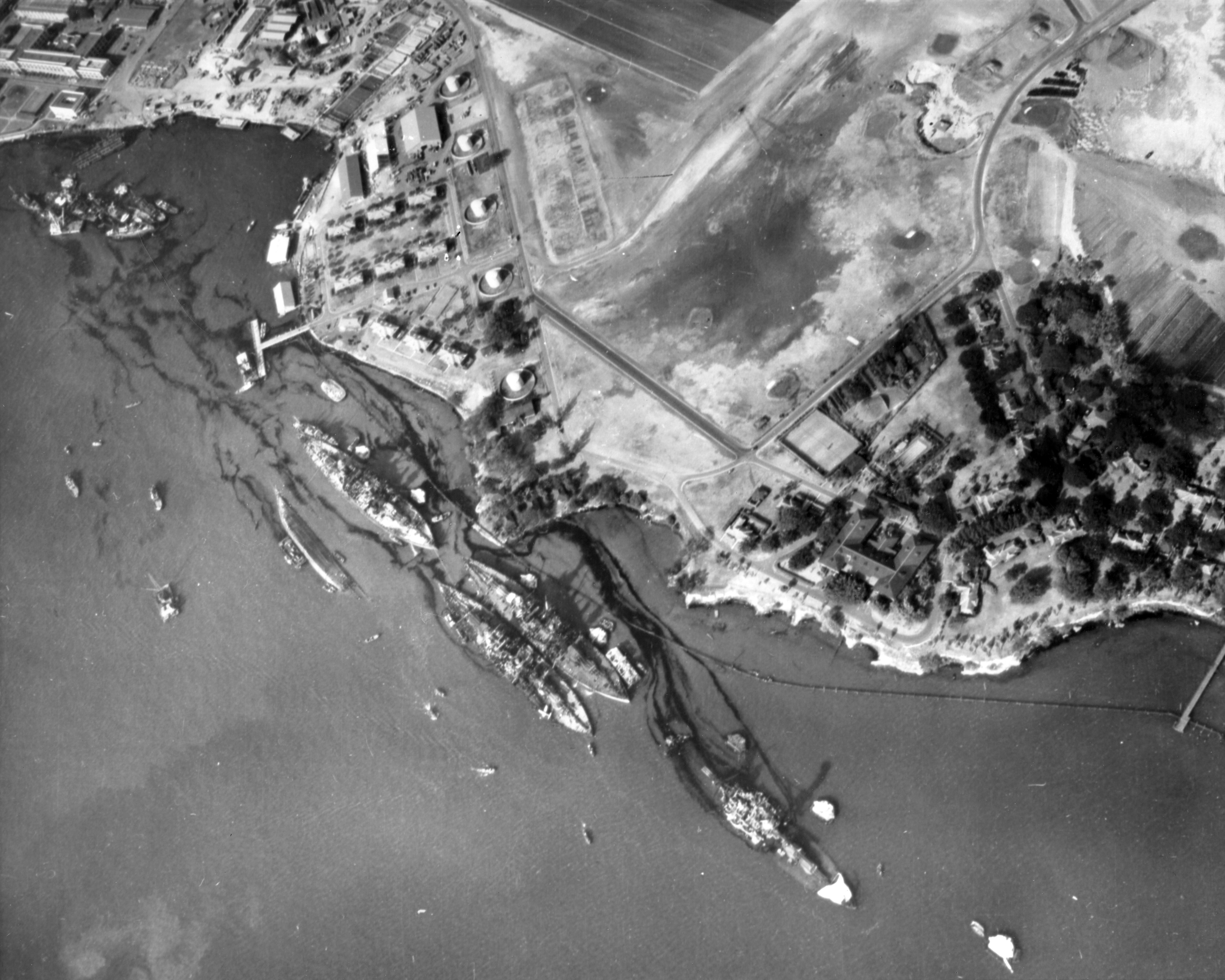
The fires are gone and the smoke cleared. You can see the multiple rivers of oil, most pouring out of the Arizona. The Arizona is on the bottom right of the ships. If you look closely, you can see the shadows of its superstructures, striking that iconic image with the fore mast crumbled over into its bow. The explosion literally obliterated the front of the ship, causing a catastrophic breach straight down through the decks. The harbor waters rushed into every level and nobody below decks had a chance. Except for one sailor, nobody in the entire front half of the ship survived. Rear Admiral Isaac Kidd, the highest ranking officer killed in the attack, was last known to be on the bridge. His body was never found.
In front of the Arizona is the Tennessee, nearest the island. It was damaged, but not badly. It was one of the first ships to return to duty, early in 1942. Next to it is the hapless West Virginia. Hit by everything, it almost capsized. The captain's decision to counter-flood kept it from doing so, instead it settled straight down, and you can see much of its port side is under water. It would be until 1944 before the West Virginia was back in service.
In front of them, nearest the island, is the Maryland. It was also lightly damaged and returned to service by early 1942. Next to it is capsized Oklahoma. Next to the Arizona, the Oklahoma had the largest single loss of life in the attack. 429 died, despite the best efforts to rescue them. Farthest ahead is the California, which actually sank, but returned to service in 1944.
The other two battleships are out of the picture. The Pennsylvania was in a dry-dock and barely touched, though two destroyers in front of it - the Cassin and Downes - were blown to pieces and would take several years to return to service. The Nevada was the other battleship. The fleet's flagship, it was located behind the Arizona. The only one to try to make a run for it, fear quickly arose that it would go down in the channel and block the opening to the harbor. Therefore it was ordered to cease its desperate gamble.
That's the gist of the battleships. It would be carriers, not battleships, that made the difference in the Pacific War. And by luck, fate or providence if you prefer, the American carriers were not there that fateful morning. The USS Enterprise was supposed to be there, but a sudden storm at sea damaged several of its escorting ships. Instead of going forward and keeping schedule, the captain decided to stay behind and help the ships damaged by the storm. As a result, the full wrath of the Japanese aircrews that morning fell on the capital ships - the battleships. Even when there were none left untouched, the subsequent waves would still attack targets that would have been better to ignore.
One final musing. Here is a scene from the movie Tora, Tora, Tora. A flop at the box office, it tried to be as accurate as two separate tellings of the same event - an American and Japanese perspective - would allow. On the whole, it succeeds. This is near the end of the attack. I've always loved the lone American machine gunner. His fellows are all dead. All around him is destruction and carnage. Explosions are everywhere. His cloths are in tatters and he is wounded and bleeding. But he'll be damned if he gives up. And the choice of the pilot he finally hits, as well as the gunner's own actions, perfectly embodies the attitude and grit and determination both sides would bring into the conflict. Wars are horrible things, but sometimes they bring out the absolute best in people. A lot better, as we've discovered, than peace and luxury and leisure tend to do.

Get hold of old speeches and publications from Germany in the 1930s and early 1940s. Scratch out the words 'Jew' and 'Jewish' and replace them with 'White' and 'Whiteness'. Then you can be invited to any hipster leftwing party. Or, apparently, get a cushy job at one of our fine modern institutions of higher learning.
Thus. Yep. It's not even trying to act with a wink and a nod. It literally speaks of the plague of whiteness in ways reminiscent of the warnings against the corruption of Jewishness in Nazi Germany. From the university page:
Racism is an epidemic (CDC, 2021) that can also be considered a pandemic given its large cross-national proportion and spread (APA, 2020). However, there is another pandemic lurking behind and driving the racism pandemic – the Whiteness Pandemic. Whiteness refers to culture not biology: the centuries-old culture of Whiteness features colorblindness, passivity, and White fragility, which are all covert expressions of racism common in the United States. Naming the Whiteness Pandemic shifts our gaze from the victims and effects of racism onto the systems that perpetrate and perpetuate racism, starting with the family system. At birth, young children growing up in White families begin to be socialized into the culture of Whiteness, making the family system one of the most powerful systems involved in systemic racism.
Compare:
The Jew caused our misery and lives from it today. That is why we nationalists and socialists oppose the Jews. The Jew has corrupted our race, soiled our morals, undermined our values, and broken our strength. He is the reason we today are the pariah of the whole world. As long as we were German, he was a leper among us. When we forgot our German nature, he triumphed over us and our future.
I'll let you guess who said that last one.
Sure, people will point out that many (though notice not all) on that university page are white. White professionals happily ensconced in their own careers it should be noted. I've noticed that many white liberals who have no problem demanding we correct the unfairness of white privilege are, themselves, quite privileged. And while they might bemoan the unfair advantage they have in life owing to their whiteness, it never seems to lead them to relinquish those careers and go flip burgers so a minority could be hired instead.
Why did white Americans flock to Trump and the GOP last election? Why did young white Americans, that age group historically tending to swing left of center, swing to the right? Because the white American liberals who look like them with six figure salaries seem hellbent on making sure those white American liberals are the last people who look like them who will be able to have six figure salaries. That's why.
 |
| Proxy Martyrdom in a nutshell, and apparently a staple for white liberalism |

