Commercialism:

Consumerism:


I'll explain later.

So here is his reaction to the Australia and Brown University shootings:
Statement of Cardinal Blase J. Cupich, archbishop of Chicago, on the Shootings in Rhode Island and Australia
December 14, 2025Once again, I write to offer solace and hope to people shocked by loss of life in places where our brothers and sisters sought to gather in places of peace and learning, yet were subjected to violence. On an Australian beach, terrorists consumed with hatred rained bullets on a celebration of the first day of Hanukkah, killing 16 and injuring many more. If anyone doubts the ancient sin of antisemitism is alive and strong today, here is proof.
Closer to home, two students preparing for final exams and a joyful holiday were murdered and a dozen injured by a gunman in the latest of a too-long series of college-related shootings.
We pray fervently for those directly affected by these attacks. But we also resolve to act against the circumstances that gave rise to them. In one case, hatred was strong enough to overcome even Australia’s strong firearms regulations. As we make ready to welcome the birth of the Christ Child to Jewish parents, let us recognize our own roots as people blessed with this tradition, speak against hatred and stand with our brothers and sisters as they claim their right to respect, safety and religious liberty.
And may we not be immunized to murder, including the latest United States campus shooting at Brown University. We must recognize that our leaders may say life is precious but act in ways that communicate it is cheap, that our children and the terminally ill are expendable. We cannot roll back mental health services and keep firearms more accessible than health care and then display outrage when the predictable consequences occur. Only if we soften the hearts of those in power can we hope to see a future where parents no longer send children to college with equal parts pride and terror. Only if we safeguard freedom of worship, including for minority faiths will we live up to the principles on which our nation was founded. Until then, we are speaking hollow platitudes about an America that is an ideal, not a reality.
Not surprising in the least. It says everything we would expect, and carefully avoids saying everything we would expect. Unlike his reaction to the Charlottesville shooting, in which we were treated to a lengthy essay that included Naziism, white nationalism and the history of racism in our country added to by a pinch of ISIS reference (read it here), he joins the mainstream Left by using the vague 'antisemitism sure is a problem' assessment, never bothering to mention the specifics. And we all know why.
But it's what isn't said that's even more telling. He does mention the coming of Christmas, with the standard progressive emphasis on the group identity of the Christ Child being Jewish. He brings up the terminally ill, though no clue why, since I'm not aware of that entering into the motive for any of the shooters. Of course he mentions guns, and the obvious assumption that gun control is the single hope for solving the violence we witnessed, which is why it's almost always the only thing we will talk about. And mental health. Apparently because the almost exclusive emphasis on mental health and subsequent tens of billions of dollars in funding we've seen over recent decades, even as the problems mental health is supposed to help have gotten worse not better, suggests the solution is more of the same.
Nonetheless, it's that this could have been released from a politician's office. It could have come from a mayor, a concerned corporate CEO, a celebrity. I wouldn't be surprised if some informed and invested pop culture figure had something like this released. There just isn't any 'there' there. Certainly not if 'there' means even Christianity in a generic sense, much less a Catholic sense. Heck, I've taken in more Christianity watching the original Ghostbusters than this.
If there is any truth at all to the historical Christian Faith, or if there is any need for the Catholic Church to exist, then I'd say this whole release was nothing but a hollow platitude. It certainly didn't suggest there was any hope beyond accepting progressive activism, narratives and policy solutions. And it isn't as if this is the only example of such a statement I've seen since we became Catholics.
Once again, allow me to tap into something one of my sons observed some time ago. He said we became Catholic almost 20 years ago. And in that time, we have yet to hear a contemporary pope suggest there was any pressing need for us to do so. Upon reflection since he mentioned that, I have to say he's right. And the good Cardinal Cupich simply adds one more page to the question of 'why did we become Catholic in the first place?' that has yet to be answered by those you'd think would provide such an answer.
Really, I'm not a lawyer. This came about on a Facebook post by Gloria Purvis:

It has to do with this press release from the DOJ. Again, I'm no lawyer, but something about 'neutral on the face but discriminatory in effect' strikes me as, well, not clear. So if anyone does understand this sort of thing, I'm all ears.

It's that day. I almost forgot. Last year this day was actually swallowed up in some quarters by those wanting to ignore this particular anniversary in preference of remembering the beginning of the Japanese (not Italian or German) Internment Camps. This year there seems to be more focus on that day which will live in infamy.
I'm not a big Hawaii guy. I've never been particularly interested in going there. But if one thing could get me, it would be visiting the Arizona memorial. It was WW2 that got me interested in history. And it was Pearl Harbor that captured my attention more than anything else. I saw it as one of those thick dividing lines in history. There was America and the world on December 6th, and then there was an entirely new age in the world on December 8th. And what happened that day in between became one of my focal points in college and much of my younger life.
I'm of that group of historians who actually disagrees with the old adage that for Japan, the attack was a tactical victory but strategic disaster. Given America's predictable reaction, the strategic disaster is certainly true. But I've often disagreed that it was some wonderful tactical success for Japan. It wasn't.
And not just because those carriers famously weren't there. It failed on some levels because, in the end, Americans reacted far better than the Japanese imagined, and because the Japanese did far worse than we sometimes remember.
_burning_after_the_Japanese_attack_on_Pearl_Harbor_-_NARA_195617_-_Edit.jpg) |
| The iconic image of Pearl Harbor: The USS Arizona crumpled and burning |
By the time the second wave came, the AA fire had formed a veritable canopy of explosions in the air over the harbor, and the second wave proved subpar at best. This was because they weren't prepared for the stiff resistance. Mitsuo Fuchida, the commander of the attack, said years later that the Japanese air crews were stunned by the speed of the American response.
Remember, the Americans had everything against them. Caught flatfooted, a blindside in a dark room, with the custom of locking things up on Sundays, or recovering from the previous night's festivities, and the general unawareness that comes with being at peace, led the planners of the attack to believe most of the first wave would meet with little if any resistance.
True, only 29 Japanese planes were shot down (roughly 8% - not a bad number if you're Japan) in the entire attack. But that's because the AA fire, while brutal and constant, was still from often antiquated or outdated guns that were better suited for old biplanes than the nimble Japanese planes in the attack. The real consequence of the AA fire was in breaking up the attack runs following the first dozen minutes or so and causing more and more of the Japanese, as often as not, to shoot wide of their marks.
Plus, you just had poor decisions on the part of the Japanese aircrews. The reasons have been kicked around for years. Were they just kids trying to go after big targets when there were none left? Was it being ill prepared for the US response? Was it simply Japanese military planners overestimating based on training versus what happens in actual battle? Hard to say. Probably yes.
But whatever the reasons, they missed many opportunities, especially in the second wave. Not just the oil fields, but the repair facilities and the all important cruisers. An often overlooked workhorse of the Navy, the Japanese could have added a dozen more ships to the casualty list, but seemed to almost purposefully avoid the less glamorous (but so crucial) cruisers in preference for battleships - even though most battleships by then were already sunk or were damaged or sinking.
,_USS_Cassin_(DD-372)_and_USS_Pennsylvania_(BB-38)_in_Dry_Dock_No._1_at_the_Pearl_Harbor_Naval_Shipyard,_7_December_1941_(306533).jpg) |
| The Pennsylvania sits behind the Cassin and Downes |
Still, in the end, only a few ships never returned to service. The Arizona, the Oklahoma and a training ship that was an ex-battleship - the Utah. They were the only total losses. Every other ship was eventually returned to service before the end of the war. Some of them seeing action against Japan itself. The planes were a big loss. 188 were destroyed and a similar number damaged. And worse than anything, 2,403 were killed. Almost half of those killed came from the two battleships Oklahoma and Arizona.
Compared to that, Japan lost 64 men, including the crews of several minisubs. 24 aircraft were shot down, but it's worth noting that over 70 aircraft were damaged. That's 30% of the air strike force destroyed or damaged. Again, the faster than expected response of the Americans.
Admiral Chuchi Nagumo, the commander of the actual Pearl Harbor strike force, received much criticism from Japanese in later years for not launching a third wave of attack. IMHO, he was correct not to. Already the second wave was far less successful than the first, and most of the planes destroyed or damaged came from that wave. It is unlikely the next wave would have capitalized on much more than the second wave. Plus most of Nagumo's worries about losing more planes and running up against logistical problems (like fuel) were reasonable concerns.
In the end, it also wouldn't have mattered. Unless a really lucky hit manifested itself, there likely would have been no more lasting damage, and the real harm - the rage ignited in the American mindset - was there and couldn't be taken away.
Japan - being a not-Western nation - has at times suggested that the attack was never meant to be a surprise. This is something it has bounced about for decades. If you watch the film Tora, Tora, Tora, it takes Japan's view that not only was the attack reliant upon surprise, but it clearly didn't want surprise and the lack of forewarning was simply a sad case of bad typing. That's non-Western nations for you.
Whatever was intended, however, the final assessment is one of ultimate failure. Little lasting damage was done, beyond the sad death toll. The attack could have been worse for America in the short term, but a series of failures and subpar performances on the part of the Japanese air crews caused many opportunities to be missed. And with all that, the horrible strategic nightmare of filling America with that famous terrible resolve was in the books and couldn't be taken back. Something that citizens of Tokyo, Hiroshima and Nagasaki would discover all too sadly before the end of the conflict.
For a bonus, I found the below photo. It is a photo I have not seen before. I always appreciate things I've not seen before. It is of Battleship Row three days after the attack:
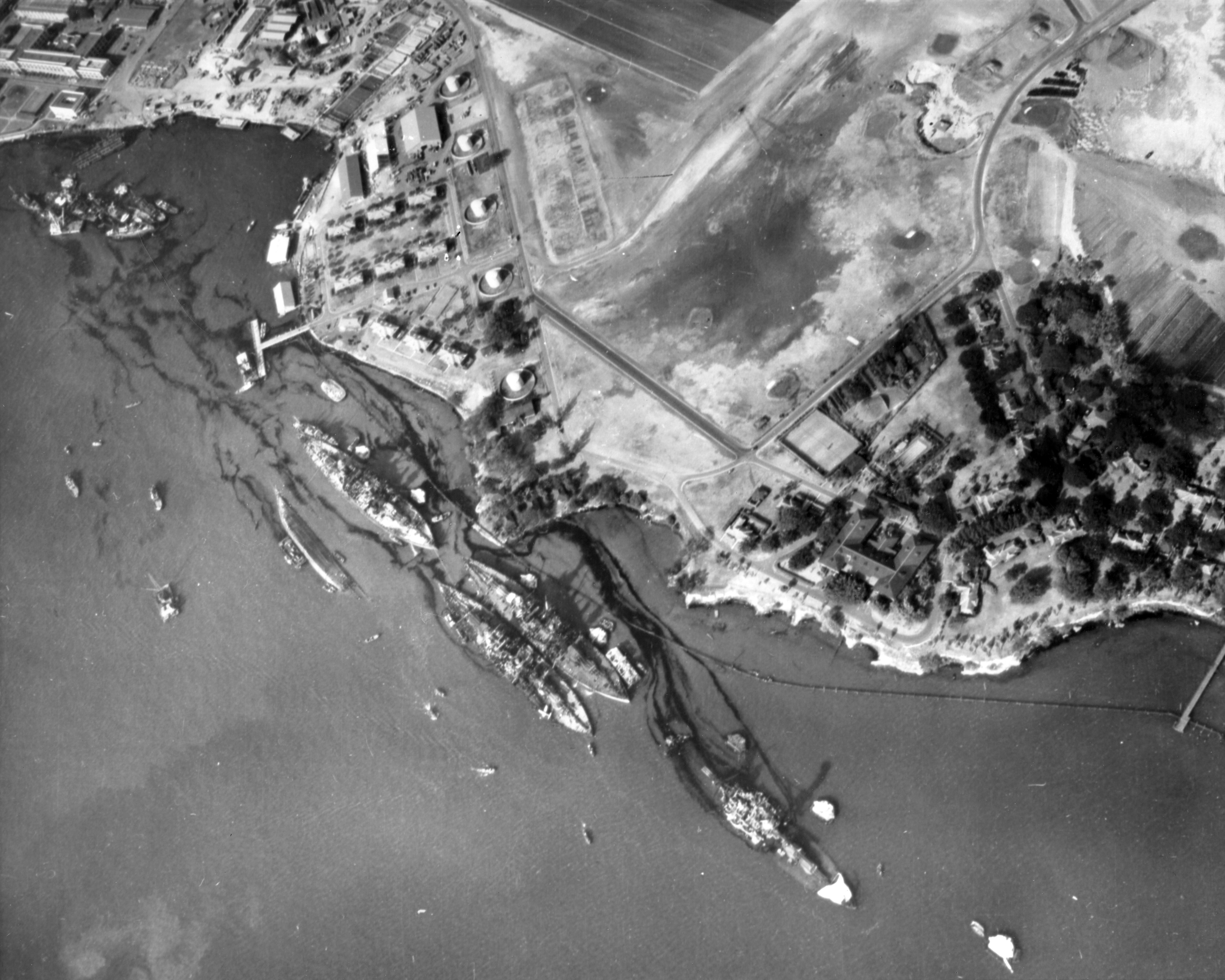
The fires are gone and the smoke cleared. You can see the multiple rivers of oil, most pouring out of the Arizona. The Arizona is on the bottom right of the ships. If you look closely, you can see the shadows of its superstructures, striking that iconic image with the fore mast crumbled over into its bow. The explosion literally obliterated the front of the ship, causing a catastrophic breach straight down through the decks. The harbor waters rushed into every level and nobody below decks had a chance. Except for one sailor, nobody in the entire front half of the ship survived. Rear Admiral Isaac Kidd, the highest ranking officer killed in the attack, was last known to be on the bridge. His body was never found.
In front of the Arizona is the Tennessee, nearest the island. It was damaged, but not badly. It was one of the first ships to return to duty, early in 1942. Next to it is the hapless West Virginia. Hit by everything, it almost capsized. The captain's decision to counter-flood kept it from doing so, instead it settled straight down, and you can see much of its port side is under water. It would be until 1944 before the West Virginia was back in service.
In front of them, nearest the island, is the Maryland. It was also lightly damaged and returned to service by early 1942. Next to it is capsized Oklahoma. Next to the Arizona, the Oklahoma had the largest single loss of life in the attack. 429 died, despite the best efforts to rescue them. Farthest ahead is the California, which actually sank, but returned to service in 1944.
The other two battleships are out of the picture. The Pennsylvania was in a dry-dock and barely touched, though two destroyers in front of it - the Cassin and Downes - were blown to pieces and would take several years to return to service. The Nevada was the other battleship. The fleet's flagship, it was located behind the Arizona. The only one to try to make a run for it, fear quickly arose that it would go down in the channel and block the opening to the harbor. Therefore it was ordered to cease its desperate gamble.
That's the gist of the battleships. It would be carriers, not battleships, that made the difference in the Pacific War. And by luck, fate or providence if you prefer, the American carriers were not there that fateful morning. The USS Enterprise was supposed to be there, but a sudden storm at sea damaged several of its escorting ships. Instead of going forward and keeping schedule, the captain decided to stay behind and help the ships damaged by the storm. As a result, the full wrath of the Japanese aircrews that morning fell on the capital ships - the battleships. Even when there were none left untouched, the subsequent waves would still attack targets that would have been better to ignore.
One final musing. Here is a scene from the movie Tora, Tora, Tora. A flop at the box office, it tried to be as accurate as two separate tellings of the same event - an American and Japanese perspective - would allow. On the whole, it succeeds. This is near the end of the attack. I've always loved the lone American machine gunner. His fellows are all dead. All around him is destruction and carnage. Explosions are everywhere. His cloths are in tatters and he is wounded and bleeding. But he'll be damned if he gives up. And the choice of the pilot he finally hits, as well as the gunner's own actions, perfectly embodies the attitude and grit and determination both sides would bring into the conflict. Wars are horrible things, but sometimes they bring out the absolute best in people. A lot better, as we've discovered, than peace and luxury and leisure tend to do.

Get hold of old speeches and publications from Germany in the 1930s and early 1940s. Scratch out the words 'Jew' and 'Jewish' and replace them with 'White' and 'Whiteness'. Then you can be invited to any hipster leftwing party. Or, apparently, get a cushy job at one of our fine modern institutions of higher learning.
Thus. Yep. It's not even trying to act with a wink and a nod. It literally speaks of the plague of whiteness in ways reminiscent of the warnings against the corruption of Jewishness in Nazi Germany. From the university page:
Racism is an epidemic (CDC, 2021) that can also be considered a pandemic given its large cross-national proportion and spread (APA, 2020). However, there is another pandemic lurking behind and driving the racism pandemic – the Whiteness Pandemic. Whiteness refers to culture not biology: the centuries-old culture of Whiteness features colorblindness, passivity, and White fragility, which are all covert expressions of racism common in the United States. Naming the Whiteness Pandemic shifts our gaze from the victims and effects of racism onto the systems that perpetrate and perpetuate racism, starting with the family system. At birth, young children growing up in White families begin to be socialized into the culture of Whiteness, making the family system one of the most powerful systems involved in systemic racism.
Compare:
The Jew caused our misery and lives from it today. That is why we nationalists and socialists oppose the Jews. The Jew has corrupted our race, soiled our morals, undermined our values, and broken our strength. He is the reason we today are the pariah of the whole world. As long as we were German, he was a leper among us. When we forgot our German nature, he triumphed over us and our future.
I'll let you guess who said that last one.
Sure, people will point out that many (though notice not all) on that university page are white. White professionals happily ensconced in their own careers it should be noted. I've noticed that many white liberals who have no problem demanding we correct the unfairness of white privilege are, themselves, quite privileged. And while they might bemoan the unfair advantage they have in life owing to their whiteness, it never seems to lead them to relinquish those careers and go flip burgers so a minority could be hired instead.
Why did white Americans flock to Trump and the GOP last election? Why did young white Americans, that age group historically tending to swing left of center, swing to the right? Because the white American liberals who look like them with six figure salaries seem hellbent on making sure those white American liberals are the last people who look like them who will be able to have six figure salaries. That's why.
 |
| Proxy Martyrdom in a nutshell, and apparently a staple for white liberalism |
 |
| It still holds a special place in my heart |
Rather than prattle on about the problems with the holiday and the issues surrounding us, perhaps just a time to stop and say thanks. Just like those first puritans spending three days celebrating and partying and thanking God for their blessings. Considering the losses they experienced and the hardships, they still found time for endless thanksgiving. And that's not a bad thought to remember.
For fun, here is an article attempting to delve into the past and figure out just what it is that those immigrants and Indians actually ate on the famous feast. I'm sure it wasn't green bean casserole, which is why we never eat that on Thanksgiving. But I'd like to think among all the venison, a nice plump turkey the way we breed found its way onto the table.
For a reminder, the reasons my wife and I have to be thankful, among many others:

A little dose of laughter courtesy of Steve Martin and his many talents on the Smothers Brothers Comedy Hour:
And yes, a reminder that he didn't always have that plume of white hair. Martin is one of those cases of how, when you're young, time seems to be somewhat telescoped. His mega hit album A Wild and Crazy Guy came out in 1978 when I was in elementary school. A year after Star Wars, and the height of Star Wars Mania (yes, that came a full year after its release), Martin seemed to be everywhere. His novelty song King Tut caught the King Tut wave that was all the rage back then, with the Treasures of Tutankhamun museum exhibit tour in the late 70s. A year later he would star in his own vehicle movie The Jerk, and only solidify that feeling for me and my peers that he had been everywhere forever.
Looking back, I realize how brief his time in the national spotlight was. Oh, he would go on and make a zillion movies of varying quality and redefine himself and become, nowadays, that elderly gentlemen of entertainment. But Martin as center of attention in the world of pop culture was only a couple years. But to youngsters at the time like me, where time seems to go at a different pace, it felt in the late 70s as though he had always been the biggest thing since the dawn of time.
If you sound like this when someone on the other side does something wrong:
But sound like this when someone on your side does the same thing or worse:
Then yeah, you're a big part of the problem. I thought of that when I saw this:

Pretty rough condemnation. And not unwarranted. I know little of the reporter in question who was murdered. I recall it from back in the day. But I think that, unless the guy was Himmler redux, he deserves a little more than a shrug and 'things happen'. Especially from our president. And I'll stand by that. But I don't think Trump's response is anywhere near what we have seen regarding some activists' and prominent professionals' reaction to transgender shooters in schools, or women who cross transgender activism, or heck, the Charlie Kirk murder. Yet regarding such things as the Charlie Kirk murder, the good deacon's response was:

But so did the murder of Charlie Kirk, only a million times more! And that includes those who defended and celebrated it. But what did you get from Deacon Greydanus the day Kirk was murdered? A platitude. Something that would fit on a bumper sticker. And not even his own. He had to quote others, saying he was too busy to address Kirk's murder. I note he wasn't too busy to comment on President Trump's statement. As for condemning such things as, say, the horrifying attacks on JK Rowling from transgender activists, I've asked for examples from him doing so but as of now have not received any.
That sort of morals by partisan plot point has no place in the Church, or decent society. If we want to bemoan President Trump or the society we've built that saw Trump's ascent, by all means. But that is only worth anything if we look at the broader culture and society we've built, even if the evidence for that declines points sharply back to the side with which we clearly sympathize.
At least traditionally for the young'uns. Now that we have our first November baby in the family, that title will pass to him. Nonetheless, October, in addition to having my late Grandma's birthday, the month of my best childhood friend's birthday, and the Feast of St. Francis to boot, was also the month our oldest son was born.
Not the one born to the best fortunes, he suffered from ill health in his early years. We never knew why. But endless doctors visits and hospitals and surgeries were his lot in his youngest days. A lot of it was respiratory, and we began to think that living in the Ohio River Valley, known for its panoramic vistas of endless coal plants and thousand foot smokestacks, might be part of the culprit.
In 1999, while I was pastoring a church in southeast Indiana, and quite frankly one of the most pleasant of all the congregations I ministered to, we nonetheless decided to move away. We came up to Ohio, where skies might be gray more often than not, but without the same industrial blanket covering the air.
And things turned for him. Within a year, most of the problems he had vanished, which was nice. Of course being the first child he was what all first children are, and that's our guinea pig. You look back when you're a parent at your first kiddo and just shake your head. By the time the other ones come along, you're already getting your parent's feet on firm ground. But those first ones are the ones who bear the brunt of your learning.
Nonetheless, with all the ups and downs he lived through, I can't deny he makes us proud. Everyone here knows how he had planned to go into the world of gourmet cooking, only to be torpedoed by an out of the blue seafood allergy. After wondering for a year or so what to do then, he finally found his new path and has been working toward it, where he stands today.
But he has a knack for excelling whenever he puts his mind to it. In middle school, though already involved in school activities like band, he decided to go out for track in order to enter the sports side of life. It was a dismal performance. At one point during a race, he actually veered off the track and slipped and fell. The good news was that he was so far behind everyone else, nobody noticed. Not to be beaten, however, he went out for cross country the following year. He asked me - who had run track and such in my day- to train him. And so I did. By the end of that season, he was second in his school only to the boy who was a freak of nature when it came to running, with our son often coming in near the front few even with multiple schools competing.
But that's been him. He may start out slow. Sometimes he takes forever to start. And that wasn't the only time he began with a trip and a fall. But once he hunkers down and sets his mind to it, even if life throws him a curve ball that makes him change his entire life's plans, he ends up graduating, and with honors to boot.
 |
| By request, a family outing for our yearly pumpkins |
 |
| And off to a local college football game |
 |
| Not OSU, but a great game and a great time nonetheless |
.jpg) |
| For old times' sake on our way from the old apple orchard |
 |
| A nice shot that captures his thoughtfulness |
Obligatory gloating over the grandkids picture, speaking of birthdays - now that they're both here to cause endless mischief:

In thinking on the murder of Charlie Kirk, something jumped out at me. How many - and I personally saw it dozens of times - rushed out and with almost joyful sneering pointed out that Kirk died while defending gun rights. The point was supposed to be irony. You get it, right? He was all about gun rights, and then he was killed by a gun - Ha! That'll teach him!
But did it ever occur to them that he was aware of the possible dangers of his very position, yet he held it anyway because he actually believed what he stood for? That he was willing to even die for his cause?
As so many rushed out with that supposed gotcha take-down, and so more many nodded ascent and gave thumbs up when it was said, all I could marvel at is how someone willing to stand by a conviction even if they died for it was so foreign to these people. How standing firm on a cause even to the point of the greatest sacrifice apparently wasn't even on their radar screen as a possibility.
I thought of those as I saw this:

Things like that, I fear, are what plague our modern age. An age of punditry over principles. An age where people make sure to stake their lives on crusades that will, at best, cost others everything if they cost anything at all.
It's one thing when bad morals, bad actors and bad motives can be found in a nation or society. It's another when those things define a society. A few weeks back, I was talking with one of my sons about the state of things in our nation. He made a funny quip. He said virtues come and go, but vices last forever. In some ways he's right. In our effort to cleans ourselves of the vices of our past we seem to have thrown out all the virtues and yet, in an odd twist, the vices in many areas remain. And when we realize how ubiquitous they are, what we are seeing go wrong in our modern day should surprise no one.
So today, it's worth going back and remembering something like this:
That is the television series finale for the 1960s British spy thriller The Prisoner. Created by Patrick McGoohan, my second oldest said it's what you would get if Lewis Carroll wrote 1984. The finale is one of those things that you have to see to believe. We've watched some crazy things in our lives, but this has to rank near the top.
Which is a nice thing to remember, since we all know what day this is:

Yep. I mused on that here. It still sticks in my mind as perhaps the single worst television broadcast of my life. Compared to that, even the finale for The Prisoner comes off as tame and ordinary.
Just a little boast that we do live in a pretty neighborhood:

The reading of this in the film My Boy Jack always brings home Veterans Day and the risks and costs behind it:
It's been said that the problem with 'Nothing to kill for' is that it is inevitably followed by 'Nothing to die for', which is a backhanded way of saying 'Nothing in this universe more important than me'. As foundational as this is for our post-war secularized liberal society, it's antithetical to not just core Christian values, but the values shared by most of humanity throughout most of time.
Yet when we see things like Veterans Day or Memorial Day or even the daily sacrifice or risk people take to help or save others, I notice that our kneejerk reaction is seldom 'what an idiot.' No, we usually, almost instinctively, cheer them on or remember those who have served or sacrificed with reverence. From the top of our pop culture down.
So it's almost as if, despite the uber-narrative that I must love me first, think of me first, prioritize me first, and heaven forbid think there is anything out there worth dying for - we really don't believe it. Just what it says about a society whose formal instructions aren't even believed by those instructing us, I don't know. I just know when days like this come along, it never seems to mesh with the usual tripe we hear from our best and brightest about how the greatest love of all is the love I should have for myself, everything else being a distant second.

Now, something is definitely wrong in the dementia world, that I admit. More and more people are being diagnosed with dementia and Alzheimer's than ever before. And these diagnoses are happening at ever younger ages. My grandma - born in the late 1800s - had a stroke and became confused and, based on what we know, stricken by some form of what we now call dementia. Of her siblings, however, she was the only one. The rest of her generation passed, many at very old ages, as sharp as tacks. Her brother Earl was well known for being completely together mentally until he passed (he was a consummate story teller).
The next generation, my parents' generation, have had only a couple who didn't end up with some form of dementia or Alzheimer's. Including both my parents. And while my dad drank like a fish when he was young, he gave it up after an accident involving my sister. Though it had nothing to do with him drinking, he was playing cards and drinking with his brothers when it happened. He felt his reaction time to her injury was compromised, so he never drank again. And that was when he was still young. Except for a few parties and wedding receptions when they were young, I don't believe my mom drank at all. Yet they, like their siblings, were struck with dementia, albeit at very old ages.
Now we have an increasing number of people having these elderly ailments at younger and younger ages. And unlike some things, perhaps cancer or some diseases which we could argue are simply easier to detect now, you can't miss dementia. Long before the diagnoses, you begin seeing the signs. As we did in both my parents' cases. Yet suddenly, it's alcohol! You know, that thing people have been doing for thousands of years before dementia began spreading like wild fire among younger and younger people. The thing that, per the same stories going after alcohol, fewer and fewer people are indulging in today.
Yet the assault continues. So as I said last time, my cynical historian's mind asks - why? Why out of the blue, over the last year or so, has the medical community (and the media) suddenly come out and said burn beer burn! Do not drink wine nor strong drink thou, whether ye go into the corner tabernacle or not! What's up?
First up? The conspiracy explanation. Why do people drink? Apart from alcoholism, to enjoy, to relax, to unwind. To indulge in the giddy side effects of the product in a troubled and difficult world. Also, just because they like a cold beer on a summer day or a nice wine with a fine meal. Sometimes they take Paul's advice when perhaps having stomach problems or other difficulties like sleeping.
But if we don't have alcohol, then what to do about all of those reason? Well, apart from the enjoyment around meals and for culinary peasures, we have - drugs. The media push for legalized recreational drugs continues apace with some pretty impressive wins. And in terms of other problems, such as difficulty sleeping or stomach issues or any such things, we have - drugs. Prescription drugs. The cynic in me has a hard time thinking there isn't some connection there.
Others have suggested it's a way to deflect from the increasing health problems plaguing more and more people. I mean, it's almost normal now to see at least one or two celebrities or well known persons die of cancer, heart disease, suicide or unknown reasons in a given week. Things that decades ago would have made the news for weeks because it was so rare. The deaths of celebrities were typically reserved back then for the elderly celebrities whose days had passed. Exceptions to that rule being exceptions to that rule. But today? I can't think of a week where I haven't seen someone, often well under 50 or even 40, dying in such a way. It seems connected to the observation that we are becoming less and less healthy overall. Why? Nobody seems to know, or dwell on the details much, but blaming alcohol could certainly work.
Some have suggested it deflects from the catastrophic results of our Covid measures, including questions about vaccines and the overall response from our medical communities. It isn't hard to see that things have definitely spiraled in some areas of life in recent years, and over a host of issues. If already we've seen alcohol linked to cancer, dementia, anything you want - why not anything else?
But one thing I'm sure of, it isn't an accident. It's not some bizarre coincidence out of the blue. There is a reason that alcohol is being targeted and fast becoming the latest cause du jour of all problems in the world. And whatever the reason - and it can obviously be more than one - it's those reasons being deflected from that we should likely be focused on.
Also, I'll add that this is not an advertisement to drink. If you don't, great. I'm not being paid by Paul Masson or Budweiser. I just see things like this in our day and age and have a very difficult time believing it's just good old medical science discovering the truths of the world that we need to know in order to thrive. As I've said before, sometimes it takes far more naivete and credulity to disbelieve a conspiracy theory than to believe in one.
Busy, busy, busy. The call came at 3AM this morning that things were happening fast, and now we have:

The Catholic Bard can sometimes be a fun read. Here is a list of important lessons that Halloween brings. This one made me laugh (in the section about how Peanuts makes every holiday better):
Halloween is a perfect time to teach children about military aviation history.
Heh. There's more fun there, so check it out.
Just in time for a nice Halloween rambling!
Back in the earliest days of my blog, Simcha Fischer posted a list of scary movies she watched with her family around spook season when she was at National Catholic Register. Deciding to shamelessly steal the idea, I posted the same thing, and it led to an early boost in my visits. No doubt in part because of the images I used being ones people at the time were likely searching for. Eh. It still worked, and the old blog got quite a lift in page views.
Since then, we've watched many more movies that weren't on the list. Some on the list aren't watched as much anymore. Of course most aren't watched with everyone because of obvious life changes. And there are those not listed here because, while we have watched them many times over the years, they aren't even a once every three Halloween watch. So here is the much awaited update - Movies to Scare Kids By, Part II:
Night of the Demon, 1957
 |
| MacGinnis (L) and Andrews selling the story |
The City of the Dead, 1960 (US: 1961)
 |
| The shadow of the cross will protect them... |
Psycho, 1960
 |
| No caption needed |
Speaking of which, somehow this began to be included in the annual cycle of spooky viewing. I needn't dwell on the specifics. I mean, is there a more iconic suspense thriller than this? I knew about the shower scene before I knew what showers were. And that was back then. Though I will say this. I have forever envied those moviegoers who saw the film upon its initial release. Only they could have appreciated Hitchcock's sleight of hand, as it's clear the early movie sets up Janet Leigh as the actual psycho. Embezzling money from her boss to force the hand of her lover Sam Loomis into marrying her, she then drives across country, becoming more neurotic and paranoid with each mile. Each person she runs into -seeing her boss cross the street, a police officer, California Charlie the used car salesman - becomes more and more of a threat as her mind runs wild. Then as the weather turns sour, she pulls into the isolated Bates Motel. Upon meeting a young Norman Bates, the audience thinks here's another person she's going to go crazy worrying about. And yet, as they converse over an impromptu snack, something is different this time. From the moment you see him change from picking keys to Room 3 to Room 1, you begin to get the impression that somehow, in some way, perhaps she wasn't the psycho after all. To be able to watch it like that is something I do envy.
The Wicker Man, 1973
 |
| Christopher Lee gives another understated performance |
Steven King's Silver Bullet, 1985
Made in the wake of The Howling and Rick Baker's groundbreaking effects for An American Werewolf in London, it is inferior to those two movies in most ways. The design for the monster in question always looked like a teddy bear with a mean streak and not much more. With most of King's movies, either they deviate enough to improve the material, or try to stretch the material out to a two hour version of not much. Somehow, this movie manages to do a little of neither. Still, there are some things to like. It wisely adds a seasonal feel by having the final confrontation take place on Halloween night (while picky observers note that in the actual year it is supposed to happen, the moon was not full on Halloween). The principal actors are good enough, and do their jobs well enough to carry the story. Many in the support cast actually shine brighter than the leads. There are some heartfelt moments, and some good scenes that suggest a better movie in the making. Plus it does contain one of the most purely gothic scenes ever put to celluloid. Then of course there is Gary Busey. Never has Gary Busey more Gary Bussied than here. If you like your Gary Busey acting three sheets to the wind even when he's not drunk, this is the movie for you.
 |
| L to R: Angry teddy bear; Werewolf to scare the bloody pants off of you (courtesy of The Howling) |
The Fall of the House of Usher
One of the catalogue of Roger Corman's 'how to mutilate Poe' films. Of all of them, this is the one trying at least somewhat to cleave unto the original source material. Vincent Price, Mr. Horror of Poe himself, does a good job of making the ailing Roderick Usher come off as unsettling at best. The settings are typical Corman, lots of fog, everything looks dead (as well it should), the interior shots are properly gothic, and the costumes are straight out of a Broadway costume drama. At only 79 minutes, it still feels like the main goal is to stretch and stretch again the story into a full length theatrical release. Nonetheless, when it does get going, and the set of the crypts is revealed, the whole begins to come together and makes for viewing that fits well into the Halloween seasonal feel.
Dracula, Prince of Darkness (1966)
The sequel to Hammer's The Horror of Dracula, its first instalment of an eternally long string of Dracula movies. Featuring one of the best showdowns between Dracula and his arch-nemesis Van Helsing, Hammer reminds us that when it comes to adapting books into movies, don't worry about the books. The names are the same, but don't apply to the same people. We still have no clue where it is supposed to take place. The story begins in the first minute by quoting Jonathan Harker's journal, and then promptly begins rewriting the journal itself, with the story to follow. Nonetheless, so successful was its performances at the box office that a sequel from Hammer was inevitable. Dracula, Prince of Darkness begins a decade or so after the events of the first movie. Not able to get Peter Cushing back, they bring in four stalwart Brit performers as well as the always reliable Andrew Keir to weave together a new story centered around a speechless Dracula (the reasons for Lee having no dialogue being debated to this day). Two brothers and their wives defy warnings from a rambunctious abbot and visit too close to the Castle Dracula. As they say, when you're in horror movies, you make dumb decisions. What follows is predictable, and the ending, while interesting in leaning on the tale that vampires can't cross running water, is nowhere close to the first movie's ending (see below). Also, the 'vampire as bizarre mutant monster, not supernatural' gets kicked into high gear, and you're left pondering just what Keir's abbot actually believes about - anything. I suppose it was the apex of accepting that everything spiritual must really be material. It's worth noting, BTW, that the TV channels we had when I was growing up must have owned this movie outright, because more than almost any other horror movie, it seemed this was shown repeatedly. Also, like The City of the Dead, one can see some clear influences on both Stephen King and, of all things, Dungeons and Dragons!
Curse of the Werewolf (1961)
Oliver Reed shines in this tortured tale. While Hammer would raid old Universal story lines and adapt them liberally from the source material, they toss Curt Siodmak's concocted Wolf Man story out the window. Instead, for this movie they lean on actual European folklore and superstitions about werewolves and their origins. Reed's Leon is definitely a tragic character, almost as much as his adopted father, played brilliantly by Welsh actor Clifford Evans. A viewer will almost be lost at first, as the initial scenes in the movie tap into historical beliefs about where werewolves originate. Then we meet Leon as a young child with decidedly un-childlike tendencies: Like sleepwalking and returning with blood all over his torn up clothes. Growing up doesn't help, and like any true Gothic tale, it oozes with tragedy, for that's typically what defines a Gothic tale. True to form, Hammer Films, as it so often did, managed to punch well above its weight in terms of what it could do with very limited budgets and resources, and makes this one of the most rewatchable of its extensive catalogue.
The Curse of Frankenstein (1957)
The Hammer film that put Hammer in the spotlight. Initially panned for its gore, its production and its gratuitous levels of - then - shocking visuals, the movie has since been seen as a milestone due to its role in bringing back the classic horror genre in the age of sci-fi and nuclear paranoia. Like most Hammer films, the source material is out the window. It isn't even based on stage plays. The film begins with Dr. Frankenstein awaiting his execution. He tells his tale of what happened, a tale we should be at least vaguely familiar with. If Frankenstein is sometimes less sympathetic than his creation in the original novel, here he's pure villain. Willing to murder to maintain his project of life creation, Cushing's Frankenstein ranks as one of Hammer's most heartless monsters. Even more than the grotesque creature itself, played again by a speechless Christopher Lee. Scottish actor Robert Urquhart is wonderful as Frankenstein's mentor, turned adversary as he begins to recoil in horror at what his prized student is capable of doing. Like most Hammer films, for its day it pulled no punches, and the ending shows that not all movies need to end happily.
The House on Haunted Hill, 1959
 |
| The move makes as much sense as this photo |
The Haunting, 1963
In keeping with the emerging focus on the supernatural and away from space aliens and giant mutants, we're treated to this cinematic version of Shirley Jackson's novel The Haunting of Hill House. To be honest, this isn't really my cup of tea. For some reason, the atmosphere and the portrayal of the haunting itself comes off as almost tinny, if that means anything. There is a mechanical feel to it all that doesn't hit me as 'supernatural' or 'spiritual.' More like sound machines and drum sets behind the stage than ethereal spirits. Nonetheless, it is liked here on the home front, and I don't hate it. There is some good there, especially the lore attached to the story. The sets themselves are good, and the acting solid. Yes, we all get the subtle inuendo behind the two female leads' relationship. But overall, each actor of the small cast does good enough. Not to mention Julie Harris's Elinore Lance has a bullseye over her that even the least attentive viewer can't help but see. So it's OK, but probably not a favorite, at least for me.
Night of the Living Dead, 1968
 |
| And in color, too! |
Ghost Story, 1981
 |
| Enough class to fill the screen |
Based on Peter Straub's 1979 novel of the same name, the movie distills the book down to the classic 'old dark secret shared by friends' storyline. As they enter the twilight of their years, four life long friends become concerned when one suddenly dies, for no apparent reason. Then goes another one. Finally, the son of the first to die shows up and tells his tale. A beautiful young woman came into his life who seemed, well, every guy's dream. It being the sex saturated early 80s, this dream is played out on screen in very non-family friendly ways. Yet something begins to look wrong. He soon links her to his own brother who died mysteriously after meeting a young woman who sounded a lot like his current flame. Stories are told, and the dark secret the four pledged to keep forever when they were young is revealed. At that point, they conclude this might be a case of revenge from the netherworld. The fact that they rounded up some phenomenal acting power - Douglas Fairbanks, Jr., Fred Astaire, John Houseman and Patricia Neal to name a few - lifts the movie by at least a letter grade. Good atmosphere and creepy settings don't hurt.
The Witch, 2015
 |
| It's a family in-joke |
CHEATS:
The next couple are movies we used to watch but my wife began to find a bit troubling. I think it has to do with raising teenagers and college students.
Halloween, 1978
 |
| It begins |
The Blair Witch Project, 1999
 |
| You have to admit - it works |
SPECIAL MENTION
Ghost Story (2017)
 |
| Really, he's in a bed sheet |
So there you have it. For the record, not all of them are watched every year, and some more often than others. A few have only been watched a couple times, but almost always around October, owing to the seasonal vibes.
.jpg)